On this page
Artificial sweeteners turn up in Class 12 chemistry, in entrance-exam questions and in the sugar-free sachets on your kitchen shelf. The exam usually wants one idea: some sweeteners survive cooking and one does not. Here is why, with a guide for the kitchen and the answer sheet.
How sweet are saccharin, aspartame and sucralose compared with sugar?
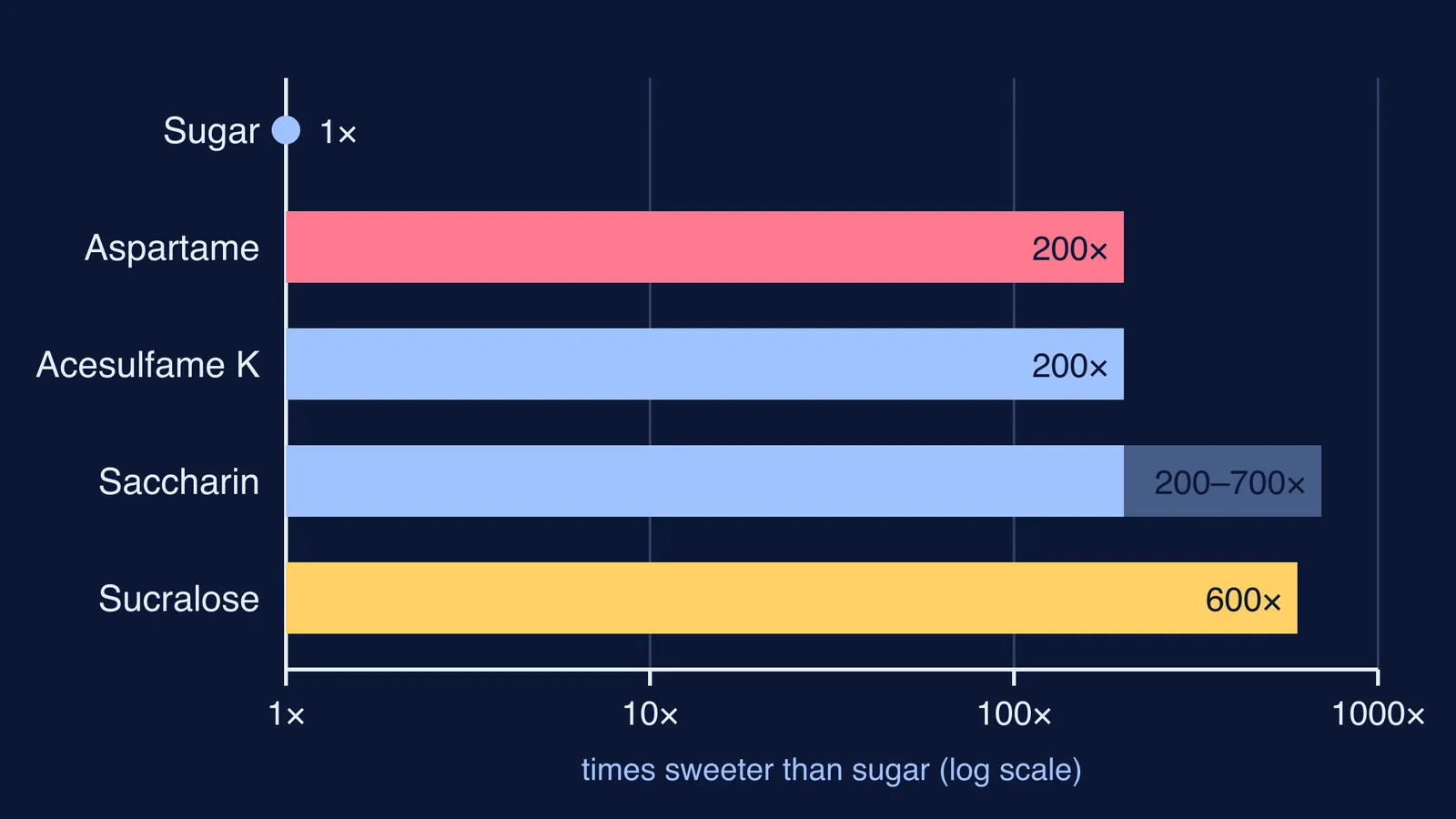
Sweetness is measured against table sugar (sucrose). The figures below come from the US Food and Drug Administration's page on sweeteners in food.
Aspartame is about 200 times sweeter than table sugar, and the FDA says it is not heat stable and loses its sweetness when heated.
Saccharin is 200 to 700 times sweeter than table sugar.
Sucralose is about 600 times sweeter than table sugar, and the FDA describes it as heat stable, staying sweet even at baking temperatures.
Acesulfame potassium is about 200 times sweeter than table sugar and is also described as heat stable.
So a pinch does the work of a spoonful. Using the FDA's figure, matching 10 g of sugar takes roughly 10 ÷ 200 = 0.05 g, or 50 mg, of aspartame, which is why sachets are padded with a bulking agent.
The structures explain the behaviour. PubChem describes aspartame as a dipeptide formed by condensing the alpha-carboxyl group of L-aspartic acid with the amino group of methyl L-phenylalaninate, so it carries both a peptide bond and a methyl ester. Sucralose, according to PubChem, is a chlorinated disaccharide: its galactose and fructose units, joined by a glycosidic bond, carry three chlorine atoms where sucrose has hydroxyl groups. Saccharin is neither a sugar nor a peptide: PubChem describes it as a 1,2-benzisothiazole.
For the building blocks, see our posts on amino acids as zwitterions and biomolecules for chemistry exams.
Why does aspartame lose its sweetness when heated?
Aspartame's ester and peptide bonds can react with water, and the molecule can also react with itself. PubChem's stability notes say aspartame is most stable in solution at about pH 4.3. In more neutral and alkaline conditions the dipeptide cyclises into a diketopiperazine, which is not sweet, and prolonged heating also degrades it.
Heat speeds this up. A study by Kim and Chung in the Korean Journal of Food Science and Technology (1996) heated aspartame between 60 and 100 °C. It broke down faster as the temperature rose, with an activation energy of 20.77 kcal/mol, and the main breakdown products were diketopiperazine and alpha-aspartylphenylalanine. It was least stable at pH 7 and most stable at pH 4.
Worked example: how much faster at 100 °C?
Use the Arrhenius equation with the activation energy from the Kim and Chung study, Ea = 20,770 cal/mol, and R = 1.987 cal/mol K (how the Arrhenius equation links rate and activation energy).
Ea/R = 20,770 ÷ 1.987 ≈ 10,450 K.
1/298 K − 1/373 K ≈ 0.000675 K⁻¹.
k(100 °C)/k(25 °C) = e^(10,450 × 0.000675) = e^7.05 ≈ 1,150.
So aspartame breaks down roughly a thousand times faster at a boil than at room temperature (a rough estimate: the study measured only 60 to 100 °C). That is the chemistry behind "use aspartame only in cold foods and soft drinks".
Is sucralose really safe to bake with?
Textbooks call sucralose stable at cooking temperature, and the FDA says it stays sweet at baking temperatures. Staying sweet is not the whole story, though.
In a communication of 26 February 2026, Germany's Federal Institute for Risk Assessment (BfR) said that heating sucralose above 120 °C for a prolonged period leads to gradual decomposition and dechlorination. Chlorinated organic compounds, such as chloropropanols and dioxins, can form, and temperatures of 120 to 150 °C are reached when cooking and baking at home. It reports that a European Food Safety Authority assessment of 17 February 2026 found this risk cannot be ruled out in home cooking. The BfR recommends not heating sucralose-containing food above 120 °C, or adding sucralose only after heating.
For the exam, write the textbook line; for the kitchen, know the update. Questions about sweeteners and a medical condition such as diabetes belong with a doctor or dietitian.
Which sweetener goes where in food and in exams?
Cold lassi, chilled desserts, soft drinks: aspartame works. Acidic conditions near pH 4.3 keep it sweet longest (PubChem).
Hot chai or coffee: stir the sweetener in after boiling, not during. Aspartame loss grows with temperature and time.
Baking or frying: check the label for a sweetener the FDA lists as heat stable, such as acesulfame potassium, and remember the BfR caution on heating sucralose.
Board or entrance answer: name the sweetener, give its sweetness relative to sugar, state heat stability, and give one reason from structure.
To revise the peptide, ester and disaccharide ideas behind these answers, the Fermi Concept Library gives every chemistry concept its own lesson and its place in the map. For Arrhenius numericals like the one above, the Fermi Problem Library has worked problems with a step-by-step solver that explains the reasoning rather than printing an answer.