On this page
CBSE and JEE Main chemistry students meet the same pair of facts: zinc-coated (galvanised) iron keeps protecting itself after a scratch, while tin-plated iron does not. You can work out why from three numbers in the electrochemical series, then test yourself with a step-by-step quiz.
What do electrode potentials say about zinc, iron and tin?
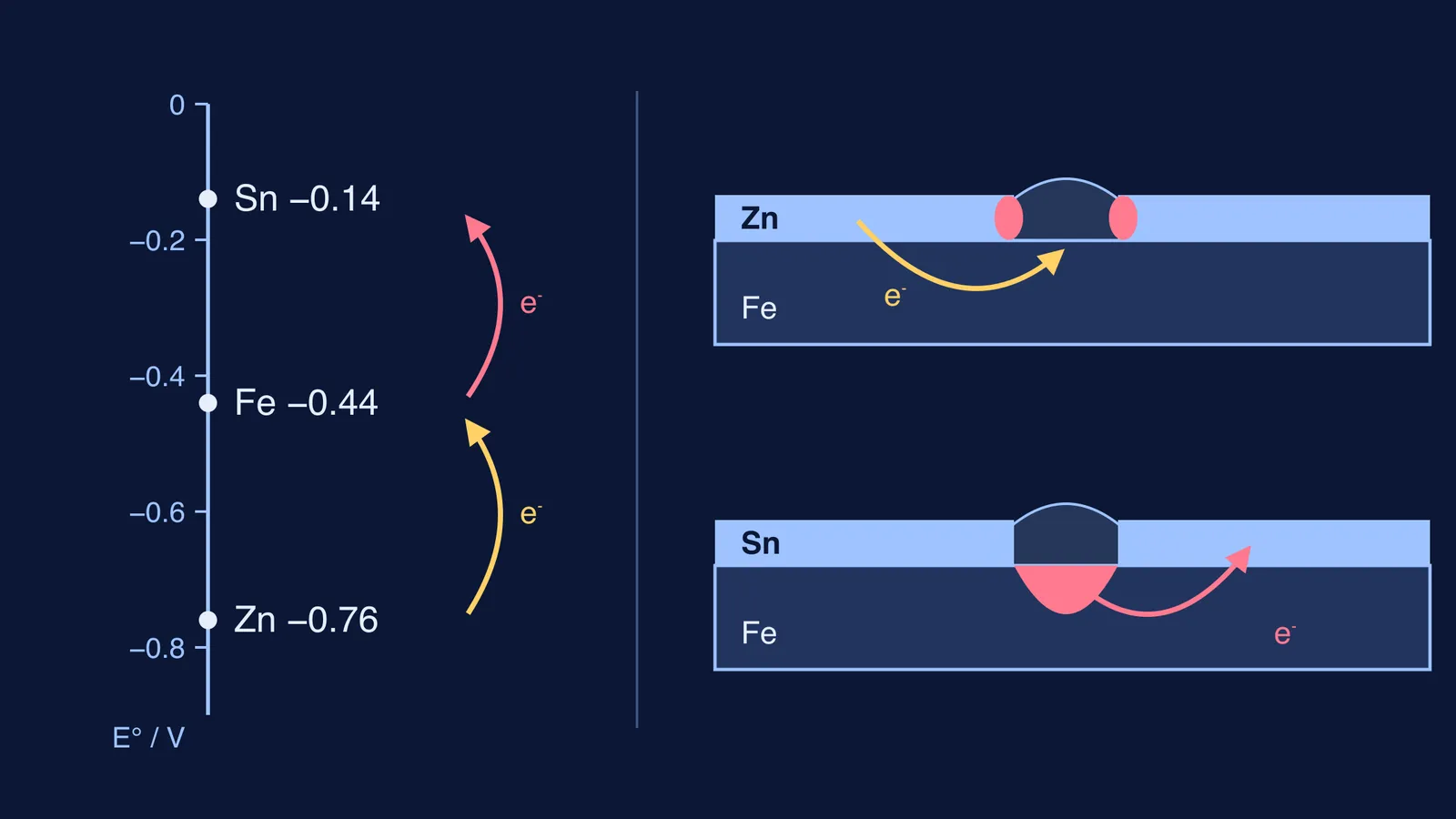
A standard reduction potential (E°) measures how strongly a metal ion pulls electrons to become the metal; the more negative it is, the more readily the metal gives electrons away and is oxidised. The values from the Chemistry LibreTexts table of standard reduction potentials are:
Zn²⁺ + 2e⁻ → Zn: −0.76 V
Fe²⁺ + 2e⁻ → Fe: −0.44 V
Sn²⁺ + 2e⁻ → Sn: −0.14 V
The same table gives O₂ + 2H₂O + 4e⁻ → 4OH⁻ at +0.40 V, which is the reaction that takes the electrons when iron rusts in moist air. Rusting is a small electrochemical cell: one metal is oxidised (the anode), and oxygen dissolved in a film of water is reduced (the cathode).
The rule follows directly. When two metals touch in a drop of water, the one with the more negative E° usually becomes the anode and corrodes. The other becomes the cathode and is protected.
Why does galvanised iron not rust even when scratched?
Put zinc and iron together and zinc has the more negative potential, so zinc is the anode. Even where a scratch exposes bare iron, electrons flow from the surrounding zinc into the iron, and oxygen is reduced on the iron surface without the iron itself dissolving. The zinc is used up in place of the iron, which is why it is called a sacrificial coating.
The Oxford chemistry teaching page on corrosion and electrode potentials puts it simply: scratch a galvanised pail and the pail will not corrode, because the zinc is oxidised instead.
This protection has a reach. The American Galvanizers Association cites studies finding that bare areas up to 2 mm wide are completely protected in urban air, and another finding full protection up to 5 mm in industrial-marine climates. The width depends on the electrolyte in the bare area, and larger bare areas can receive only partial protection.
Why does tinned iron rust quickly once it is scratched?
Now swap zinc for tin. Tin at −0.14 V is less negative than iron at −0.44 V, so in a tin-iron cell iron is the anode. While the tin layer is whole, water and oxygen cannot reach the iron, so tin works like paint. The Oxford page notes that once the tin is scratched, the iron is oxidised in preference to the tin and corrosion is rapid.
Picture it this way: the exposed iron is a small anode, and the large tin surface around it is the cathode where oxygen collects the electrons. So the damage concentrates in the scratch.
Worked example: which way do the electrons go?
Use E°cell = E°cathode − E°anode with the values from the LibreTexts table. This compares the two metals; in real rusting, oxygen finally takes the electrons.
Zinc on iron: anode Zn, cathode Fe. E°cell = −0.44 − (−0.76) = +0.32 V. Positive, so zinc is oxidised spontaneously and iron is spared.
Tin on iron: anode Fe, cathode Sn. E°cell = −0.14 − (−0.44) = +0.30 V. Positive, so iron is oxidised spontaneously and tin is spared.
Both cells have similar voltages. What changes is which metal is sacrificed, and that is the whole story.
How can an AI tutor quiz you through this, step by step?
Reading an explanation is not the same as producing it. Answer one step at a time, without notes, and move on only when each answer is right:
Which half-reaction takes the electrons when iron rusts in moist air?
Of Zn, Fe and Sn, which has the most negative E°, and what does that tell you?
In a zinc-iron couple, which metal is the anode? Why?
A galvanised sheet has a 1 mm scratch. What corrodes first?
In a tin-iron couple, which metal is the anode?
Why can a scratched tin can rust faster at the scratch than you might expect?
Would a magnesium coating protect iron if scratched? Justify with E°.
If you stall on question 2 or 3, the gap is the meaning of E°, not corrosion. Go back to that before memorising more examples.
Fermi's AI tutor can run a sequence like this with you: it notices where you are stuck and decides whether to explain, ask or show, checking understanding as it goes. If the meaning of electrode potential itself is shaky, the Fermi Concept Library has a lesson for each chemistry concept, so you can fix that gap first.
Next time you see a GI sheet roof or a tin can, try predicting which metal goes first before you check.