

On this page
You have probably noticed it after a good cry, or when chopping onions: a tear reaches your lips and tastes like weak salt water. That is not a quirk. Tears are made from the fluid in your blood, and they keep a similar level of salt, which matters for the cells on the surface of your eye.
Where do tears come from?
The American Academy of Ophthalmology explains that lacrimal glands above each eye make your tears. They drain through puncta, tiny holes in the corners of your eyelids, then through small canals and a duct that empties into your nose. Crying hard overwhelms this drainage, so tears spill over and can dribble out of your nose.
The same page lists three types of tears: basal tears, which are in your eyes all the time to lubricate, nourish and protect the cornea; reflex tears, which wash away irritants such as smoke or onion fumes; and emotional tears.
The raw material comes from your blood. The lacrimal gland is fed by the lacrimal artery, a branch of the ophthalmic artery, and the fluid it makes is isotonic to plasma, meaning it has a similar total concentration of dissolved particles, according to the anatomy reference Kenhub.
Why do tears taste salty and not just wet?
Gland cells cannot simply pump out water. They move ions, and water follows. A study of mouse lacrimal glands by Walcott and colleagues in the American Journal of Physiology describes the idea: chloride and potassium ions move into the gland's central channel, and water follows by osmosis. A cotransporter called NKCC1, which carries sodium, potassium and chloride into cells together, replaces the ions that leave. In stimulated mouse glands, blocking it with the drug furosemide cut the later, steady phase of fluid flow by about 30%.
So the dissolved ions in tears are not a leftover. They are what pulls water out of the gland and onto your eye. In human tears, sodium is the main positively charged ion, and sodium chloride, the compound in table salt, is present at high concentration, according to a paper in Experimental Eye Research by Woodward, Senchyna and Argüeso.
How salty are tears compared with blood?
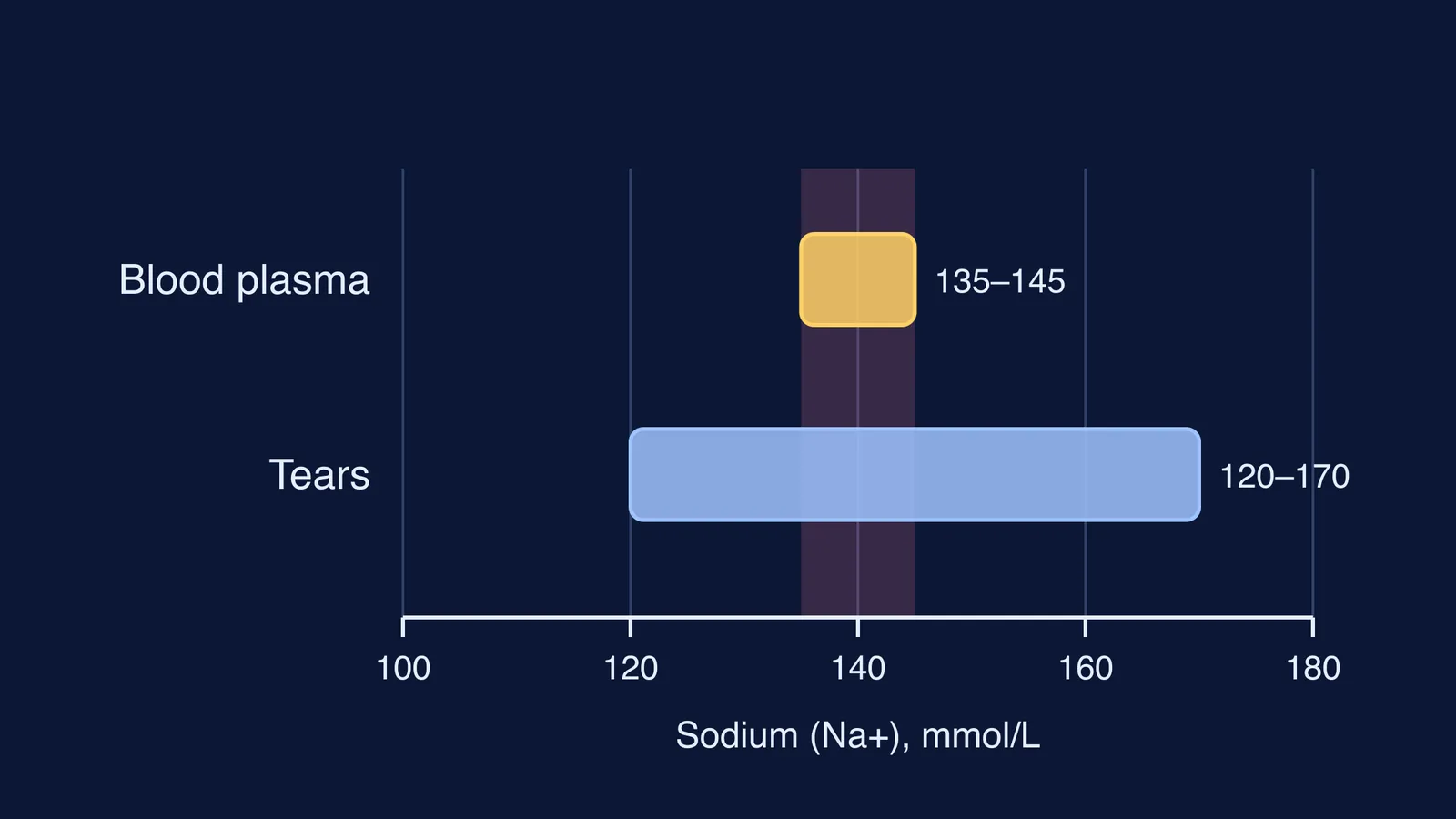
Normal human tears contain about 120 to 170 mM of sodium, according to the same Woodward paper. The normal range for blood sodium is 135 to 145 mEq/L, according to the US National Library of Medicine's MedlinePlus. For sodium, mM, mmol/L and mEq/L are the same quantity, so the two ranges overlap, as the diagram at the top of this page shows.
Here is a worked example you can redo in your notebook.
Take a middle value of 140 mmol of sodium in one litre of tears.
Pretend every sodium ion is paired with a chloride ion, so you have 0.140 mol of NaCl.
The molar mass of NaCl is 23.0 + 35.5 = 58.5 g/mol.
Mass = 0.140 × 58.5 = about 8.2 g of salt per litre.
That is about 0.8 g of salt in every 100 mL of tears.
Step 2 is a simplification, because some sodium is balanced by other negative ions such as bicarbonate. Still, it shows why tears taste salty but not like a pickle.
What does the salt actually do for your eye?
The cells of your cornea are bathed in tears. The Woodward paper says that keeping a precise osmotic gradient of electrolytes between the tear film and the eye's surface cells is of paramount importance for how those cells work.
That balance can slip. The same paper notes that where the tear film breaks up, its osmolarity can reach up to 560 mOsm, and it puts raised tear osmolarity down mainly to extra sodium chloride. The international TFOS DEWS II report defines dry eye disease by a loss of homeostasis of the tear film, with tear film instability and hyperosmolarity (tears that are too concentrated) among the factors that play a role in causing it.
How does this link to the rest of biology?
Tears are a neat way to revise a cluster of class 11 and 12 biology ideas, because the ions-then-water rule connects osmosis, glands and body fluids. Try this checklist:
Can you explain osmosis in one sentence, using tears as the example?
Can you name the main positive ion in tears, and the cotransporter that brings ions into gland cells?
Can you say why blood and tears have a similar salt level?
Can you predict what happens to tear concentration if the tear film evaporates?
If osmosis still feels abstract, it can help to see it rather than read about it. The Fermi Simulation Lab has interactive simulations for the ideas that are easier to see than to read, and the Fermi Concept Library gives every concept in biology and chemistry its own lesson and its place in the map.
Next time a tear reaches your lips, you will know you are tasting salt that started out in your blood.


