

On this page
You sit at a red light on an empty road at night. Next morning you ride four greens in a row down the main road. Neither is luck. Both come from a few numbers an engineer chose using school motion maths.
How do traffic lights decide when to change?
A signal runs a cycle: the time for every direction at the junction to get its turn once. Each turn is a phase. The US Federal Highway Administration's Traffic Signal Timing Manual says coordinated signals are set by three numbers: cycle length, split (how the cycle is shared between phases) and offset (when the cycle starts at this junction compared with the others).
A fixed-time signal repeats the same plan whatever the traffic. The same manual says yellow is based on driver perception-reaction time plus the distance needed to stop or to cross safely, and quotes US guidance of about 3 to 6 seconds, longer on faster roads.
You can check that with physics. Yellow is roughly t + v/(2a): reaction time plus the time to brake to rest. The manual says t = 1.0 s and a = 10 ft/s² (about 3 m/s²) are often cited. On a 50 km/h road (13.9 m/s) that gives 1 + 13.9/6.1, or about 3.3 seconds. The braking part is the same idea as working out friction from a car's stopping distance.
How do traffic lights know a car is waiting?
A common answer is a loop of wire cut into the road near the stop line. The FHWA Traffic Detector Handbook explains that vehicles passing over or stopped on the loop decrease its inductance, and the electronics unit senses this and signals the controller. In physics terms, the loop's changing magnetic field drives eddy currents in the car's metal, and by Lenz's law their field opposes the loop's. Railways use a different trick for the same job, sensing a train with track circuits.
With detectors, a signal becomes actuated. The timing manual defines two ways a green ends. It "gaps out" when no car arrives within a set passage time. It "maxes out" when it reaches its maximum green. The manual also notes that a failed detector usually sends a continuous call, so that phase runs to maximum green every cycle. That may be your empty-road red.
How long should a full cycle be?
For a junction on its own, the timing manual gives F. V. Webster's 1958 formula for the cycle meant to keep delay lowest when cars arrive at random: C = (1.5L + 5)/(1 - Y). Here L is the time lost per cycle in seconds, and Y is how busy the junction is: each phase's busiest-lane flow divided by the most that lane could carry, summed over the phases.
Try it. With L = 12 s and Y = 0.6, C = (18 + 5)/0.4, or about 58 seconds. Push Y to 0.9 and C jumps to 230 seconds. As Y nears 1 the formula breaks down, and the manual says it no longer applies at Y = 1.
How is a green wave calculated?
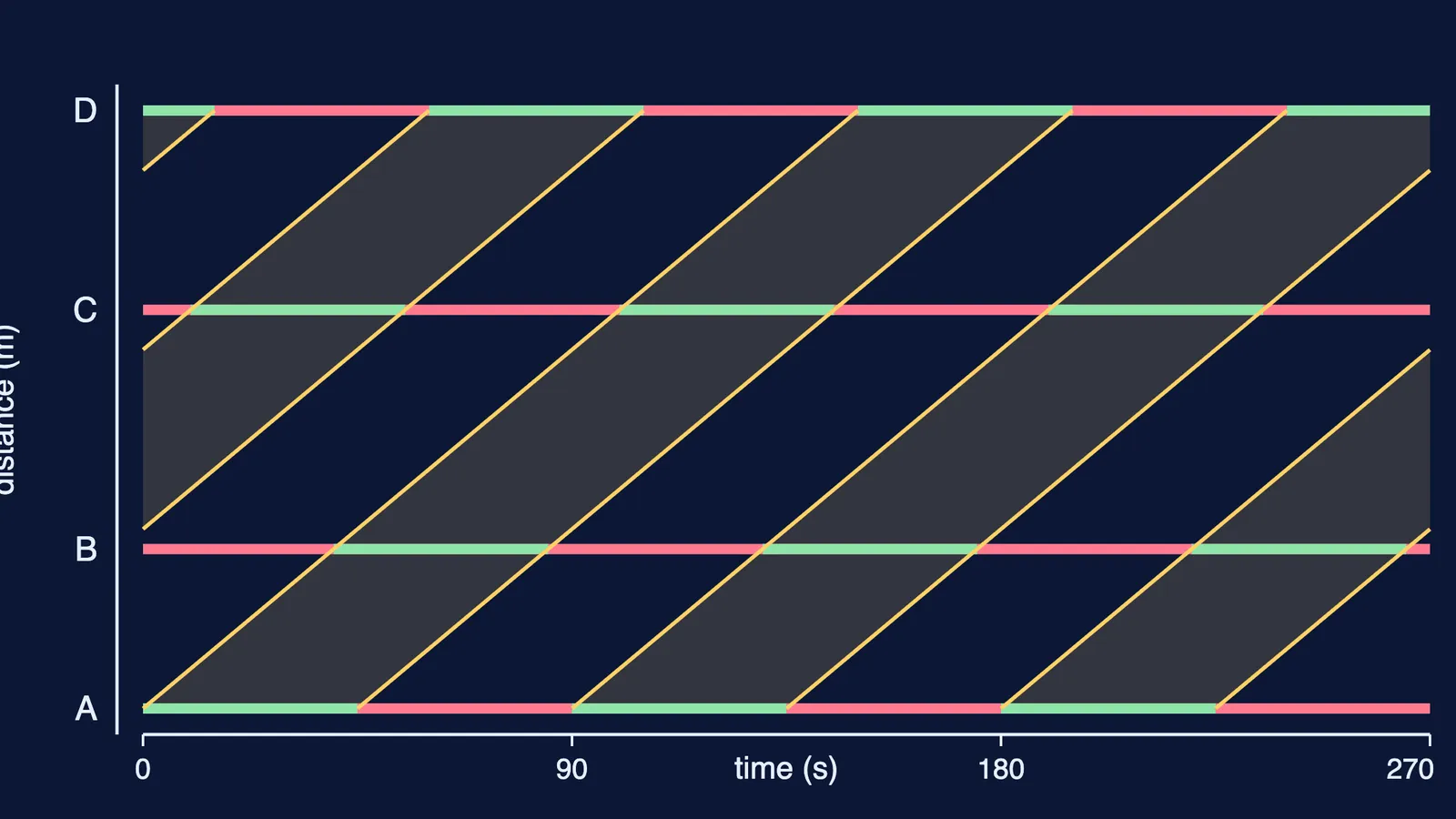
The manual defines the offset as the time between a reference point in the cycle at the master clock and the same point at this junction. A green wave is a choice of offsets: every signal shares one cycle, and each green starts when a car from the last green would arrive.
Worked example: junctions A, B, C and D sit at 0, 400, 1,000 and 1,500 m along a road. The design speed is 36 km/h, the cycle 90 s and each green 45 s.
Convert the speed: 36 km/h is 10 m/s.
Travel time from A is distance divided by speed: 0, 40, 100 and 150 s.
Subtract whole cycles of 90 s: the offsets are 0, 40, 10 and 60 s.
Check: a car leaving A as it turns green reaches B, C and D just as each turns green.
The diagram at the top draws this plan: the shaded band is every car moving at 10 m/s that meets no red.
Now the catch. Coming back, you need offsets of minus the travel time. Both directions fit exactly only when the travel time between junctions is a whole multiple of half the cycle: with a 90 s cycle at 10 m/s, junctions 450 m or 900 m apart. Real roads are rarely that neat.
Can you time a signal near you?
From somewhere safe, time one full cycle with a phone stopwatch.
Time the yellow and compare it with t + v/(2a) for the speed limit.
Measure the distance to the next signal on a map app.
Divide by a sensible speed and see if the next green starts about that much later.
If the time-space picture is hard to see in your head, the Fermi Simulation Lab has interactive simulations for ideas easier to see than read. For more problems like the offset sum, the Fermi Problem Library has a step-by-step solver that explains the reasoning. And if you enjoy this, transportation engineering turns it into a career.


