On this page
Railway signals do not watch for trains with a camera. Many feel them electrically, through a track circuit: the rails are wires in a circuit, and the train's steel wheels and axles act as the switch.
How do railway signals know a train has passed?
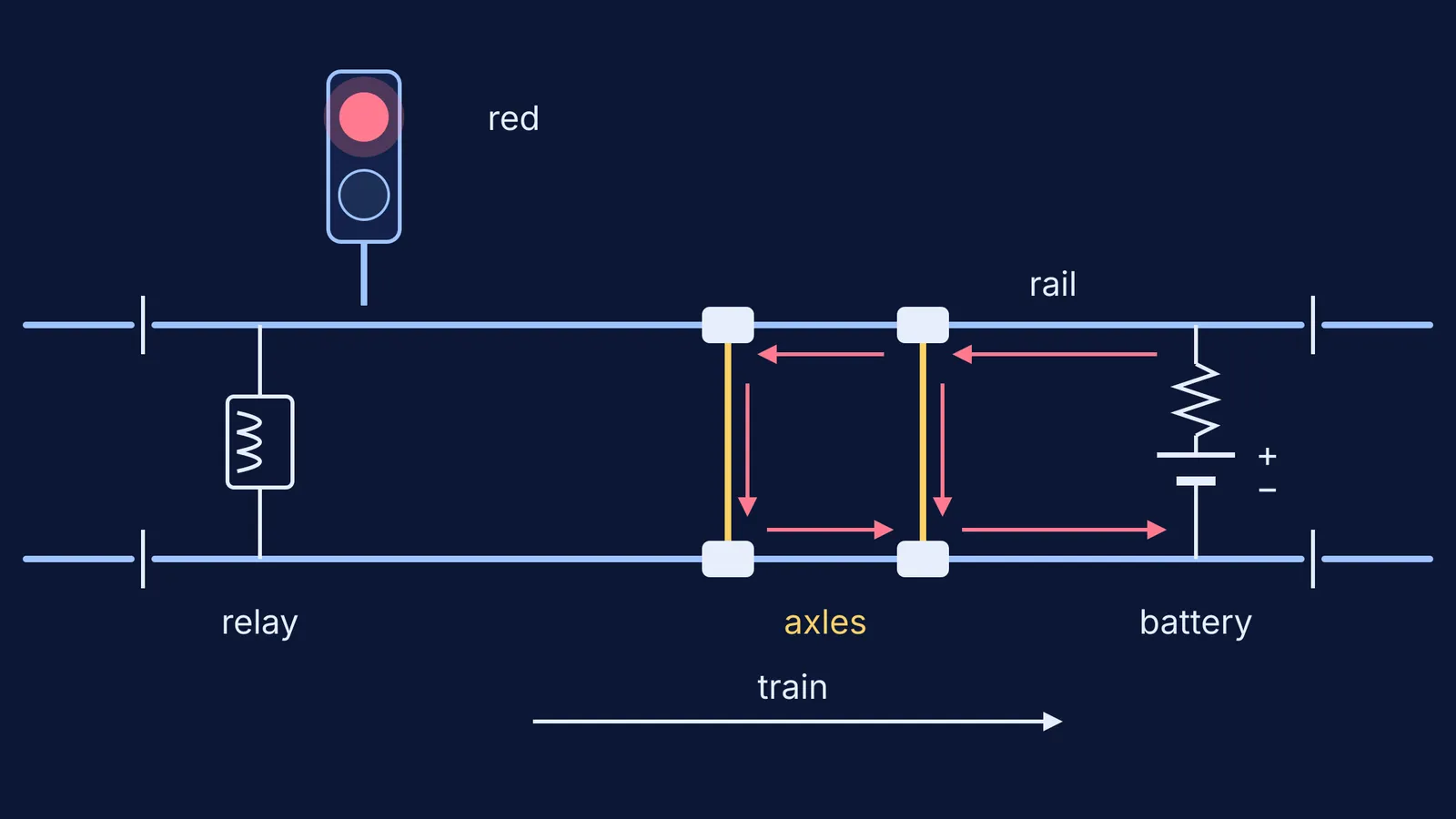
Insulated joints divide the line into sections, each its own circuit. A track circuit has power applied to the rails and a relay coil wired across them, so current flows from the power source along one rail, through the relay coil and back along the other (Wikipedia: Track circuit). The same overview says the circuits are powered at low voltages, 1.5 to 12 V DC, and that a series resistor limits the current when the track is short-circuited.
While the section is empty, current flows through the relay coil and turns it into an electromagnet (here is how an electromagnet differs from a permanent magnet). The energised relay holds its contacts closed, which lets the signal guarding the section show green.
When a train enters, its metal axle completes a circuit between the two rails (igg.org.uk, history of railway signalling). Current takes the easy route through the wheels and axle instead of the relay coil. The relay lets go and the signal behind the train turns red. When the last axle leaves, the relay picks up again and the signal can clear: the signal "knows" the train has passed when the short circuit disappears.
The idea is old: track circuits were first used in 1864, and William Robinson invented the fail-safe track circuit in 1872 (Wikipedia: Track circuit).
Why does a short circuit switch the signal?
The relay coil and the axle are connected across the same two rails, so they are in parallel, and current divides inversely with resistance. A path of almost zero resistance takes nearly all of it. It is the same idea as our explainer on why a short-circuited resistor carries no current.
How low is low enough? US federal rules say each track circuit controlling a home signal or approach locking must be maintained so that its relay drops when a shunt of 0.06 ohm is connected across the rails of the dry circuit (49 CFR 236.56, Cornell LII).
What happens if a wire breaks or the battery dies?
The relay drops and the signal shows red. As one signalling history puts it, "This system fails safe as if the circuit is broken the relay also drops out" (igg.org.uk). A broken rail or wire, or a power failure, de-energises the relay and shows the track as occupied (Wikipedia: Track circuit). A train may wait needlessly, though rarer "wrong-side" failures, such as a stuck relay, are still possible.
In a written reply in the Rajya Sabha on 6 February 2026, the Railways Minister said complete track circuiting had been provided at 6,665 stations up to 31 December 2025 (PIB). The same reply said Block Proving Axle Counters, which confirm a train has fully arrived before the next is let into a section, covered 6,142 block sections.
Worked example: how much does one axle cut the relay current?
Illustrative values, ignoring rail resistance and ballast leakage; the axle gets the 0.06 ohm of the US test shunt above (49 CFR 236.56).
Battery: 2 V
Series resistor: 2 ohm
Relay coil: 4 ohm
One axle: 0.06 ohm
Empty track: total resistance is 2 + 4 = 6 ohm, so I = 2/6 = 0.333 A, all through the relay.
Train present: relay and axle in parallel give (4 x 0.06)/(4 + 0.06), about 0.0591 ohm.
Total resistance is 2 + 0.0591 = 2.0591 ohm, so the battery current is about 0.971 A.
Voltage across the relay is 0.971 x 0.0591, about 0.0574 V, so relay current is 0.0574/4, about 0.0144 A.
Relay current falls from 333 mA to about 14 mA, roughly 23 times less: here, too little to hold the relay up.
Try it yourself: rerun the steps with a poor contact of 0.5 ohm. You should get a relay current of about 91 mA, which is why good wheel-to-rail contact matters.
How do you use this in physics exams?
Find the parallel pair: when a low-resistance path joins two points, ask what else sits across those same points.
Use the current divider: the smaller resistance takes the larger share.
Ask what happens on failure: an open circuit and a short circuit have opposite effects, so name which one you have.
Electrified lines add a twist: because traction current would swamp a small DC signal, track circuits there typically use AC at audio frequencies from 91 Hz up to 10 kHz (Wikipedia: Track circuit). For the power side, read how metro trains get their power.
TheFermi Simulation Lab has interactive simulations for ideas, like current splitting between branches, that are easier to see than to read. If a circuit numerical keeps going wrong, the Fermi Problem Library has a step-by-step solver that explains the reasoning rather than printing an answer.
Next time a signal turns red behind your train, you will know your train's axles did it.