

On this page
When a metro train accelerates out of a station, it draws a large amount of electrical power. But unlike a car with a fuel tank or a phone with a battery, a metro train is continuously plugged into the city's power grid while moving at high speeds.
How it taps into this power depends on the city's engineering choices.
How do metro trains get their electricity?
Globally and across India, metro trains use one of two main current collection systems.
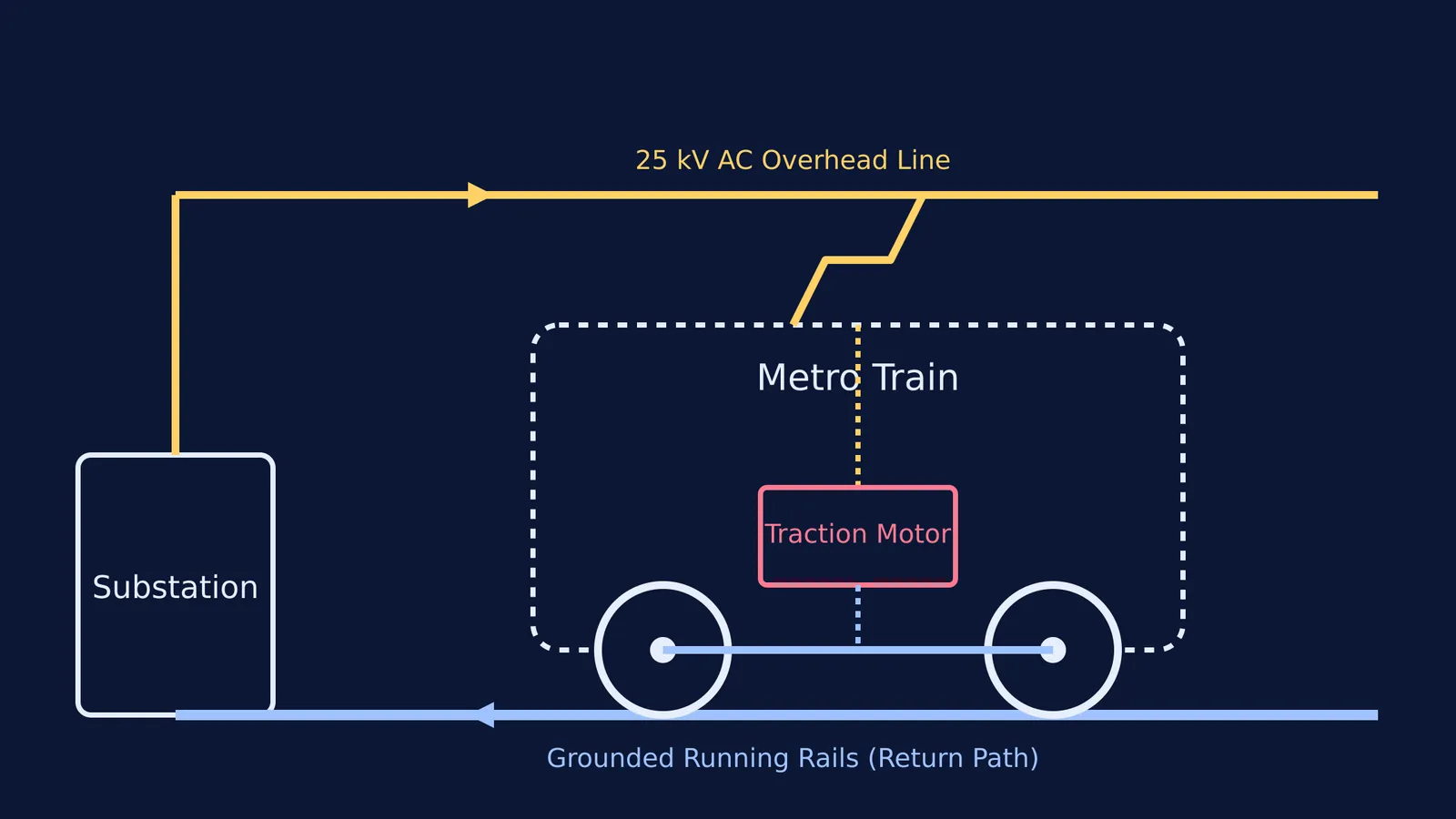
1. The Overhead Pantograph (25 kV AC) Many modern networks, including the Delhi, Mumbai, and Chennai Metros, use an overhead catenary system. A spring-loaded, folding arm called a pantograph sits on the train's roof and slides along a suspended high-voltage wire. This wire typically carries 25,000 volts (25 kV) of alternating current (AC). Because the wire is high up, it is safely out of reach of passengers and allows the train to travel at high speeds.
2. The Third Rail (750V DC) To save on the massive cost of digging tall tunnels, some systems use a "third rail". This is an extra, electrified rail laid on the ground beside the two running tracks. A metal "collector shoe" extends from the train's bogie (wheel assembly) and glides along this rail to pick up power. Third rails typically supply 750 volts of direct current (DC). It requires much less vertical space but is generally limited to lower speeds and poses a severe safety risk if people access the tracks.
Where does the return current go?
In physics, electricity requires a closed loop to flow. A train touching a live wire is only half the equation. Where does the electricity go after it powers the train?
The answer lies beneath the train. After the current passes through the train's internal transformers and motors, it travels down the metal axles and into the steel wheels. The wheels transfer the current into the standard running rails, which act as the ground or return path, carrying the electricity back to the local substation.
If you are studying these loops for the JEE, solving circuits often requires identifying these continuous paths; you can review the node potential method to see how voltages drop across a circuit.
How does the power turn the wheels?
Whether the train picks up 25 kV AC from the roof or 750V DC from the ground, that raw power cannot drive the wheels efficiently on its own. It must be carefully converted onboard.
Modern metro trains use 3-phase AC induction motors because they are robust and require very little maintenance. This means the train's internal electronics must convert whatever power it receives into precisely controlled 3-phase AC.
Transformer and Rectifier: In an overhead system, a heavy onboard transformer steps the 25 kV AC down to a lower voltage, and a rectifier converts it into DC.
The VVVF Inverter: This DC power is then fed into a Variable Voltage Variable Frequency (VVVF) inverter. The inverter slices the DC back into AC, changing the frequency and voltage to dictate exactly how fast the motors spin.
Induction: The alternating current creates a rotating magnetic field inside the motor, which induces a current in the rotor, forcing it to turn the wheels via gears. This relies on the same electromagnetic principles described in Faraday's law for a changing B.
If visualizing how a rotating magnetic field turns a rotor is difficult, the Fermi Simulation Lab provides interactive simulations for the ideas that are easier to see than to read.
Do metro trains save electricity when braking?
Yes, through a process called regenerative braking.
When the train needs to stop, the VVVF inverter reverses the role of the AC induction motors. Instead of consuming electricity to create motion, the forward momentum of the train forces the motors to spin, turning them into generators. They convert the train's kinetic energy back into electrical energy.
This generated electricity is fed back up through the pantograph (or down through the collector shoe) into the overhead wire or third rail, where it can be used instantly by another train accelerating on the same line.


