

On this page
The Class 10 chapter Magnetic Effects of Electric Current sums up the electromagnet in one line: it "consists of a core of soft iron wrapped around with a coil of insulated copper wire" (NCERT Class 10 Science, Chapter 12). Why a permanent magnet never switches off is explained later, in the Class 12 chapter Magnetism and Matter. Here are both halves in one place, with uses and a way to write the answer in an exam.
What is the difference between an electromagnet and a permanent magnet?
An electromagnet is a magnet whose field is produced by an electric current, and that field disappears when the current is turned off (Electromagnet, Wikipedia).
A permanent magnet is an object made from a magnetised material that creates its own persistent magnetic field (Magnet, Wikipedia).
NCERT builds the electromagnet from a solenoid. The field inside a current-carrying solenoid is uniform, and it is strong enough to magnetise a piece of soft iron placed inside the coil; the magnet so formed is called an electromagnet (NCERT Class 10, Section 12.2.4). The same chapter shows that a coil with n turns gives n times the field of a single turn, which is why electromagnets are wound with many turns. To see it on your desk, follow our guide to making an electromagnet with a nail and a cell.
Why is soft iron used in an electromagnet and steel in a permanent magnet?
Iron and magnet steel are both ferromagnetic. The difference is what happens when the outside field goes away.
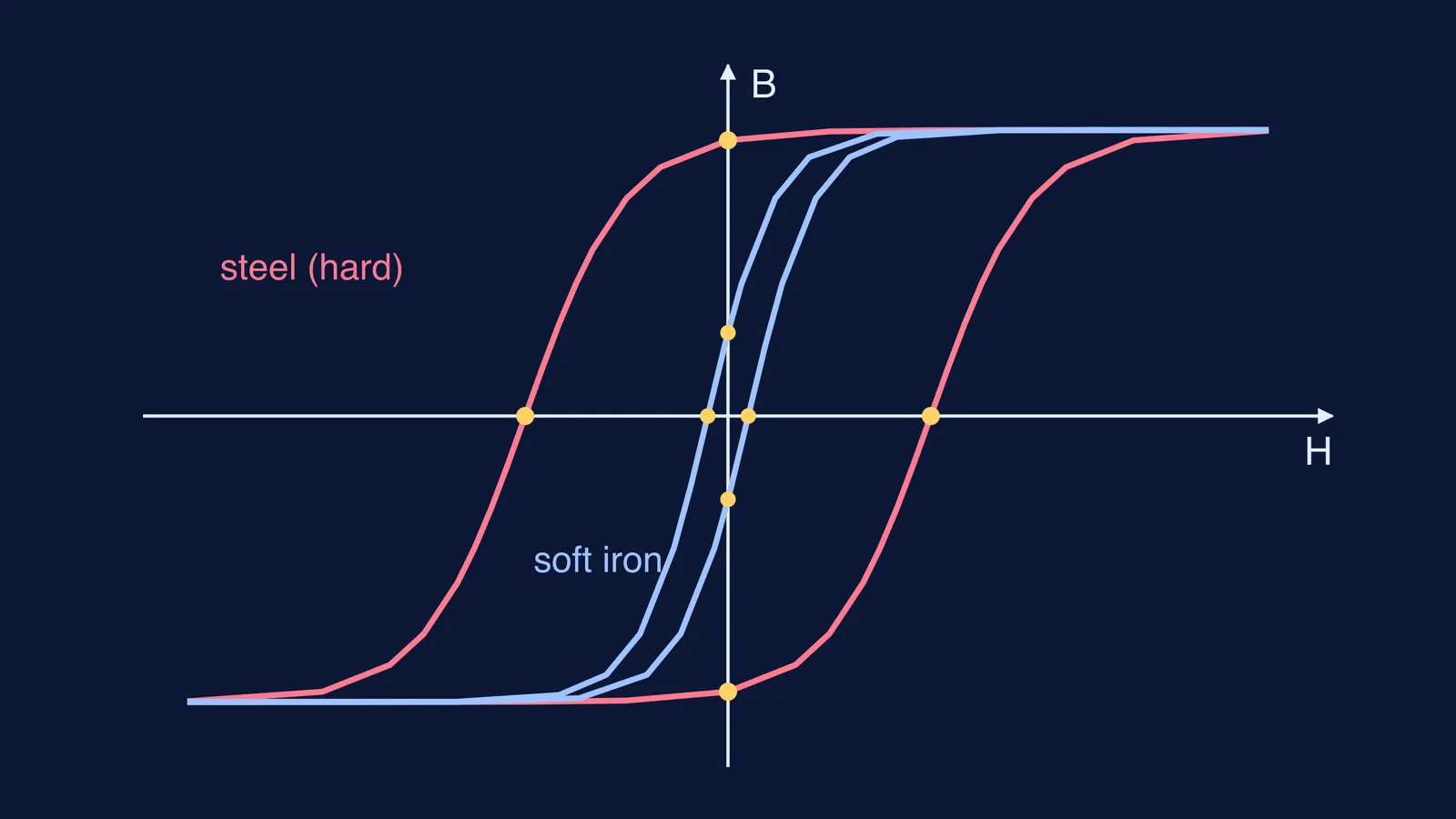
NCERT's Class 12 textbook (Section 5.5.3) explains that in hard ferromagnets the magnetisation persists after the external field is removed, and these form permanent magnets such as a compass needle; in soft ferromagnets such as soft iron, the magnetisation disappears (NCERT Class 12 Physics Part 1, Chapter 5). The same section names alnico (an alloy of iron, aluminium, nickel, cobalt and copper) and natural lodestone as hard materials, and gives the relative permeability of ferromagnets as more than 1000.
The technical word is coercivity, the reverse field needed to demagnetise a material: hard materials have high coercivity and soft materials have low coercivity (Magnet, Wikipedia). Soft iron suits something you want to switch; magnet steel suits something that must stay a magnet.
A warning about the word steel: not all steel is hard. Electromagnet cores are often made of mild steel (Magnet, Wikipedia). The steels used for permanent magnets were special alloys; KS steel, developed by Kotaro Honda in 1917, contained cobalt, tungsten and chromium (KS steel, Wikipedia).
That leftover field is described on the electromagnet page. Our explainer on dia-, para- and ferromagnetism with hysteresis loops shows why a wide loop means a good permanent magnet and a narrow loop means a good electromagnet core.
Where are electromagnets and permanent magnets used?
Electromagnets are used wherever the field must be switched or varied. Applications include (Electromagnet, Wikipedia):
industrial lifting magnets that pick up scrap iron and steel and drop it when switched off
electric bells, buzzers and relays
motors, generators and transformers
MRI machines and particle accelerators
Permanent magnets are used where a steady field is needed with no power supply (Magnet, Wikipedia):
compass needles
refrigerator magnets
loudspeakers and electric motors
hard disk drives
How do you write the difference in a Class 10 exam?
Use matching pairs, one line each.
Source: an electromagnet gets its magnetism from current in a coil; a permanent magnet from the material itself.
Core material: soft iron for an electromagnet; a hard material such as magnet steel or alnico for a permanent magnet.
Switching: an electromagnet can be switched on and off; a permanent magnet cannot.
Strength: an electromagnet's strength changes with current and number of turns; a permanent magnet's cannot be adjusted with a switch.
Poles: reversing the current reverses an electromagnet's poles; a permanent magnet's poles are fixed.
Uses: cranes, bells and relays; compasses and fridge magnets.
Worked example: the steel rod in Figure 12.11
NCERT's Figure 12.11 shows a current-carrying solenoid magnetising a steel rod. Question: after the current is switched off, is the rod still a magnet?
While current flows, coil and rod together act as an electromagnet. What happens at switch-off depends on the steel. Soft iron or mild steel keeps only a weak remanent field. A hard magnet steel keeps much of it, so you have used an electromagnet to make a permanent magnet. Industrial permanent magnets also get special processing in a strong magnetic field during manufacture (Magnet, Wikipedia).
For the rest of the chapter, from field lines to home wiring, see our guide to magnetic effects of current in Class 10.
If a word like coercivity or permeability is the gap, the Fermi Concept Library gives every physics concept its own lesson and its place in the map. For practice, the Fermi Problem Library has worked problems with a step-by-step solver that explains the reasoning rather than printing an answer.


