

On this page
What materials do you need to build an electromagnet at home?
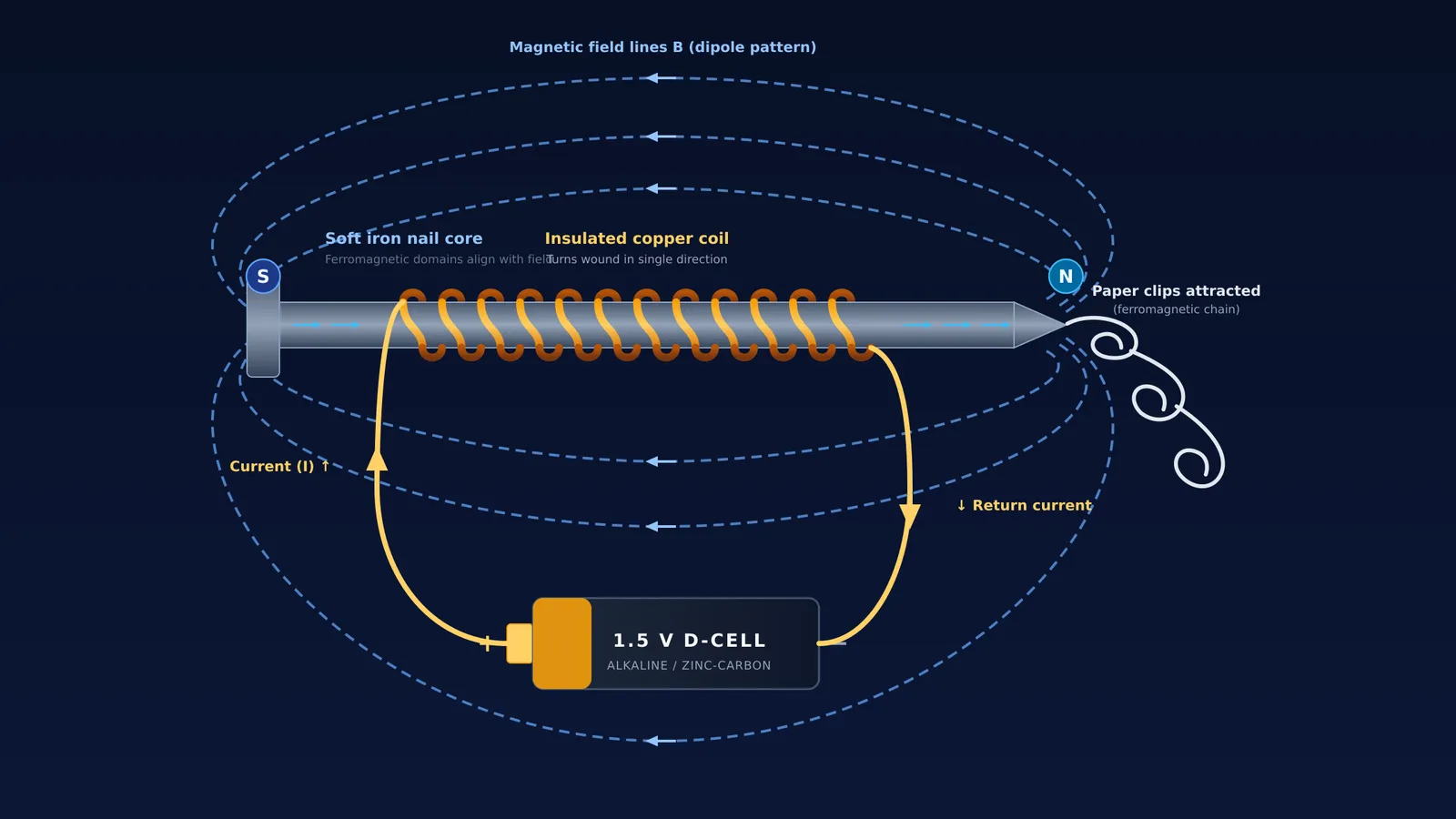
You do not need laboratory equipment to explore electromagnetism. The standard school experiment—outlined in the NCERT Class 7 Science curriculum—requires five basic items:
An iron nail or bolt, about 6 to 10 cm long.
About 75 to 100 cm of thin insulated copper wire (enamelled magnet wire or plastic-coated hookup wire, 24 to 28 AWG).
A fresh 1.5 V cell (a D-cell lasts longest under heavy drain).
A box of steel paper clips for testing magnetic attraction.
Sandpaper or a hobby knife to strip 1 to 2 cm of insulation from each wire end.
Bare wire will cause electric current to short-circuit through the conductive iron nail rather than circulating around it. In 1825, William Sturgeon coated an iron bar with varnish to insulate his 18 turns of bare wire, as described in William Sturgeon's 1825 invention of the electromagnet. Soon after, Joseph Henry used silk-insulated wire, allowing tightly packed multi-layer coils that multiplied magnetic force without shorting.
How do you assemble and test the nail and cell electromagnet?
Assembly takes five minutes following the standard steps outlined in the NCERT Class 7 Science practical guide:
Strip the insulation: Scrape roughly 2 cm of insulation from both wire ends, exposing clean copper.
Wind the coil: Leaving 10 cm of lead wire free, wind 40 to 50 tight turns around the nail shank toward the tip. Keep all turns coiled in the same rotational direction; reversing direction creates opposing magnetic fields that cancel each other out.
Secure the windings: Use a small piece of tape to hold the coil in place.
Test the circuit: Scatter 15 to 20 paper clips on a table. Hold one stripped wire end against the negative terminal of the 1.5 V cell and briefly touch the second end to the positive terminal.
Lift the paper clips: Touch the nail tip to the clips while the circuit is closed. The clips will cling to the tip. When you release the wire, the nail loses its magnetism and the clips drop.
How do wire turns and current change magnetic strength?
Inside a cylindrical coil (a solenoid), circulating charges produce a magnetic field. As detailed in the NCERT Class 10 Science textbook and our Class 10 magnetic effects guide, the magnetic field B inside an ideal solenoid is:
B = μ × n × I
Here, n is turn density (turns per metre, N / L), I is current in amperes, and μ is the core permeability (μ = μ_r × μ_0). In an air-core coil, relative permeability μ_r is 1, producing a weak field that cannot lift a paper clip. A soft iron nail aligns its magnetic domains with the coil's field, raising μ_r to several hundred.
In an experiment reviewed by Thomas B. Greenslade Jr. in The Physics Teacher (2011), an air-core coil supported only a few tiny ferrous items, whereas an iron core supported long strands of paper clips.
Two variables determine lifting capacity:
Number of turns (N): Each turn adds an equal increment of magnetic flux. Doubling turns from 30 to 60 over the same length doubles turn density n and field B.
Current (I): Connecting two 1.5 V cells in series provides 3.0 V, doubling current and magnetic field density.
For learners exploring current loops, Biot-Savart and Ampère's law shows how circular loops sum along an axis. When visualizing how field lines loop through ferromagnetic cores, the Fermi Simulation Lab provides interactive simulations for ideas that are easier to see than to read.
Why does adding turns sometimes fail to increase lifting power?
Winding 100 extra turns of very thin wire can unexpectedly weaken an electromagnet. As Dennis C. Henry and Sarah A. Danielson demonstrated in The Physics Teacher (1993) for high-current demonstration coils, delivering magnetic flux depends on accounting for both source internal resistance and coil load resistance. Applying Ohm's law to a real DC power source:
I = V / (R_wire + r_int)
A standard 1.5 V cell has an internal resistance r_int of 0.15 to 0.30 Ω. Because wire resistance grows with length (R_wire = ρ × L_wire / A), fine 30 AWG wire adds several ohms over 100 turns. Current drops faster than turn count rises, reducing total ampere-turns (N × I). To boost strength predictably:
Use thicker wire (22 to 24 AWG) to maintain low electrical resistance.
Wind multiple layers over the same section of the nail rather than spreading turns thinly.
Connect two fresh cells in series (3.0 V) if wire resistance exceeds battery internal resistance.
A simple testing matrix confirms this relationship:
30 turns with 1 cell (1.5 V): low resistance, moderate current, lifts 3 to 5 paper clips.
60 turns with 1 cell (1.5 V): doubled turns, slightly higher resistance, lifts 7 to 11 paper clips.
60 turns with 2 cells in series (3.0 V): doubled voltage restoring high current, lifts 14 to 20 paper clips.
For students mastering circuits and magnetic formulas, the Fermi Concept Library covers every concept in physics, each with its own lesson and its place in the map, while the Fermi Problem Library offers worked problems with a step-by-step solver that explains the reasoning rather than printing an answer.


