On this page
If you have ever sat in a jam and wondered why one signal holds up a whole road, you have already asked a transportation engineer's question. This specialisation sits inside civil engineering. It covers how roads, railway lines, metros and airports are planned, designed and kept moving.
What is transportation engineering in civil engineering?
A clear official outline comes from GATE, the national engineering exam used for postgraduate admissions. The GATE 2027 Civil Engineering syllabus, published by IIT Madras, has eight sections, and Section 6 is Transportation Engineering. It splits into four parts:
Infrastructure: geometric design of roads using IRC codes (sight distances, horizontal and vertical alignments), railway track design for speed and cant, and airport runway length.
Pavements: testing highway materials and designing flexible (bitumen) and rigid (concrete) pavements.
Traffic engineering: studies of flow and speed, accident analysis, signal design by Webster's method, intersections, and highway capacity.
Transportation planning: four-step travel demand modelling, which predicts how many trips people make, where they go, which mode they pick and which route they take.
It overlaps with neighbouring specialisations, which our guide to civil engineering career paths lays out side by side.
How much road, rail and metro work is there in India?
The scale is large and recent. According to a PIB Research Unit report from June 2025, India had more than 63 lakh km of road network as of 31 March 2025, including 1,46,204 km of National Highways. The same report says National Highway construction rose from about 11.6 km a day in 2013-14 to about 34 km a day in 2025, and calls India's road network the second largest in the world.
Cities are changing too. A PIB backgrounder from August 2025 reports that India's operational metro network grew from 248 km across 5 cities in 2014 to 1,013 km across 23 cities by May 2025. It puts average daily metro ridership at over 1.12 crore.
If railways interest you most, read our piece on careers in railway engineering.
What does traffic engineering maths look like?
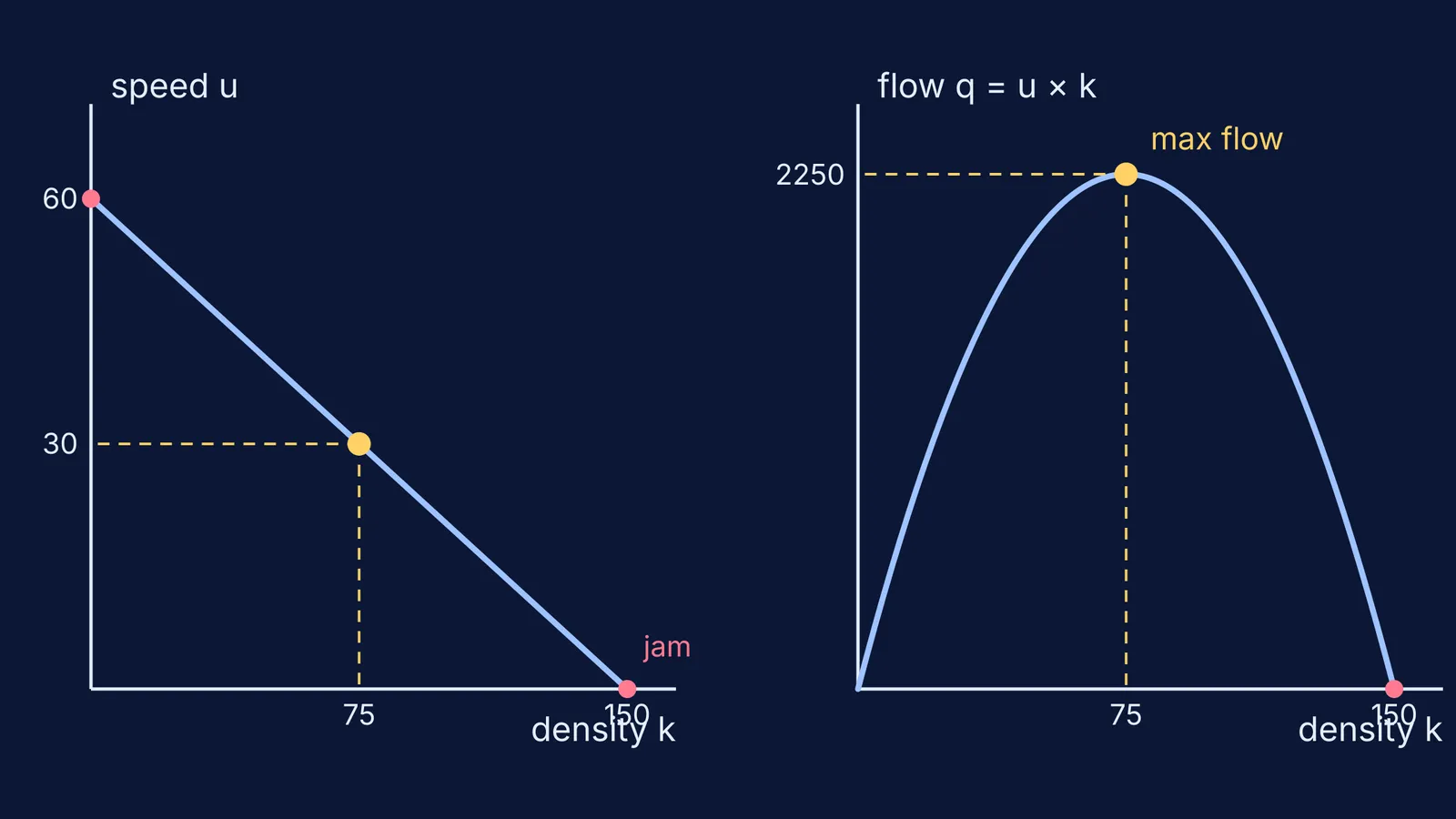
A 1935 study by the traffic researcher Greenshields proposed that speed falls in a straight line as a road gets more crowded: u = u_f(1 - k/k_j). Here u is speed, k is density (vehicles per km), u_f is free-flow speed and k_j is jam density, when traffic stops. The FHWA monograph on traffic flow theory explains that this model dominated the field for over 50 years. It also notes real criticisms: Greenshields drew his line from about half a dozen data points plus one congested observation, he did not use freeway data, and later studies found contradictory evidence.
A worked example with round numbers. Take u_f = 60 km/h and k_j = 150 vehicles per km on one lane.
Flow is speed times density: q = u × k = 60k(1 - k/150).
This is a downward parabola in k. It is zero when the road is empty (k = 0) and when it is jammed (k = 150).
The maximum sits halfway, at k = 75 vehicles per km. Speed there is 60(1 - 0.5) = 30 km/h.
Maximum flow is 30 × 75 = 2,250 vehicles per hour.
The surprise is step 3: in this model, a lane moves the most cars when they travel at half the free speed, not at full speed. Push more cars in past that point and flow drops. That is the start of a jam.
If finding the maximum of a quadratic still feels shaky, the Fermi Concept Library has a lesson on each mathematics concept and shows where it sits in the map, so you can patch the gap before it slows you down.
How can a school student explore transportation engineering?
You do not need to choose a branch today. Try this four-week plan and see whether the questions keep pulling you back.
Week 1, observe: stand safely near a busy junction for 15 minutes with a parent or friend. Count vehicles per minute in one direction and time the signal cycle. Note where queues form.
Week 2, read: open the GATE syllabus above and pick one topic, such as sight distance or signal timing. Watch the first two lectures of the NPTEL course Introduction to Transportation Engineering from IIT Kharagpur.
Week 3, calculate: redo the worked example with your own guesses for free speed and jam density on your street. Does the peak flow seem believable?
Week 4, talk: ask a civil engineer, a metro staff member or a college faculty member what a normal workday looks like. Our guide to a civil site engineer's first job gives you questions to start with.
At the end, write three lines: what you enjoyed, what bored you, and one question you still want answered. Bring that note to your next conversation about college and branch choices.
If you are unsure where to begin with the maths, Fermi's AI tutor can work out what you already know and build a plan for the session, so you start with a clear next step.