On this page
If you are studying civil engineering, your first job after graduation will likely be as a site engineer. While architects and senior engineers design the project from an office, the site engineer is the one standing in the dust, ensuring the physical building perfectly matches the drawings.
A site engineer is the technical backbone of a construction project. But what does the day actually look like between the hard hats and heavy machinery?
What does a site engineer do daily in construction?
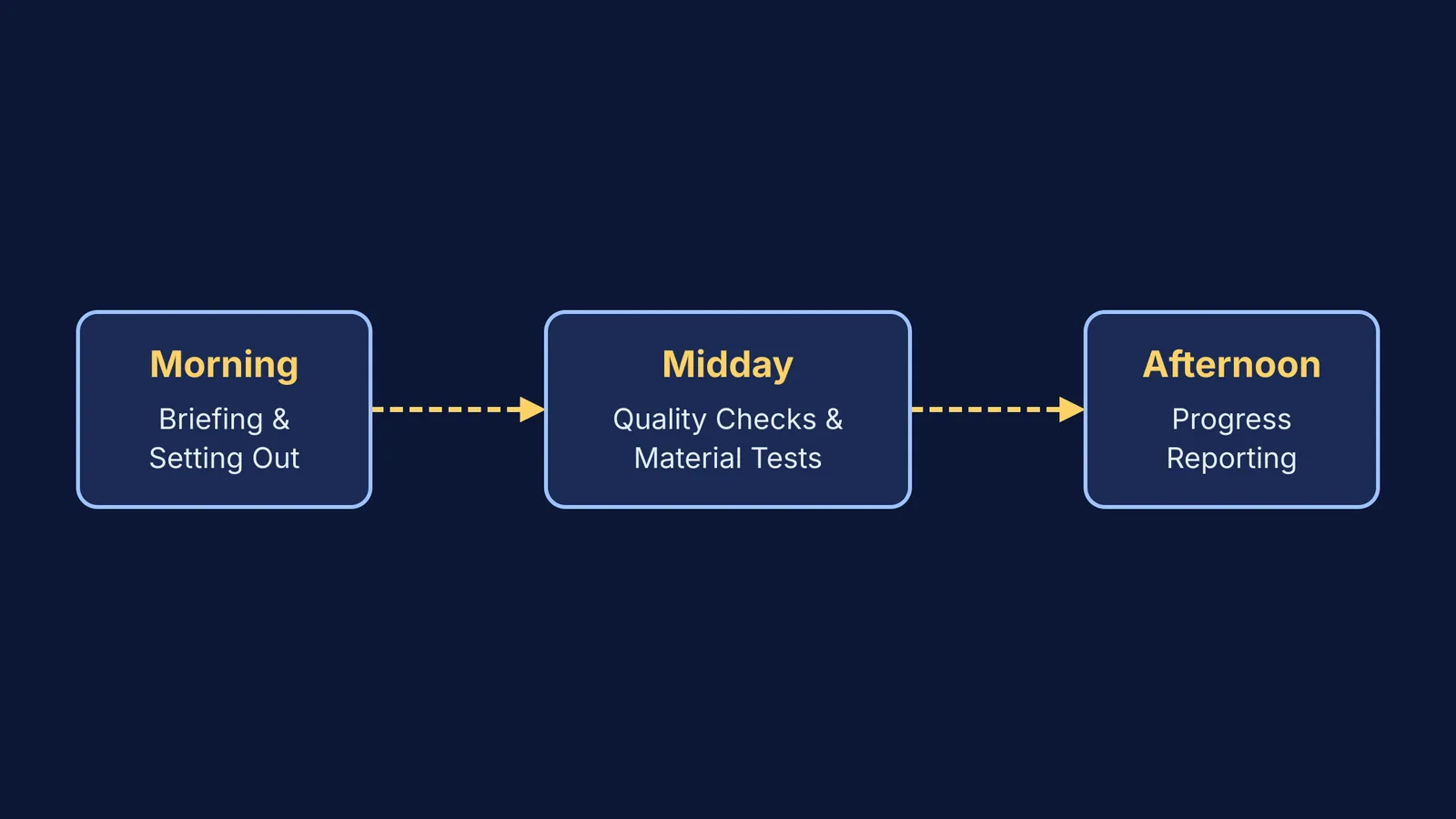
A typical day splits time between the site office and the field, often starting before the sun is fully up. Based on industry standards outlined by Prospects, the core daily tasks include:
Setting out and surveying: Using precision instruments like total stations and GPS to mark exactly where a structure’s foundations, walls, and pillars will go. If a coordinate is off by just a few centimetres, the entire building can be compromised.
Material and quality checks: Before concrete is poured, the site engineer inspects the steel reinforcement bars to ensure they match the structural drawings. They also verify that incoming materials meet exact specifications.
Labor supervision and briefing: A site engineer translates complex technical drawings into actionable instructions for subcontractors, masons, and machinery operators.
Progress reporting: At the end of the day, they log what was completed, update the project schedules, and flag any technical roadblocks to the senior management.
What are the main roles and responsibilities?
The central responsibility of a site engineer is technical compliance. You are the link between the abstract plan and the concrete reality.
When unexpected issues arise—like hitting a hidden utility line during excavation or realizing a specific material is out of stock—the site engineer must propose a safe, structurally sound workaround. They also enforce health and safety regulations, conducting daily inspections to ensure workers are wearing protective gear and operating machinery correctly.
Because they act as the technical advisers on site, they must confidently communicate with everyone from the bricklayers to visiting clients and architects.
Is civil engineering a growing career path?
Yes. Despite fluctuations in the economy, people always need housing, highways, and water systems.
Globally, the U.S. Bureau of Labor Statistics projects that employment of civil engineers will grow 6% from 2025 to 2035. This steady growth translates to roughly 22,700 job openings for civil engineers projected each year in the US alone.
In India, the scale is even larger. Driven by national infrastructure projects, the National Infrastructure Pipeline has a projected investment of $1.4 trillion between 2020 and 2025, with a focus on roads, railways, and urban development. Because this sector is one of the largest employers in the country, fresh civil engineering graduates are in high demand to manage these expanding sites.
What skills do you need for a civil site engineering job?
Beyond holding a civil engineering degree, a successful site engineer needs strong spatial reasoning and a firm grasp of physical mechanics. You must be able to look at a 2D drawing and visualize the 3D structure.
You also need a solid foundation in material science and basic physics—understanding how forces like tension, compression, and torque affect different structures. If you find yourself struggling with foundational mechanics during your degree, the Fermi Concept Library covers every concept in physics, chemistry, biology, mathematics and computing, each with its own lesson and its place in the map, to help you rebuild your understanding of physical forces from the ground up.
Attention to detail is non-negotiable. As a student, a calculation error costs marks; on site, an unchecked dimension can cost millions or lead to a safety failure. Developing habits like learning how to use dimensions to check your physics answers will train your brain to catch errors before they propagate.
What is a practical checklist for your first day on site?
If you have just landed your first site engineering role, the environment can be overwhelming. Keep this daily framework in your pocket to stay organized:
Review the drawings: Start your morning by reviewing the specific drawings for the day's tasks. Never rely on memory.
Walk the site: Before the heavy work begins, walk the perimeter to spot safety hazards and check the previous day's curing concrete or completed work.
Verify the "Setting Out": Personally double-check the survey marks and levels. Do not assume the markers haven't been nudged by machinery overnight.
Inspect before pouring: Never authorize a concrete pour until you have cross-checked the steel reinforcement sizing and spacing against the structural plan.
Document everything: Take photos of hidden works (like underground pipes or covered foundations) and log them in your daily report before they are buried.