

On this page
The question of what comes after a civil engineering degree is common, especially as the sector evolves. The choices extend far beyond basic site supervision, splitting into distinct paths across government departments, multinational construction firms, tech-driven design roles, and specialised higher education.
According to a 2023 report by Knight Frank and RICS (Skilled Employment in Construction Sector in India), India's construction workforce is projected to grow to 100 million by 2030. Many graduates also opt for competitive exams or higher studies rather than taking immediate placements.
What are the career options after civil engineering in India?
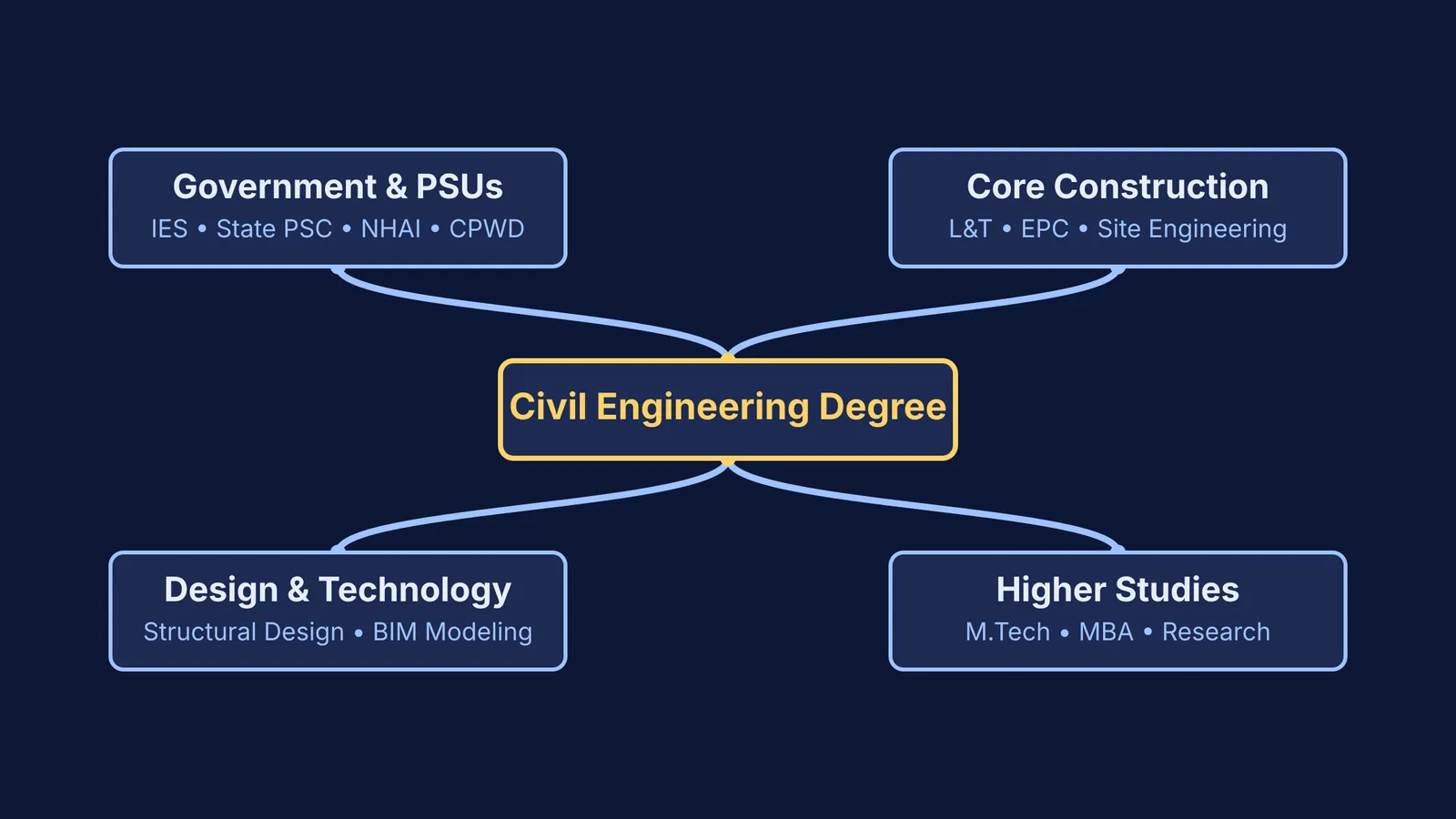
Broadly, career paths fall into four tracks: government and public sector, private construction and EPC (Engineering, Procurement, and Construction), design and technology, and higher studies. The right path depends heavily on whether you prefer managing teams on a physical site or designing structures in an office.
What are the government jobs after civil engineering?
Government roles offer job security, structured progression, and fixed pay scales. Entry is primarily through rigorous competitive examinations, which is why a significant portion of graduates spend a year or two preparing.
Engineering Services Examination (ESE): Conducted by the Union Public Service Commission (UPSC), this recruits Group A officers for central departments like the Central Public Works Department (CPWD), Military Engineer Services (MES), and Border Roads Organisation (BRO).
Junior Engineer (JE) Exams: The Staff Selection Commission (SSC JE) and State Public Service Commissions (PSCs) recruit Junior Engineers and Assistant Engineers. Under the 7th Pay Commission, these roles offer a structured basic pay with allowances.
Public Sector Undertakings (PSUs): Companies such as the National Highways Authority of India (NHAI), ONGC, and NTPC often recruit management trainees or executive engineers based on GATE (Graduate Aptitude Test in Engineering) scores.
If you find it difficult to visualise structural loads or fluid mechanics from textbook diagrams while preparing for these exams, Fermi Simulation Lab provides interactive simulations that bring these core ideas to life.
What is the private sector demand for civil engineers?
The private sector absorbs the largest volume of graduates. Core construction firms like L&T Construction, Tata Projects, and Shapoorji Pallonji hire for roles that manage large-scale infrastructure and real estate projects.
Site Engineer: This is the most common entry point. It focuses on field execution, material management, ensuring structural integrity, and daily labour supervision on active construction sites.
Quantity Surveyor and Planning Engineer: These office-based roles focus on the commercial side of construction. Planners use software like MS Project or Primavera to map out project schedules, while surveyors estimate costs and manage budgets.
The construction industry is also rapidly digitising, creating a premium for engineers who can bridge the gap between civil principles and software.
Structural Design Engineer: Using software like AutoCAD, STAAD.Pro, and ETABS, design engineers calculate the loads and stresses to ensure buildings are safe. If your foundation in applied mathematics is strong, this is a natural fit. (For more on maintaining a strong mathematical base, you might read about helping with maths you've forgotten).
BIM Modeler: Building Information Modeling (BIM) creates precise 3D digital representations of physical places. Roles in BIM and green building consultancy frequently command a substantial salary premium over traditional site roles.
Should you consider higher studies?
If you want to specialise or move out of core engineering, further education is a strong route.
M.Tech or MS: Specialising in structural, environmental, geotechnical, or transportation engineering can lead to research, academia, or senior consultancy roles. Environmental engineering, in particular, is growing due to national water and sanitation missions.
MBA: A Master of Business Administration in Construction Project Management or General Management allows engineers to shift from technical execution to business strategy, finance, and operations.
It is entirely normal to pivot your interests after graduation. If you are a parent supporting a graduate through this transition, our guide on when your child's career choice differs from yours offers practical advice.
A decision framework for civil engineering students
When choosing your path, consider what daily work environment suits you best using this simple framework:
Do you prefer field execution? If you enjoy seeing physical progress, working outdoors, and managing large teams, aim for Site Engineering in the private sector.
Do you prefer desk-based technical work? Focus on Structural Design or BIM, and invest your final university years in mastering the relevant CAD and modeling software.
Is job security your absolute priority? Dedicate time to prepare for GATE, ESE, or State PSC exams for PSU and government roles, understanding that the selection process is highly competitive.
Do you want to manage businesses and budgets? Look towards an MBA or roles in Quantity Surveying and Project Management, where the focus shifts from concrete to commerce.
Civil engineering in India is not a single path, but a robust foundation that supports careers in public service, digital design, and large-scale project management.


