

On this page
Many mechanics questions give you two numbers, a starting speed and a stopping distance, and ask for the coefficient of kinetic friction. It looks like it needs the mass and a force diagram. It needs neither. One line of Newton's second law and one kinematics equation give you a formula you can use for a block on a floor, a hockey puck on ice and a car leaving skid marks.
How do you find the coefficient of kinetic friction from stopping distance?
The magnitude of kinetic friction is f = μN, where μ is the coefficient of kinetic friction and N is the normal force (OpenStax University Physics, section 6.2). The same section notes that at small but nonzero speeds, friction is nearly independent of speed, which is why we can treat the deceleration as constant.
On a level surface the normal force balances the weight, so N = mg. The only horizontal force is friction, so Newton's second law gives ma = μmg, and the deceleration is a = μg. The mass has cancelled.
Now use the constant-acceleration equation v² = u² + 2as (OpenStax, equation 3.14). The object stops, so v = 0, and the acceleration is −μg:
0 = u² − 2μgs, so μ = u²/(2gs).
For g, the standard value is 9.80665 m/s² (NIST); exams usually take 9.8 or 10 m/s², so use the paper's value.
Worked example 1: a block sliding across a floor
A block is pushed and released at 4.0 m/s on a level floor. It slides 2.0 m and stops. Find μ.
Write the formula: μ = u²/(2gs).
Substitute: μ = (4.0)²/(2 × 9.8 × 2.0) = 16/39.2.
Answer: μ ≈ 0.41.
Sanity check: OpenStax lists kinetic coefficients of 0.3 for wood on wood and metal on wood (OpenStax, Table 6.1), so an answer between 0.1 and 1 for an ordinary floor is believable. If you get 4.1 or 0.041, look for a slipped power of ten.
How do you find μ for an ice-hockey puck?
A puck leaves the stick at 6.0 m/s and glides 61 m before it stops.
μ = (6.0)²/(2 × 9.8 × 61) = 36/1195.6 ≈ 0.030.
That is tiny, as expected. OpenStax gives 0.03 for ice on ice and 0.02 for steel on ice (Table 6.1).
Bonus: the time to stop is t = u/(μg) = 6.0/(0.030 × 9.8) ≈ 20 s.
If a question gives you the stopping time instead of the distance, use v = u + at to get μ = u/(gt).
How fast was the car from its skid marks?
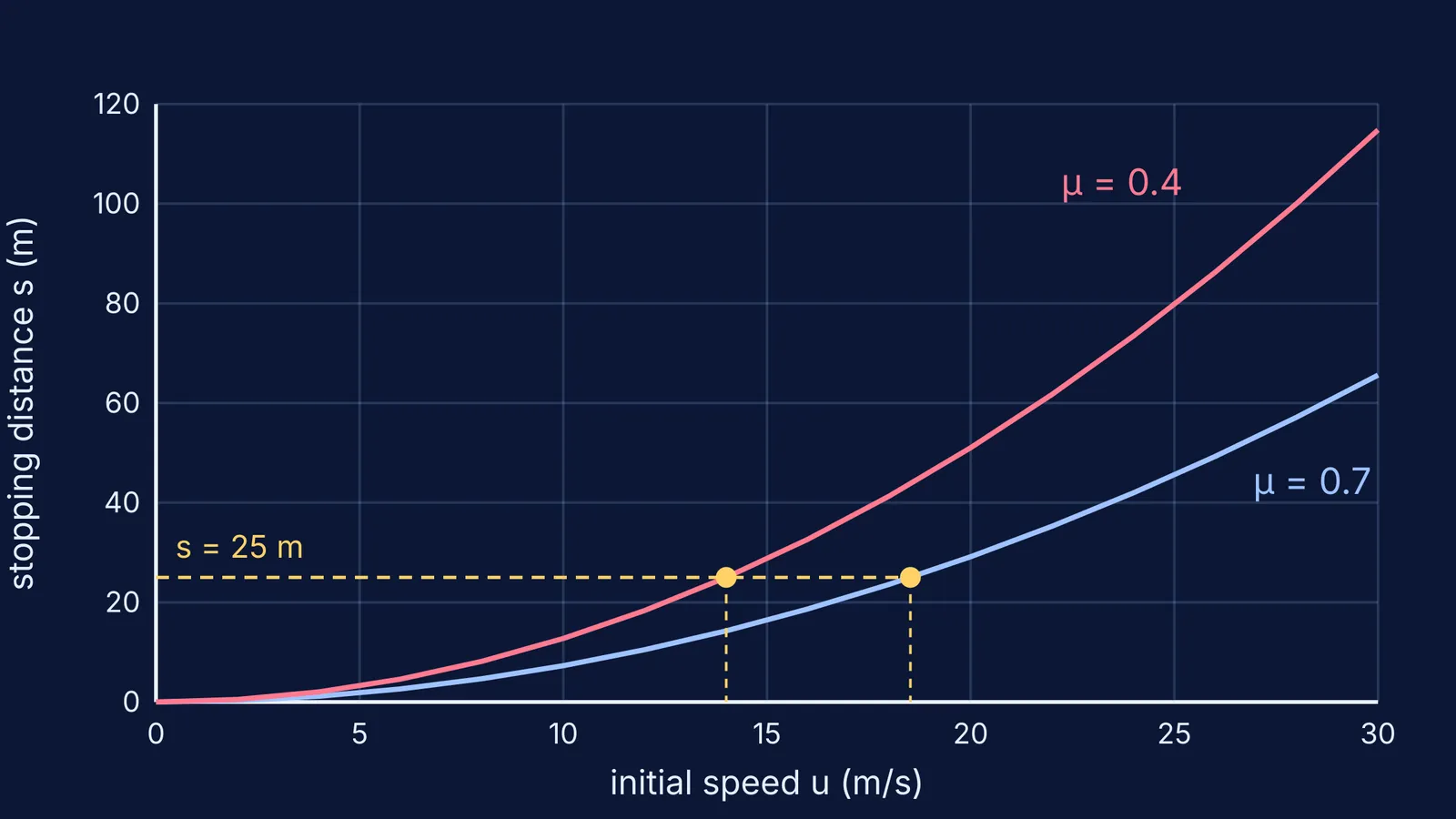
Run the formula backwards: u = √(2μgs). A car locks its wheels and leaves skid marks 25 m long before it stops on a level road.
Dry concrete: OpenStax lists μ = 0.7 for rubber on dry concrete (Table 6.1). Then u = √(2 × 0.7 × 9.8 × 25) = √343 ≈ 18.5 m/s, about 67 km/h.
Wet concrete: the same table gives 0.3 to 0.5. Taking 0.4, u = √196 = 14 m/s, about 50 km/h.
The same 25 m of marks gives two different speeds, so you need the right μ for the surface. Because distance grows with the square of speed, doubling the speed makes the skid four times as long; our post on why doubling speed means four times the stopping distance shows this with a simulation. If the car hit something before stopping, the formula gives only a minimum speed, because some kinetic energy went into the crash instead of the skid.
If you can follow the algebra but freeze when the numbers change, work through a few variations in the Fermi Problem Library, where the step-by-step solver explains the reasoning rather than printing an answer.
What mistakes cost marks in these problems?
Check these before you write the final answer:
Units. Speeds in km/h must be divided by 3.6 before you square them.
Slopes. On an incline N = mg cos θ, and gravity has a component along the slope. Sliding up, the deceleration is g(sin θ + μ cos θ); sliding down, it is g(μ cos θ − sin θ). The simple u²/(2gs) works only on level ground.
Reaction distance. Road-safety questions often add the distance travelled before the brakes go on. Only the braking part involves μ.
Static or kinetic. Skidding means sliding, so use kinetic friction. Static friction is a different number and is not always μN; see why static friction is not always equal to μsN.
Contact area. It does not enter the formula, and examiners like to test that; here is why friction does not depend on the area of contact.
If the idea of a normal force itself still feels shaky, the Fermi Concept Library has a lesson on each concept in physics and shows where it sits in the map, so you can fill the gap first.


