

On this page
About 59% of India's land is prone to earthquakes of different intensities, according to a government answer in Parliament reported by Down To Earth. Engineers cannot stop the shaking, but they control how a building responds through four ideas: resonance, base isolation, dampers and ductility.
Why do some buildings collapse while others survive?
A building's natural period is the time it takes to sway back and forth once after a push. IIT Kanpur's Earthquake Tip 10 gives indicative values of about 0.05 seconds for a single-storey building, 0.4 seconds for a low-rise building and 1 second for a 15-storey building. The same tip says ground shaking mixes waves with periods from 0.03 to 33 seconds, and buildings respond most to waves matching their own period.
That is resonance (our guide to forced vibration and resonance covers the basics). In the 1985 Mexico City earthquake, the old lake bed under the city vibrated with a natural period of about 2.5 seconds, and the buildings most damaged were 6 to 15 storeys tall, according to the encyclopaedia summary of the 1985 earthquake and the surveys it cites.
How does base isolation protect a building?
Base isolation rests the building on flexible pads instead of fixing it to the ground. Properly chosen pads can make earthquake forces up to 5-6 times smaller than in a fixed-base building, according to IIT Kanpur's Earthquake Tip 24. The pads, often rubber and steel plates around a lead plug, make a stiff building very flexible, moving its natural period away from the strongest shaking, and they absorb energy.
After the 2001 Bhuj earthquake, the four-storey Bhuj Hospital was rebuilt on base isolators, the same tip records. Isolation suits low and medium-rise buildings on hard soil, not tall buildings or soft soil.
Worked example: how much does isolation help?
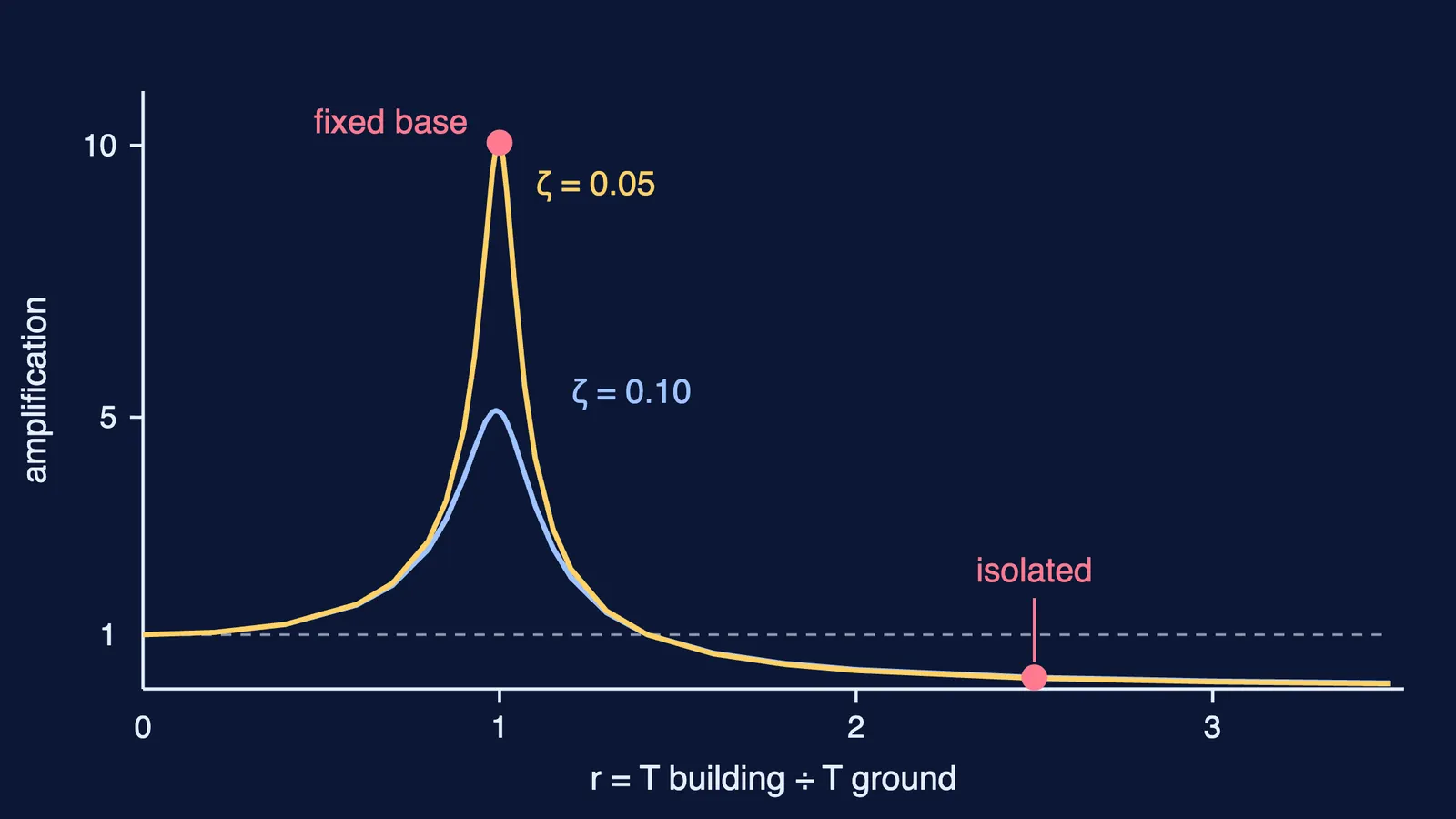
Model the building as a damped mass on a spring, shaken steadily at its base. Its peak acceleration divided by the ground's is TR = √(1 + (2ζr)²) ÷ √((1 − r²)² + (2ζr)²), where r is the building's period divided by the period of the strongest shaking, and ζ is the damping fraction. Suppose the ground shakes hardest at 0.4 seconds.
A fixed-base low-rise building has a period of about 0.4 seconds, according to Earthquake Tip 10, so r = 1. With ζ = 0.05, TR ≈ 10: it is shaken about ten times as hard as the ground.
On isolators that stretch its period to 1 second, with ζ = 0.10, r = 2.5 and TR ≈ 0.21: about a fifth of the ground's acceleration.
A single-storey building at 0.05 seconds (ζ = 0.05) has r = 0.125 and TR ≈ 1.02, so it simply moves with the ground.
In this model, moving the period away from the strongest shaking cuts the building's acceleration from ten times the ground's to a fifth of it, without making the building any stronger. Real shaking mixes many periods and real buildings are not perfect springs, so treat these numbers as a trend, not a design value. Ideas like this are often easier to see than to read, which is what the Fermi Simulation Lab and its interactive simulations are for.
What do dampers and ductile frames add?
Seismic dampers absorb part of the shaking's energy, like the shock absorbers in a car, explains Earthquake Tip 24. Types include viscous, friction and yielding metal dampers. Our post on how bike shock absorbers work shows the same spring-and-oil physics. Taipei 101 uses a giant pendulum instead: a 660-tonne tuned mass damper hanging from the 92nd floor, records Guinness World Records.
Ductility is the ability to stretch a lot before breaking. Earthquake Tip 9 explains that steel is ductile while concrete and masonry are brittle, so steel should yield first. Columns are made stronger than beams, because a failed beam causes local damage but a failed column can bring the building down. India's code for this detailing is IS 13920.
Which seismic zone is your city in, and what should you ask?
The Bureau of Indian Standards map puts about 11% of India in Zone V, 18% in Zone IV and 30% in Zone III, with the rest in Zone II, according to the Parliament answer reported by Down To Earth. A 2025 revision of the code IS 1893 added a Zone VI, but was withdrawn in March 2026 in favour of the 2016 standard, reports Vision IAS, summarising The Economic Times.
Buying or renting a flat? Ask the builder or a structural engineer:
Which seismic zone is this site in, and was the design checked against IS 1893?
Is the concrete frame detailed for ductility under IS 13920?
What soil is the building on, and was its period checked against it?
How were the concrete and steel tested during construction?
Since earthquakes cannot be predicted, good design is what protects you. If oscillations feel shaky before JEE, Fermi's AI tutor can work out what you already know and build a plan for the session.


