

On this page
Ride a scooter over a speed breaker and the rear sinks, rebounds and, if the suspension is healthy, settles almost at once. That settling is a damped oscillation, the same physics as a pendulum slowly losing its swing.
What does a shock absorber in a bike actually do?
It does two jobs.
The spring stores energy. When the wheel hits a bump, the spring compresses and holds that energy as elastic potential energy.
The damper removes it. Inside the shock, a piston moves through oil, forcing it between chambers through small holes called orifices, which converts the shock energy into heat (Wikipedia: Shock absorber).
Ideal springs alone are not shock absorbers, because springs only store energy and do not dissipate it (Wikipedia). Without a damper, the bump's energy comes straight back as a rebound.
On a motorcycle, compression damping controls how the suspension responds when pushed in over a bump, and rebound damping controls how quickly it extends back (MSL Magazine).
How is a shock absorber a damped oscillator?
Treat the bike and rider as a mass m on a spring of constant k. The damper adds a force that opposes velocity, F = −bv, where b is the damping constant (OpenStax University Physics, 15.5).
The resulting motion is x(t) = A₀e^(−bt/2m) cos(ωt + φ): an oscillation whose amplitude shrinks exponentially, with ω = √(ω₀² − (b/2m)²) and ω₀ = √(k/m) (OpenStax). Energy goes as amplitude squared, so it decays as e^(−bt/m), and every joule that leaves the spring ends up as heat in the oil.
Critical damping, b = 2√(mk), returns the system to equilibrium as fast as possible without overshooting, and OpenStax uses car shock absorbers as its example (OpenStax).
In Class 11, the CBSE 2025-26 Physics syllabus covers a loaded spring and energy in SHM in Chapter 13, viscosity in Chapter 9, and a practical activity on energy dissipation in a simple pendulum, plotting amplitude squared against time (CBSE Physics syllabus 2025-26). Our guide to the pendulum damping practical is the lab version of your bike's rear shock.
Worked example: a healthy damper vs a worn one
These are round numbers we chose to show the physics, not data for a real bike: m = 100 kg on the rear suspension, k = 16,000 N/m, using the damped-oscillation formulas from OpenStax University Physics, 15.5.
Natural frequency: ω₀ = √160 ≈ 12.6 rad/s, about 2 oscillations per second.
Critical damping: b = 2√(100 × 16,000) ≈ 2,530 N s/m.
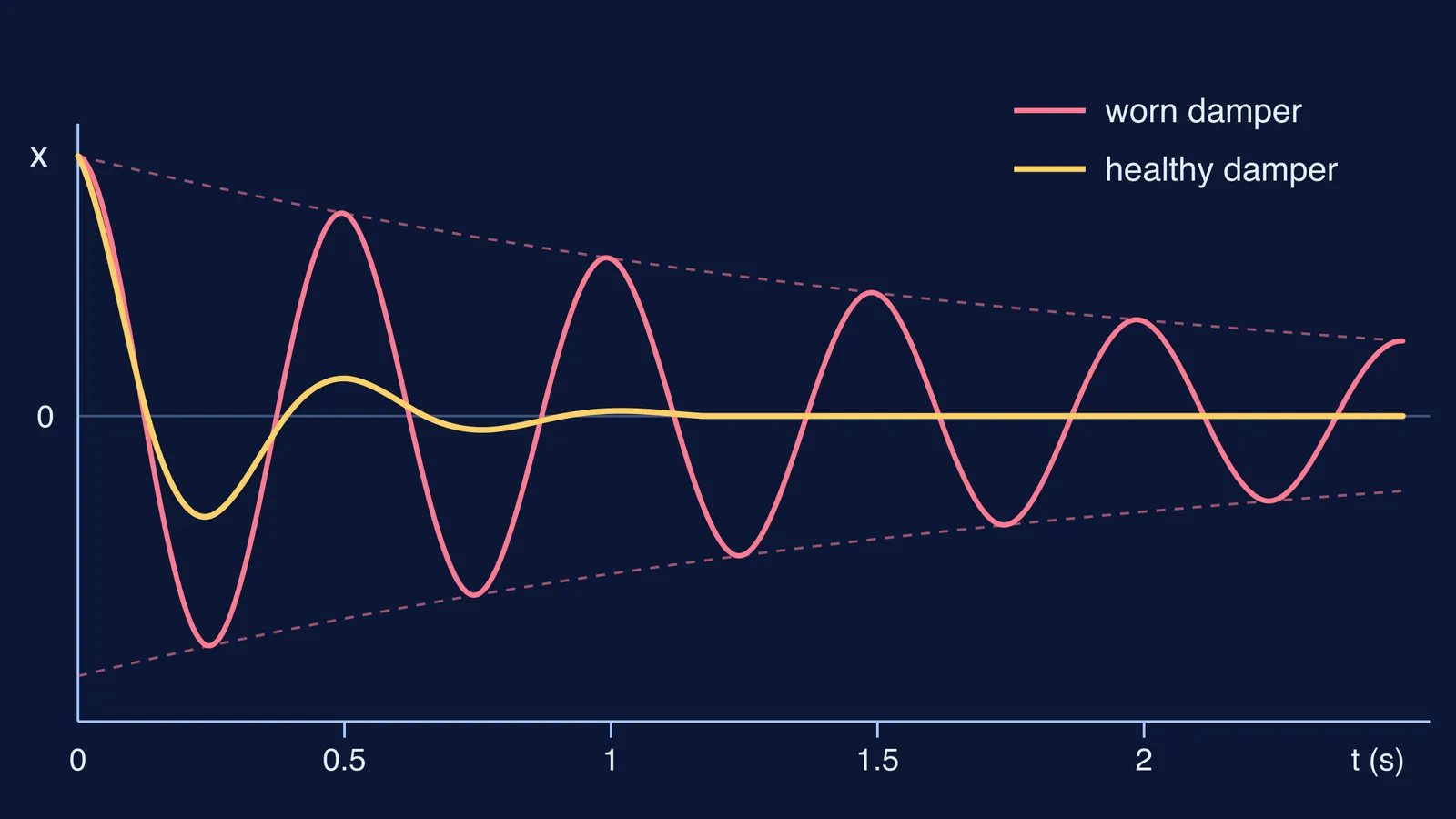
Healthy damper, b = 760 N s/m: the decay rate b/2m is 3.8 per second and one bounce takes about 0.52 s. After one bounce the amplitude is e^(−3.8 × 0.52) ≈ 14% of before, and below 10% within about 0.6 s.
Worn damper, b = 100 N s/m: the decay rate is 0.5 per second and a bounce takes about 0.50 s. Each bounce keeps about 78% of the last, so reaching 10% takes ln 10 / 0.5 ≈ 4.6 s, roughly nine bounces.
Energy: a 5 cm compression stores ½kx² = ½ × 16,000 × 0.05² = 20 J, which the healthy damper turns into heat within a second.
The period barely moved, 0.52 s against 0.50 s. What changed is how fast the bounces die.
To practise numericals like this, the Fermi Problem Library has worked problems with a step-by-step solver that explains the reasoning rather than printing an answer. For damping alongside resonance, see our guide to damped and forced oscillations.
Why does a worn shock absorber make a bike bounce?
Wear lowers b. Oil leaking from the shock body is a clear sign of internal seal failure (Bilstein). With less oil to push through the orifices, the damper resists less. With a smaller b, the exponential decays slowly and the spring keeps trading energy back and forth.
That is the symptom riders feel. Bilstein says that if a vehicle keeps bouncing after a bump, the shock's damping ability has diminished (Bilstein); MSL Magazine describes a pogo-like bouncing after bumps instead of the bike settling quickly (MSL Magazine).
A check to do with a parent:
Look for oil streaks on the front fork tubes or the rear shock body.
Ride slowly over one speed breaker and count the rebounds. One small rebound and then still means a healthy b; bob-bob-bob means a low b.
If you see either, ask a mechanic to inspect the suspension.
The decaying curve is an idea that is easier to see than to read, which is what the Fermi Simulation Lab is for. Then test your intuition with our damped oscillation predictions.


