

On this page
The CISCE Physics syllabus for the 2027 ICSE examination lists natural, damped and forced vibrations, and calls resonance "a special case of forced vibrations". Once you see why resonance belongs inside forced vibration, the rest is easy.
What are natural, forced and resonant vibrations?
These definitions follow OpenStax University Physics, section 15.6.
Natural vibration: a body disturbed once and then left alone vibrates at its natural frequency. That is the frequency it would have with no driving force and no damping.
Damped vibration: the same vibration losing energy to friction or air, so its amplitude shrinks over time.
Forced vibration: an outside periodic force keeps acting. Once the start-up wobble dies out, the body vibrates at the driving frequency, not at its own.
Resonance: a forced vibration in which the driving frequency equals the natural frequency, so the amplitude grows large.
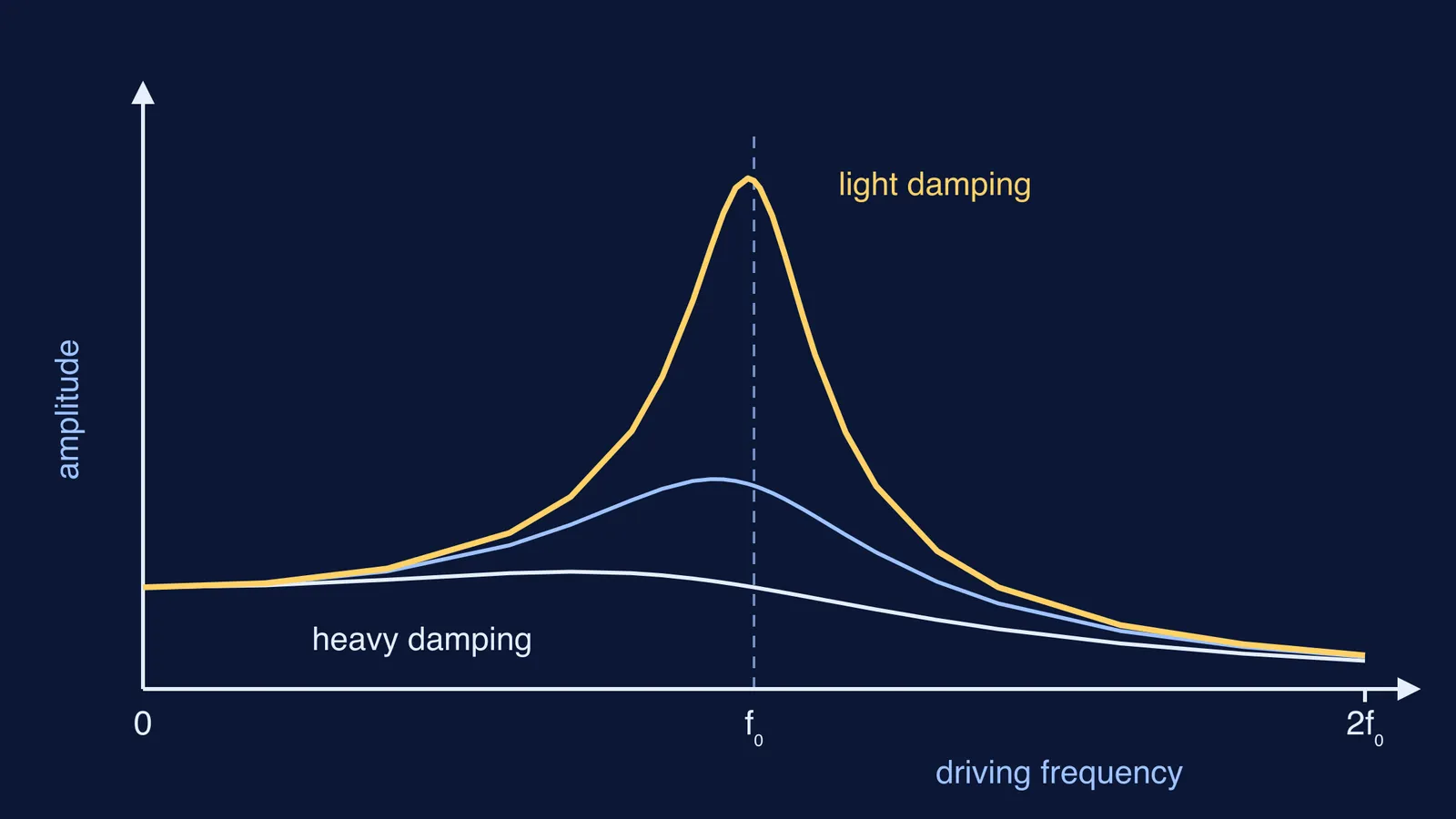
The graph at the top shows the main idea: amplitude peaks when the driving frequency is close to the natural frequency f₀, and lighter damping makes the peak taller.
How does a swing show all three?
Pull a swing back and let go: it swings at its natural frequency and slowly dies down (natural, then damped). Push it at a steady rhythm that does not match its own and the swings stay small (forced). Push once per swing, at the top of each back-swing, and it goes higher every time (resonance). In OpenStax's version, the parent "applies small pushes to the child at just the right frequency, and the amplitude of the child's swings increases".
A swing behaves roughly like a simple pendulum. For swings under about 15°, a pendulum's period is T = 2π√(L/g) (OpenStax, section 15.4). Take chains 2.5 m long and g = 9.8 m/s²:
L/g = 2.5 ÷ 9.8 = 0.255 s²
√0.255 = 0.505 s
T = 2π × 0.505 = 3.17 s, so f₀ = 1 ÷ 3.17 ≈ 0.32 Hz
So for resonance you push about once every 3.2 seconds. Push every 2 seconds instead and you force the swing at 0.5 Hz: many pushes arrive at the wrong moment, so the amplitude stays small.
What does a guitar teach about forced vibration?
A plucked string vibrates at its natural frequency. For a string fixed at both ends, the fundamental frequency is f₁ = v/2L, and the wave speed v depends on the tension (OpenStax, section 16.6). Pressing a fret shortens L, which raises the note.
The wooden body is where forced vibration comes in. The string pushes on the body at the string's frequency, whatever note you play. OpenStax notes that guitars "use resonance in their sounding boxes to amplify and enrich the sound created by their vibrating strings" (OpenStax, section 17.5). For more everyday examples, see our post on how vibrating objects produce sound.
Why do soldiers break step on a bridge?
Marching feet strike a bridge in a regular rhythm, which is a periodic force. If that rhythm is close to one of the bridge's natural frequencies, the bridge's swaying can build up. On 12 April 1831, 74 soldiers of the 60th Rifle Corps were marching across the Broughton Suspension Bridge near Manchester when it collapsed. Twenty were injured and nobody died. Afterwards, the British Army ordered troops to break step when crossing bridges.
Ordinary walkers can do it too: London's Millennium Bridge swayed under pedestrians and was closed for roughly two years (OpenStax, section 15.6). More in our post on why soldiers break step on a bridge.
What is the difference between forced vibration and resonance?
Side by side:
Frequency: natural is the body's own f₀; forced is the driver's frequency; resonance is the driver's frequency when it equals f₀.
Amplitude: natural is set by the first push, then dies away; forced is usually small; resonance is large, limited mainly by damping.
Swing: natural is letting go and leaving it; forced is pushing at a steady rhythm that does not match; resonance is pushing once per swing.
Guitar: natural is the plucked string; forced is the body driven by the string; resonance is a matching string starting to hum on its own.
For a 3-mark answer, use this pattern:
Define forced vibration: vibration of a body under an external periodic force, at the frequency of that force.
Define resonance: a special case of forced vibration where the driving frequency equals the natural frequency, giving a large amplitude.
Give one example of each, such as a guitar's sound box (forced) and soldiers breaking step on a bridge (resonance).
If damping still feels vague, our pendulum damping practical shows amplitude falling over time. Resonance is easier to see than to read about, and the Fermi Simulation Lab has interactive simulations for ideas like this, so you can watch the motion instead of picturing it.


