On this page
Put two fingers on your throat and hum. That buzz is the whole topic: sound is what happens when something moves back and forth quickly and pushes the air. Here are four examples, each with a test.
What does "sound is produced by vibration" mean?
NCERT defines vibration as the to and fro motion of an object, and notes that a plucked rubber band makes sound only while it vibrates (NCERT Class 8 Science, Chapter 10: Sound). Frequency is the number of oscillations per second, measured in hertz (Hz).
The human ear detects vibrations from roughly 20 Hz to 20,000 Hz, according to the same NCERT chapter. Most vibrations are too small to see, but you can feel them, which is why each example below comes with a test.
How does a tabla membrane make sound?
NCERT's table of instruments and their vibrating parts lists the tabla's vibrating part as a stretched membrane, and the veena's as a stretched string (NCERT Class 8 Science, Chapter 10). Strike the tabla and the skin moves up and down, pushing on the air.
Many drums give a short thud, but the tabla gives a sustained, musical tone. C. V. Raman and Sivakali Kumar published a 1920 note in Nature titled "Musical Drums with Harmonic Overtones". Raman returned to the subject in a 1934 paper, "The Indian musical drums", in the Proceedings of the Indian Academy of Sciences. A Live History India account of the work explains that the syahi patch that loads the drumhead greatly increased the energy of vibration and gave a sustained tone.
For drum pitch, see why a dhol sounds deeper than a tabla.
Why does a guitar string change its note?
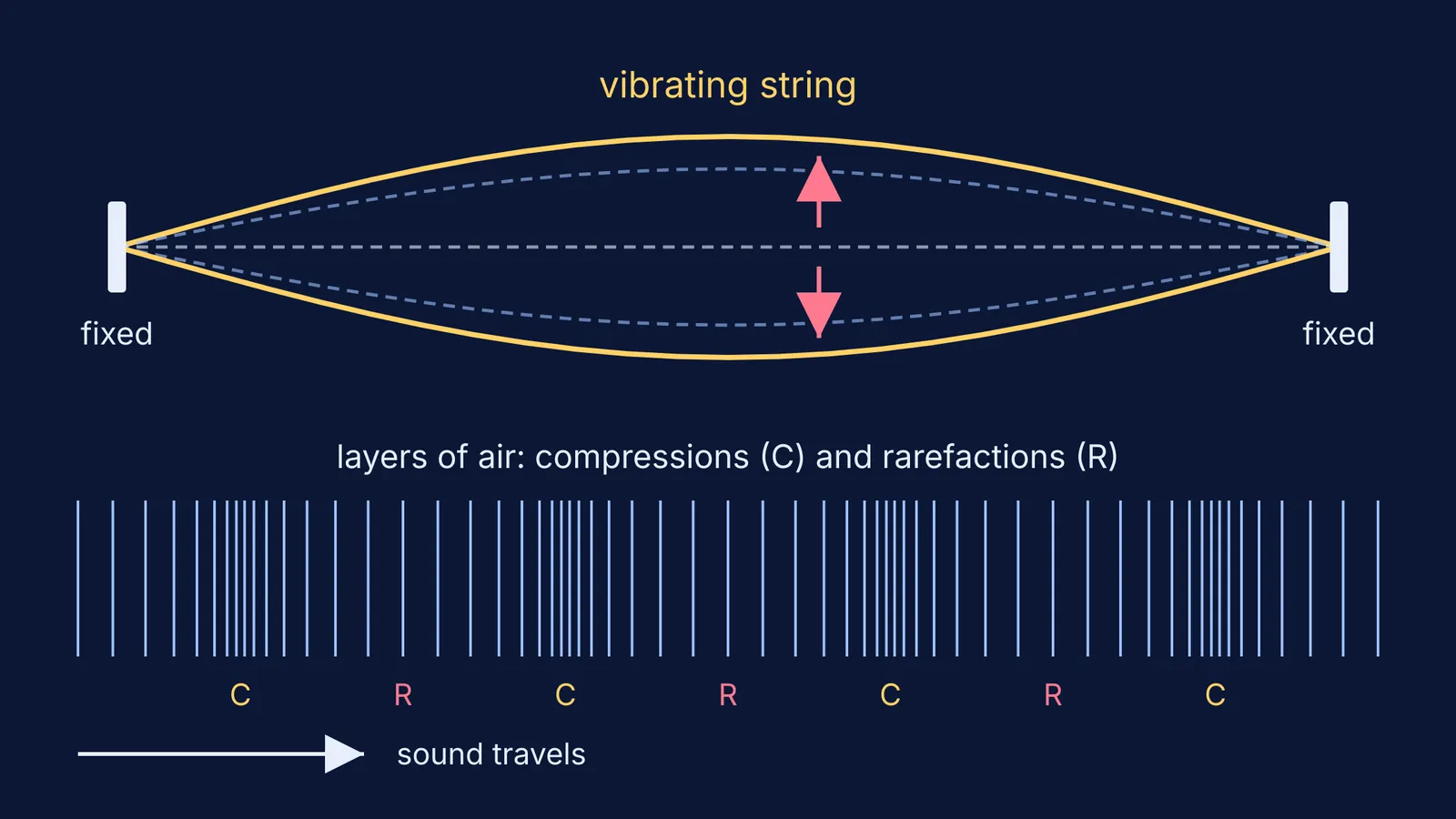
A plucked string vibrates between the nut and the bridge. Its lowest frequency is f = (1/2L)√(T/μ), where L is the vibrating length, T the tension and μ the mass per metre of string (HyperPhysics, Georgia State University).
Worked example: take round numbers of a realistic size, L = 0.65 m, T = 70 N and μ = 0.0004 kg/m.
Wave speed on the string: √(T/μ) = √(70 ÷ 0.0004) = √175,000 ≈ 418 m/s.
Frequency: f = 418 ÷ (2 × 0.65) = 418 ÷ 1.3 ≈ 322 Hz.
Press the string at its midpoint so L halves to 0.325 m: f doubles to about 644 Hz.
Tighten the peg until T is four times bigger: √T doubles, so f doubles too.
Shorter length or more tension gives a higher pitch; a heavier string gives a lower one. Exams test exactly this reasoning, and the Fermi Problem Library has worked problems with a step-by-step solver that explains the reasoning rather than printing an answer.
It is not only the string you hear, though. NCERT points out that a plucked sitar string forces the whole instrument to vibrate, and it is that vibration you hear.
How do vocal cords produce sound?
Your voice box, or larynx, sits at the top of the windpipe. NCERT describes two vocal cords stretched across it with a narrow slit between them, and when the lungs force air through the slit, the cords vibrate and produce sound (NCERT Class 8 Science, Chapter 10).
The same chapter says vocal cords are about 20 mm long in men and about 15 mm in women, and that children have very short ones, giving this as the reason the three voices sound different. More in our explainer on how your vocal cords make sound and what sets the pitch.
How does a tuning fork in water prove vibration?
Strike a tuning fork and you hear a steady note, but the prongs look still. Strike it again and dip the prongs into a beaker of water, and the water splashes.
Rowan University's physics demonstration notes say the demo shows that sound comes from rapid oscillations, usually too rapid to be seen, and recommend a 125 Hz fork (Rowan University, Oscillations with Sound and a Splash). At 125 Hz, each prong moves back and forth 125 times every second.
No tuning fork? NCERT uses a metal dish of water: strike its edge with a spoon and waves appear on the water; then hold the dish and watch what happens to them (NCERT Class 8 Science, Chapter 10).
A 10-minute check you can do at home
Do this to revise, or sit through it with your child.
Rubber band on a pencil box: pluck it, watch the blur, then pinch it still.
Steel plate or katori with water: strike the edge, look for ripples.
Your throat: hum low, then high, and feel the buzz change.
Any drum or upturned tin: put a few grains of rice on top and tap it gently.
For each, write what vibrates, how you saw or felt it, and what happened when you stopped it. If waves are still hard to picture, the Fermi Simulation Lab has interactive simulations for ideas that are easier to see than to read.
For pitch, loudness and worked sums on the full chapter, continue with our guide to sound in Class 8.