On this page
Put two fingers lightly on the front of your throat and hum. The buzz you feel comes from your larynx, or voice box. Biology teaches it in the breathing chapter and physics in the sound chapter, but it is one mechanism.
How do humans produce sound with the vocal cords?
The vocal cords are better called vocal folds: two bands of muscle and soft tissue stretched across the larynx at the top of your windpipe. When you breathe, they sit apart. When you speak, muscles pull them together, and air pushed up from the lungs builds pressure beneath them.
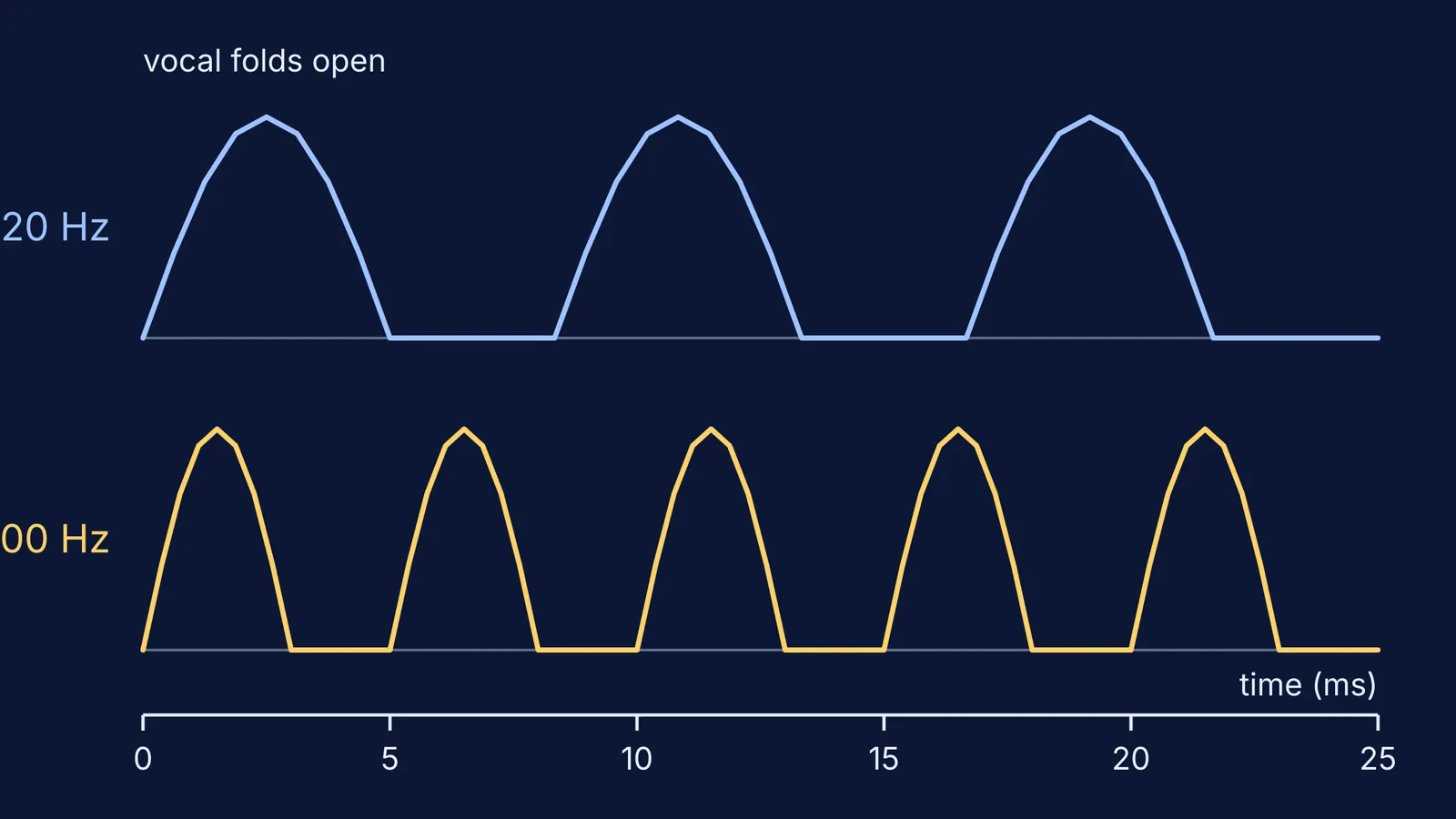
In a review of voice mechanics in the Journal of the Acoustical Society of America, Zhaoyan Zhang explains that vocal fold vibration modulates the airflow through the glottis into a pulsating jet, which becomes the voice source. The glottis is the gap between the folds. Pressure from below pushes them apart, a puff of air escapes, and they spring back together. Each puff is a small pressure pulse, and a regular train of pulses is a sound wave. The number of open-and-close cycles per second is the fundamental frequency, which you hear as pitch. A voice at 120 Hz means the folds open and close 120 times every second.
Why do tension and length change the pitch?
A vocal fold behaves a little like a guitar or sitar string. Zhang's review states that, in the simple string picture, the fundamental frequency rises with increasing tension, decreasing mass and decreasing vocal fold length. The review adds that this picture ignores tissue stiffness. You can see the rule worked through in our post on Marin Mersenne's laws of vibrating strings.
Cartei, Cowles and Reby, writing in PLoS ONE, note that men's average pitch is about 120 Hz and women's about 200 Hz. The same paper reports that during puberty the male larynx outgrows the female larynx by 40%, and vocal fold length grows by about 60%, reaching roughly 16 mm in adult men against 10 mm in adult women. Longer folds vibrate more slowly, so the voice drops. That is what a boy's voice "breaking" is.
There is a puzzle here. To sing a higher note, you make your folds longer. The cricothyroid muscle tilts the cartilages of the larynx and, in Zhang's words, elongates the vocal folds and increases the stiffness and tension. Stretching adds a little length but raises stiffness and tension much more, and those win.
A worked example: does length alone explain the gap?
Use the ideal string formula, f = (1/2L) × √(T/μ), where L is length, T is tension and μ is mass per unit length. Real folds are layered tissue, not ideal strings, so treat this as an estimate.
Assume a woman's folds are 10 mm long and vibrate at 200 Hz, using the figures from Cartei and colleagues.
Keep tension and mass per length the same, and make the folds 16 mm long. Frequency goes as 1/L, so f = 200 × 10/16 = 125 Hz.
Compare with the measured male average of about 120 Hz. In this idealised model, length accounts for most of the gap.
Now the puzzle from the last section. Suppose, purely as an illustration, that the cricothyroid stretches the 10 mm folds to 11 mm and triples the tension. Then f = 200 × (10/11) × √3, which is about 315 Hz. The folds got 10% longer and the note still went up by more than half.
If you mix up which quantity changes, the Fermi Problem Library has worked problems with a step-by-step solver that explains the reasoning rather than printing an answer.
What makes your voice louder, and what turns a buzz into words?
Zhang's review describes subglottal pressure, the air pressure below the folds, as the main control of vocal intensity, because raising it increases how far the folds swing and how sharply the airflow drops as they close. Our post on amplitude and loudness covers the wave side of this.
The buzz from the larynx is not yet speech. The same review explains that the vocal tract, meaning your throat, mouth and nose, acts as a filter and shapes the sound source spectrum into different sounds before they leave your mouth. It is also part of why your recorded voice sounds strange.
Try it: a three-minute check at your desk
Hum a low note with your fingers on your throat, then glide up to a high note. You should feel the larynx move.
Whisper a word, then say it aloud. Whispering lets air pass without the folds vibrating, so the buzz disappears.
Hum one note quietly, then loudly. Only the push of air changes.
Hold one note and switch between "aa" and "oo". Only your mouth shape changes.
To connect breathing, Mersenne's laws and sound waves, look them up in the Fermi Concept Library, which gives every concept in physics, chemistry, biology and mathematics its own lesson and its place in the map.