

On this page
Most of us have had the exact same reaction to hearing our own voice on a voice note or video: "Is that really what I sound like?" The voice on the recording usually sounds higher, thinner, and surprisingly unfamiliar.
This universal discomfort is not just in your head. It is a predictable result of how sound waves travel through different materials, and how your ear is built.
How does sound reach the inner ear?
When you listen to someone else speaking, the sound reaches you entirely through the air. The sound waves travel from their mouth, through the air, and into your ear canal, where they vibrate your eardrum. This is called air conduction.
When you speak, however, your brain receives two signals at the same time. The first is air conduction: the sound leaves your mouth and travels through the air to your own ears.
The second path is bone conduction. Your vocal cords vibrate, and those vibrations travel directly through the bones of your jaw and skull to reach the cochlea, the hearing organ in the inner ear.
Why do skull bones boost bass?
The speed and quality of sound depend heavily on the medium it travels through. In air, sound travels at roughly 343 metres per second. In the dense, elastic tissue of human cortical bone, sound travels significantly faster. If you have studied vibration and pitch, you will know that solid objects transmit sound differently than gases.
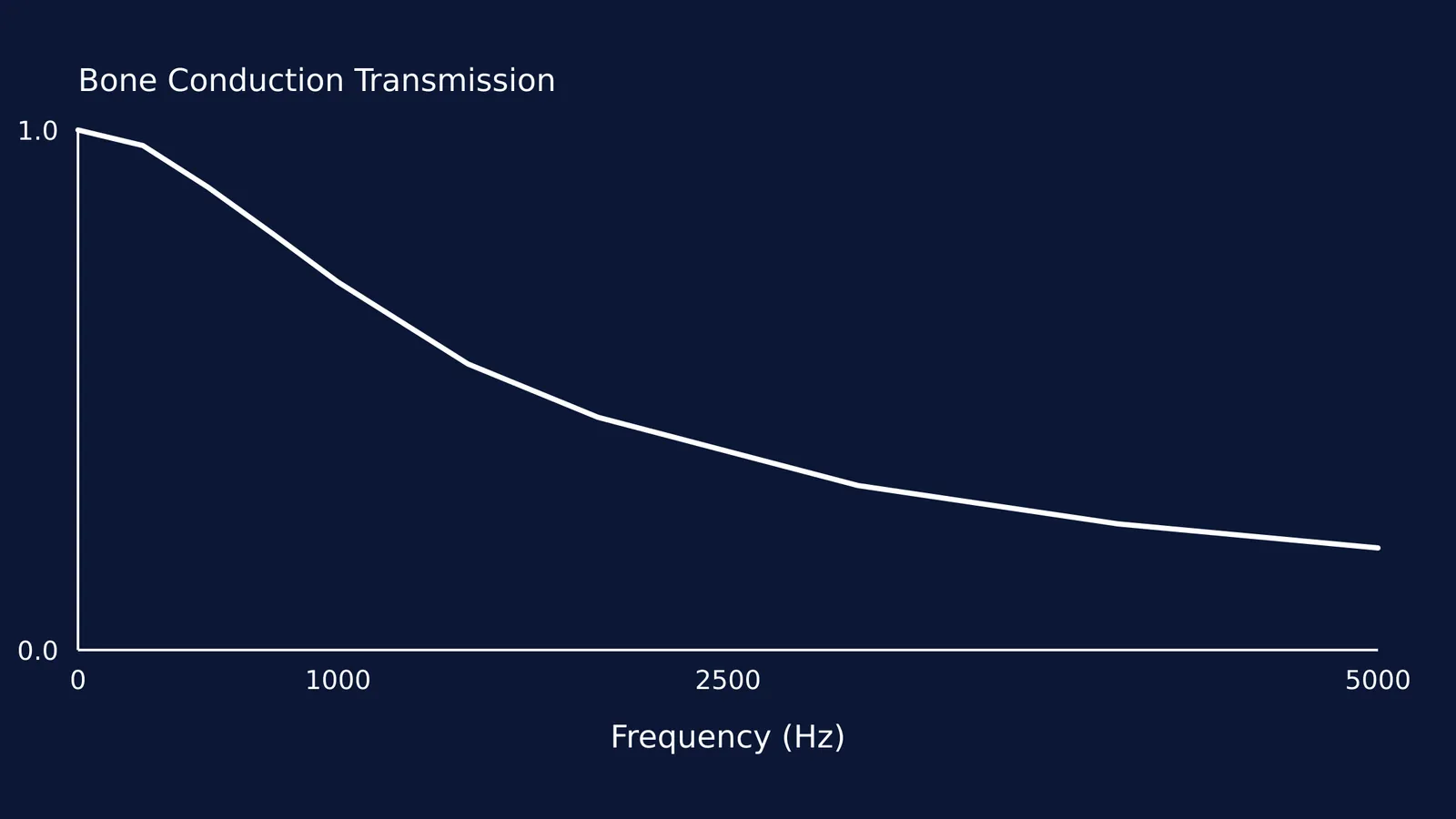
More importantly, your skull bones act as a low-pass filter. They are highly efficient at transmitting low-frequency (bass) vibrations while dampening higher frequencies. Because you always hear your own voice partly through your bones, the version you hear in your head is artificially deep, rich, and resonant.
Why does a recording sound different?
A microphone is built to mimic air conduction. It only captures the sound waves travelling through the air.
When you play back a recording, the bone-conduction path is completely missing. Without the internal bass boost provided by your skull, the voice you hear lacks its usual warmth and depth. It sounds higher and thinner, which is exactly how everyone else has always heard you.
For students trying to understand the physics of waves, some ideas are easier to see than to read. The Fermi Simulation Lab has interactive simulations for the ideas that are easier to see than to read, such as how waves move through different materials.
What is voice confrontation?
Psychologists call the jarring feeling of hearing your recorded voice "voice confrontation." The term was coined in a 1966 study by Philip Holzman and Clyde Rousey in the *Journal of Personality and Social Psychology*, which found that people experience a sense of shock when they hear their recorded voice because it strips away the expressive qualities they thought they were projecting.
More recently, a 2023 study by Pavo Orepić and colleagues in *Royal Society Open Science* proved just how heavily we rely on bone conduction for self-recognition. The researchers played participants recordings of their own voices, sometimes mixed with the voices of strangers. They found that participants were significantly better at identifying their own voice when the recording was played through bone-conduction headphones that recreated the missing vibrations.
How to use this when presenting
If you are practising for an oral exam, a presentation, or an interview, record yourself.
The first time you listen back, you will probably focus entirely on how strange your voice sounds. This is normal. Listen to the recording a few more times. Once your brain gets used to the missing bone conduction, you will stop cringing at the pitch and start noticing the things that actually matter: your pacing, your clarity, and where you use filler words like "um" or "like".
Your recorded voice is the one the examiner will hear, so making peace with it is the first step to speaking with confidence.


