

On this page
Strike a steel tumbler gently with a spoon, then strike it hard. The second sound is louder, and you can see why if you hang a small thermocol ball touching the rim: the ball is pushed further. That displacement shows the size of the vibration, its amplitude. This is the first idea in Class 8 sound, and it also tells you how to look after your ears.
What is the relation between amplitude and loudness?
Amplitude is how far a vibrating object moves from its resting position. The NCERT Class 8 science chapter on sound puts it simply: when the amplitude of vibration is large, the sound is loud, and when it is small, the sound is feeble.
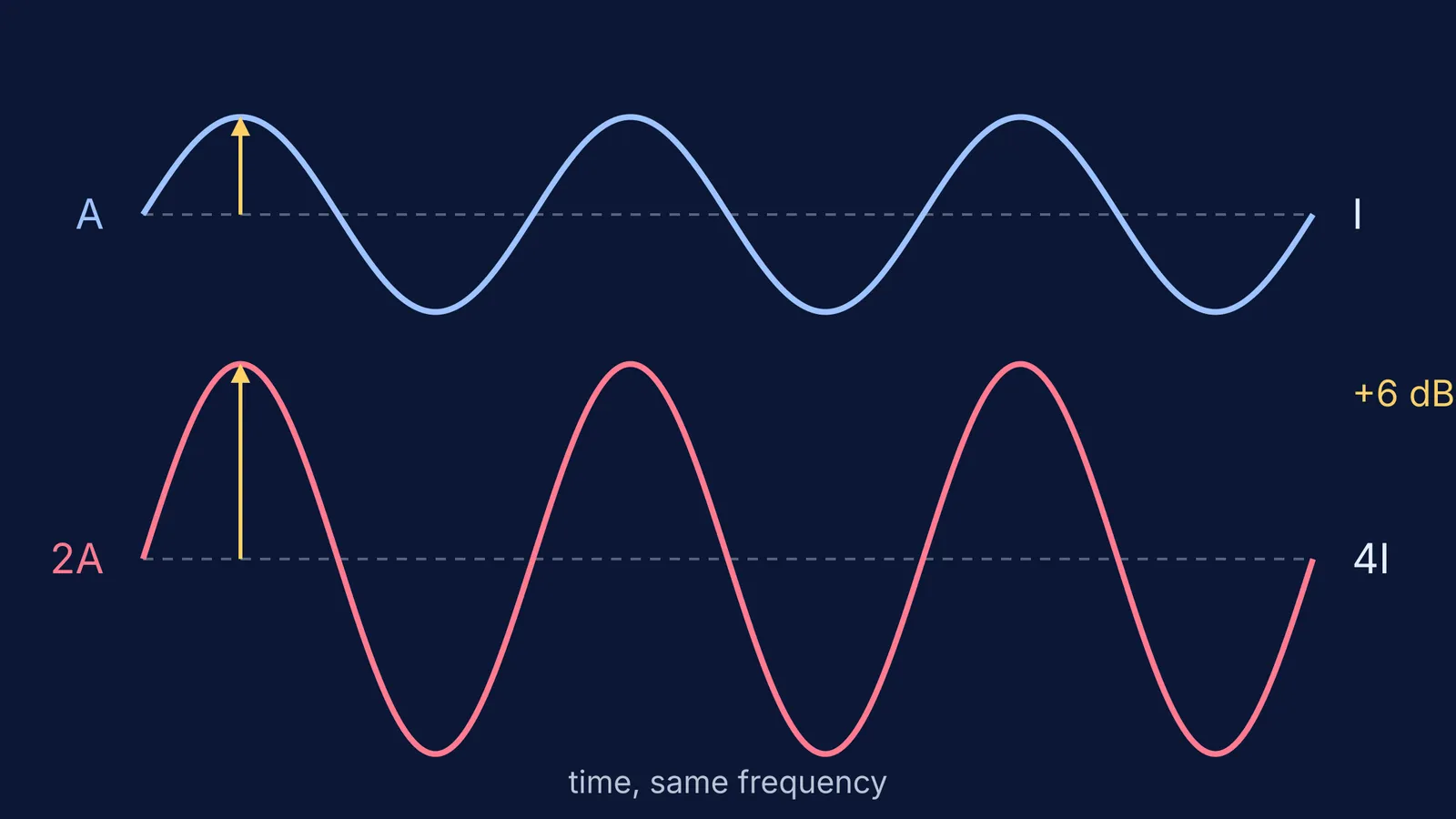
The same chapter gives the rule: loudness of sound is proportional to the square of the amplitude of the vibration producing it (NCERT). Its own example: if the amplitude becomes twice as large, the loudness increases by a factor of 4.
Amplitude is not the same as pitch. Pitch depends on frequency, how many vibrations happen each second. A lion's roar is low-pitched but very loud, and a bird's call is high-pitched but feeble, the NCERT chapter notes. So two sounds can have the same pitch and different loudness.
What does a decibel actually measure?
The decibel (dB) is the unit used to express how loud a sound is. NCERT's table gives a feel for the scale (NCERT):
Normal breathing: 10 dB
Soft whisper (at 5 m): 30 dB
Normal conversation: 60 dB
Busy traffic: 70 dB
Average factory: 80 dB
The same textbook adds that above 80 dB, noise becomes physically painful.
In higher classes and university physics you meet the formula. Sound intensity level is β = 10 log10(I/I0), where I0 = 10^-12 W/m², the faintest sound a person with normal hearing can perceive at 1 kHz (OpenStax University Physics). The intensity of a sound wave is proportional to its amplitude squared, which is where NCERT's square rule comes from (OpenStax).
Two facts from that formula are worth remembering. Each factor of 10 in intensity adds 10 dB, and doubling the intensity adds only about 3 dB (OpenStax). For more practice with the log, see our explainer on how to calculate sound intensity level in decibels and our visual guide to why the decibel scale is logarithmic.
Worked example: what happens when the amplitude doubles?
Say your friend is speaking at 60 dB, the level NCERT gives for normal conversation (NCERT), and then speaks so the air vibrates with twice the amplitude.
Amplitude × 2 means intensity × 2² = × 4.
Change in level = 10 log10(4) = 10 × 0.602 ≈ 6 dB.
New level ≈ 60 + 6 = 66 dB.
Now try amplitude × 10. Intensity goes up 100 times, and 10 log10(100) = 20 dB, so the level goes from 60 dB to 80 dB, the level the NCERT table gives for an average factory.
If you mixed up 'twice the amplitude' with 'twice the intensity' (which is only +3 dB), the Fermi Problem Library has worked problems with a step-by-step solver that explains the reasoning rather than printing an answer.
How loud is too loud for your ears?
The WHO–ITU safe listening standard (2019) sets a reference exposure of 80 dB for 40 hours a week for adults and 75 dB for 40 hours a week for children (WHO). WHO says over 1 billion people aged 12 to 35 risk losing their hearing due to prolonged and excessive exposure to loud music and other recreational sounds (WHO, 2 March 2022).
The recommended time falls fast as level rises. For workplaces, the US National Institute for Occupational Safety and Health recommends a limit of 85 dBA averaged over an 8-hour workday, and halving the time for every 3 dBA increase (CDC/NIOSH). On that rule, 88 dBA allows 4 hours, 91 dBA 2 hours, and 94 dBA 1 hour.
A safe-listening checklist for students
Use your phone's volume limit or hearing-health setting if it has one.
If someone an arm's length away has to shout for you to hear them over your earphones, the volume is probably too high.
In a noisy bus or metro, do not turn music up to drown out traffic.
Take breaks from earphones during long study sessions.
At weddings, concerts and Diwali crackers, stand away from speakers and use earplugs.
If you notice ringing or muffled hearing that does not go away, see a doctor.
For revision, try the tumbler activity at home and predict, before you strike, how far the ball will move. To review amplitude, frequency and intensity together, the Fermi Concept Library has a lesson for every concept in physics, each with its place in the map.


