

On this page
Decibel questions cost marks because the scale is logarithmic: you add intensities, never decibels, and distance enters as a square. Here is the method, four worked examples and a quick check.
What is the formula for sound intensity level?
Sound intensity level is defined as β = 10 log₁₀(I/I₀), with β in decibels and I in W/m² (OpenStax College Physics 2e, section 17.3). The reference intensity I₀ = 10⁻¹² W/m² is the faintest sound a person with normal hearing can detect at 1000 Hz, so it sits at 0 dB (OpenStax; HyperPhysics). Each factor of 10 in intensity adds 10 dB.
Two anchor values from the OpenStax table of sound levels help you sanity-check answers:
Normal conversation: 60 dB, which is 10⁻⁶ W/m².
Threshold of pain: 120 dB, which is 1 W/m².
Worked example 1. A sound has I = 1 × 10⁻⁵ W/m². Then I/I₀ = 10⁻⁵ / 10⁻¹² = 10⁷, so β = 10 × 7 = 70 dB. Check backwards: I = I₀ × 10^(β/10) = 10⁻¹² × 10⁷ = 10⁻⁵ W/m².
If the log step slows you down, see our guide to comparing logarithms without a calculator. Two values worth memorising here are log 2 ≈ 0.301 and log 3 ≈ 0.477.
How many decibels does doubling the intensity add?
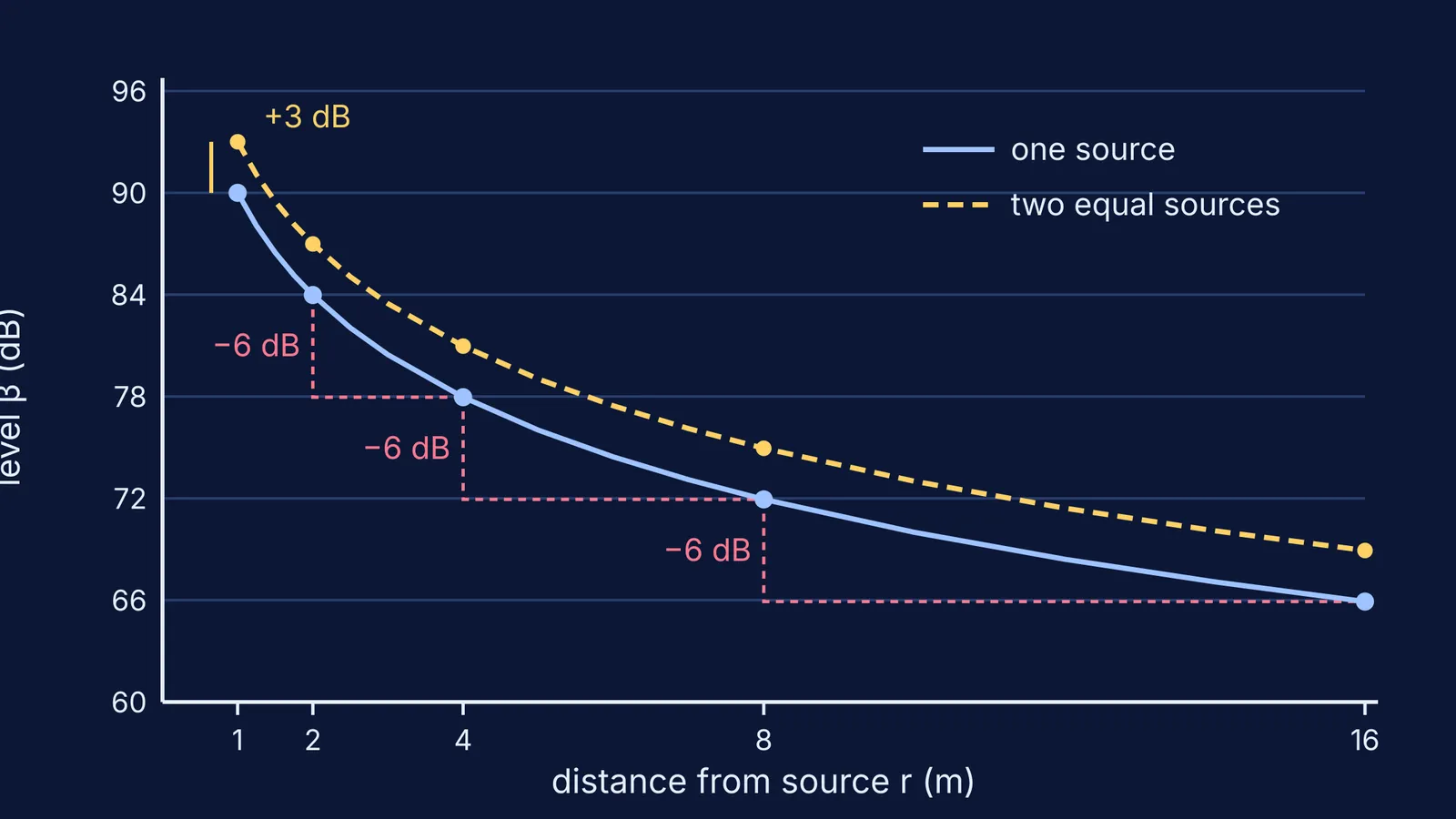
About 3 dB: a sound twice as intense as another is about 3 dB higher, 3.01 dB to be exact (OpenStax, Example 17.3). In symbols, β₂ − β₁ = 10 log(I₂/I₁) = 10 log 2 ≈ 3.01 dB.
The trap is amplitude. Intensity varies as the square of the pressure amplitude, I ∝ (Δp)² (OpenStax). So doubling the amplitude multiplies intensity by 4 and adds 10 log 4 ≈ 6.02 dB. In decibel terms, 10 log goes with intensity ratios and 20 log goes with amplitude ratios.
For a longer walk through the equal-source case, read why two equal sound sources add 3 dB.
How do you combine two sound sources in decibels?
Convert each level to an intensity with I = I₀ × 10^(β/10), which is the OpenStax definition rearranged, add, then convert back. For independent sources such as two machines or two people talking, the intensities add. (Two sources locked to the same frequency can interfere instead, which is a different problem; see beats versus interference of sound.)
Worked example 2. A 70 dB fan runs beside a 60 dB fridge.
Fan: I₁ = 10⁻¹² × 10⁷ = 1 × 10⁻⁵ W/m².
Fridge: I₂ = 10⁻¹² × 10⁶ = 1 × 10⁻⁶ W/m².
Total: I = 1.1 × 10⁻⁵ W/m².
β = 10 log(1.1 × 10⁷) = 70 + 10 log 1.1 ≈ 70.4 dB.
The quieter source barely moves the total. A combined level is never below the loudest source and, for two sources, never more than 3 dB above it.
Worked example 3. Three identical 80 dB sources give 80 + 10 log 3 ≈ 84.8 dB, not 240 dB.
How does sound intensity level change with distance?
From a point source with no reflections or reverberation, intensity follows the inverse square law (HyperPhysics, inverse square law for sound): the power spreads over a sphere of area 4πr², so I ∝ 1/r². In decibels that becomes β₂ = β₁ − 20 log(r₂/r₁). Doubling the distance drops the level by about 6 dB, and ten times the distance drops it by 20 dB (HyperPhysics).
Worked example 4. A speaker reads 90 dB at 2 m in an open field. At 8 m the distance ratio is 4, so β = 90 − 20 log 4 ≈ 90 − 12 = 78 dB. At 20 m the ratio is 10, so β = 90 − 20 = 70 dB.
Indoors, reflections keep the level higher; exam questions assume open air unless told otherwise.
Why does a 10 dB difference matter for your ears?
The World Health Organization says you can listen safely at 80 dB for up to 40 hours a week, and that at 90 dB the safe time drops to four hours a week (WHO, safe listening Q&A). That 10 dB step is ten times the intensity, and in WHO's figures the safe time falls to one-tenth. WHO also suggests keeping your device volume at no more than 60% of maximum.
A one-minute check before you write the answer
Did you use log base 10, not ln?
Did you add intensities, not decibels?
Is the ratio an intensity ratio (10 log) or an amplitude or distance ratio (20 log)?
Is the combined level at least the loudest source, and no more than 3 dB above it for two sources?
Does the answer sit sensibly between 0 dB (hearing threshold) and 120 dB (pain), the OpenStax reference points?
To practise these steps, the Fermi Problem Library has worked problems with a step-by-step solver that explains the reasoning rather than printing an answer. If logarithms or the inverse square law still feel shaky, start with the lesson in the Fermi Concept Library.


