

On this page
You have two logarithms with different bases, no calculator, and a question asking which one is larger. The trick is to never work out either value. Instead, you find a simple fraction that sits between them and check it with whole-number powers you can do in your head.
What rules make a logarithm comparison possible?
Three facts do all the work. Each one is stated in the free OpenStax Precalculus textbook.
Logs with a base above 1 are increasing. OpenStax describes y = log_b x as "increasing if b>1" and "decreasing if 0<b<1", with domain (0, ∞) (OpenStax, graphs of logarithmic functions). So for a base above 1, a bigger input gives a bigger log.
Change of base. For positive M, b and n with b ≠ 1 and n ≠ 1, log_b M = log_n M / log_n b (OpenStax, logarithmic properties).
Logs undo powers. The same page gives log_b(b^x) = x.
Put the first and third together and you get the only test you need.
Why: log_a b > p/q means b > a^(p/q), and raising both positive sides to the power q keeps the order, giving b^q > a^p.
How do you compare log₂3 and log₃5 step by step?
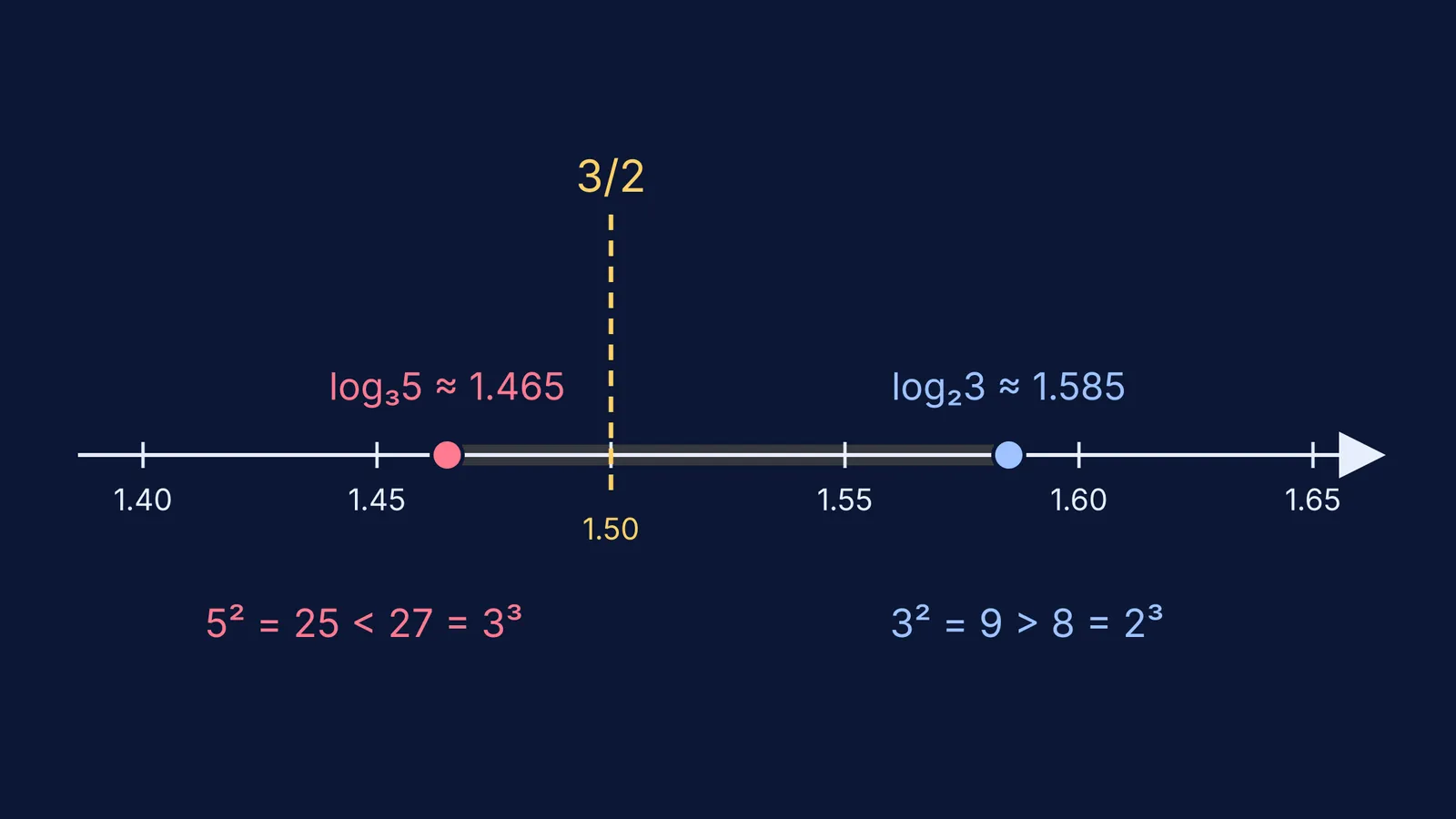
Estimate roughly. 3 lies between 2¹ and 2², so log₂3 is between 1 and 2. 5 lies between 3¹ and 3², so log₃5 is also between 1 and 2. Whole numbers do not separate them, so try the midpoint, 3/2.
Test log₂3 against 3/2. Compare 3² with 2³: 9 > 8, so log₂3 > 3/2.
Test log₃5 against 3/2. Compare 5² with 3³: 25 < 27, so log₃5 < 3/2.
Conclude: log₃5 < 3/2 < log₂3, so log₂3 is the larger one.
As a check, the On-Line Encyclopedia of Integer Sequences gives log₂3 = 1.58496… (OEIS A020857) and log₃5 = 1.46497… (OEIS A113209). The fraction 3/2 sits inside a gap of about 0.12.
How do you find the fraction that separates two logs?
Try whole numbers first, then halves, then thirds and quarters. Your rough estimates tell you where to look.
Take log₂5 and log₃10. Both lie between 2 and 3, because 4 < 5 < 8 and 9 < 10 < 27. Now look closer. 10 is barely above 3² = 9, so log₃10 is only a little over 2. 5 is well past 2² = 4, so log₂5 should be further above 2. That suggests a fraction just above 2, such as 9/4.
log₂5 against 9/4: compare 5⁴ = 625 with 2⁹ = 512. 625 > 512, so log₂5 > 9/4.
log₃10 against 9/4: compare 10⁴ = 10,000 with 3⁹ = 19,683. 10,000 < 19,683, so log₃10 < 9/4.
So log₂5 > log₃10.
What about close pairs like log₄5 and log₅6?
Some pairs are too close for a neat fraction. Use change of base and an inequality instead.
By change of base with n = 5, log₄5 = 1/log₅4. So log₅6 < log₄5 exactly when log₅4 × log₅6 < 1. Both factors are positive.
By AM-GM, the product of two positive numbers is at most the square of their average: log₅4 × log₅6 ≤ ((log₅4 + log₅6)/2)² = (log₅24 / 2)².
Since 24 < 25 = 5², log₅24 < 2, so the right side is less than 1.
So log₅6 < log₄5.
The same argument shows that log_n(n + 1) gets smaller as n grows, which settles a whole family of questions at once. If AM-GM is new to you, our guide to using the AM-GM inequality in JEE maths covers when it applies.
Which mistakes cost marks in log comparisons?
Ignoring a base below 1. OpenStax notes the log is decreasing when 0 < b < 1 (linked above), so every inequality flips. log₀.₅ of a bigger number is smaller.
Swapping the powers. log_a b > p/q means b^q > a^p, not b^p > a^q. The base gets the numerator.
Ignoring signs. The whole-number test needs both sides positive, and a log of a number below 1 (base above 1) is negative.
Stopping at a failed fraction. If 3/2 lands on the same side of both logs, try 4/3, 5/4 or 7/4 before reaching for decimals.
Practise on two more pairs, each with its separating fraction and integer check: compare log₂7 with log₃11 (use 5/2: 7² = 49 > 2⁵ = 32 and 11² = 121 < 3⁵ = 243), and log₃2 with log₅3 (use 2/3: 2³ = 8 < 3² = 9 and 3³ = 27 > 5² = 25).
If you keep getting the direction of an inequality wrong, the Fermi Problem Library has worked problems with a step-by-step solver that explains the reasoning rather than printing an answer, so you can see exactly which line flipped. If the rules themselves feel shaky, the Fermi Concept Library gives each concept in mathematics its own lesson.
For the story behind these tools, read how John Napier turned multiplication into addition and how Henry Briggs computed the first base-10 logarithms by hand.


