

On this page
If you place a 60-decibel (dB) speaker next to another 60 dB speaker, the resulting wall of sound will not be 120 dB. Instead, the combined sound level of two equal sound sources is about 63 dB (HyperPhysics). This counterintuitive math happens because human hearing covers an enormous range of physical pressures, so scientists use a logarithmic scale to measure it. In a logarithmic system, you cannot simply add the numbers arithmetically.
How do you find the combined sound level of two equal sound sources?
When you combine two identical sound sources, the total sound level increases by about 3 decibels (HyperPhysics). This rule applies regardless of how loud the initial sources are.
For instance, if one violin produces 70 dB of sound, two violins playing at the same volume will produce 73 dB. If you add two factory machines that each run at 90 dB, the combined noise level is 93 dB. You are doubling the physical energy, but on the decibel scale, a doubling of acoustic power always translates to a simple +3 dB addition.
If you struggle with the distinction between physical properties and what we measure, the Fermi Concept Library holds every concept in physics, chemistry, biology, mathematics and computing, each with its own lesson and its place in the map.
Why does doubling the sound intensity only add 3 dB?
The decibel is not a direct measure of physical energy; it is a ratio. To find out why the numbers behave this way, you have to look at the formula for sound intensity level. The level in decibels is calculated as 10 times the base-10 logarithm of the ratio of a sound's intensity to a reference intensity.
When you bring in a second, identical sound source, you are multiplying the physical intensity by two. The mathematics of logarithms dictates that multiplying the value inside the logarithm by two is equivalent to adding the logarithm of two to the total. Since the base-10 logarithm of 2 is approximately 0.301, multiplying that by 10 gives roughly 3.01. This is why doubling the intensity adds 3 dB to the measurement.
If you need a refresher on how intensity relates to waves in general, our post on the energy density and intensity of an EM wave explores the underlying equations.
What happens when you add two different sound levels?
In the real world, you rarely add two identical sources. Usually, one machine, voice, or speaker is louder than the other. Because the scale is logarithmic, the louder source dominates the total energy. If one sound is much louder than the other, the quieter sound is effectively drowned out and adds almost nothing to the final measurement.
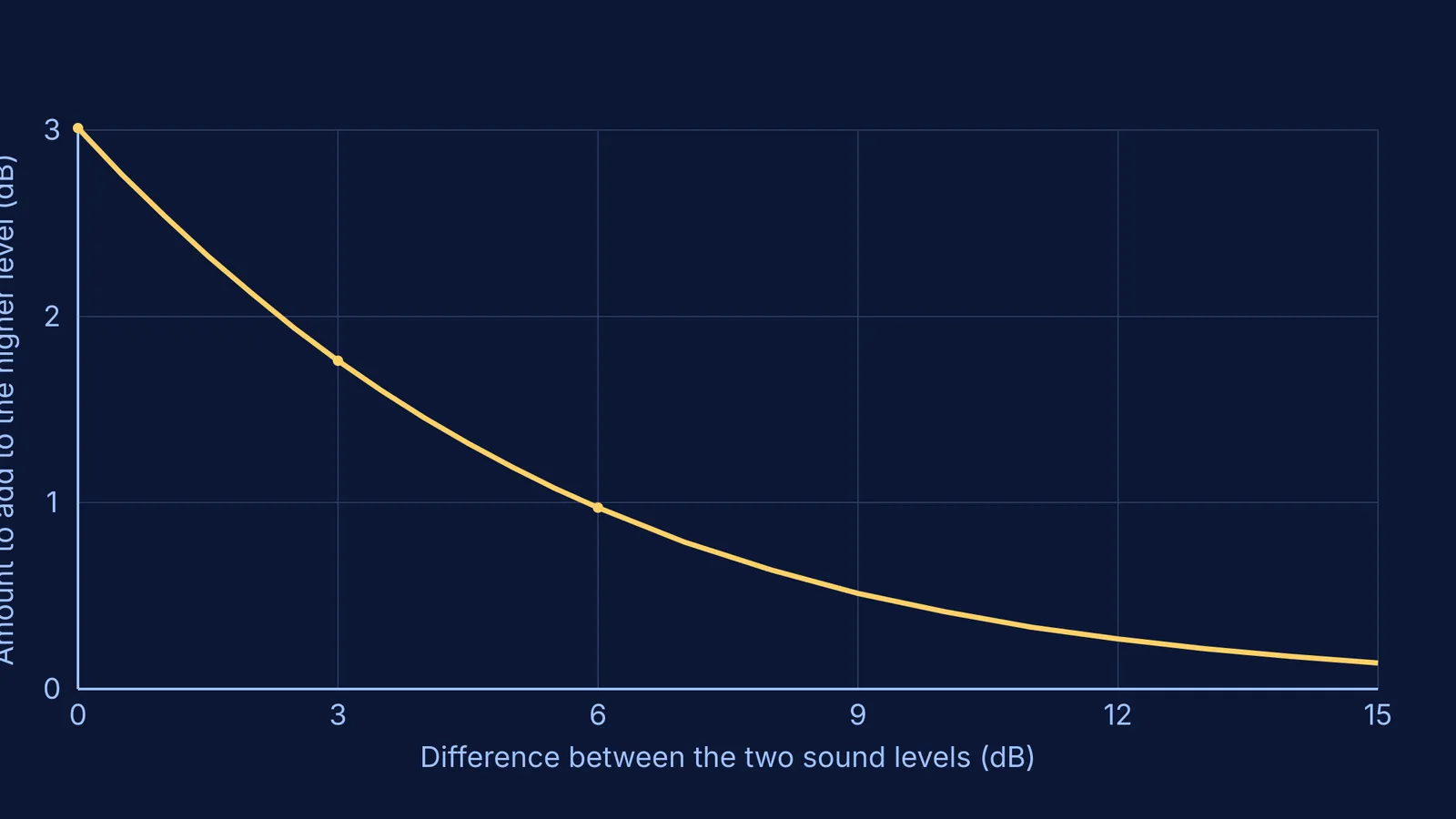
To estimate the total sound level without a calculator, engineers use a practical framework derived from logarithmic addition (HyperPhysics) known as the decibel addition checklist.
Find the difference in decibels between the two sound sources.
Apply the following correction to the louder of the two sounds:
Difference of 0 to 1 dB: add 3 dB to the higher number.
Difference of 2 to 3 dB: add 2 dB to the higher number.
Difference of 4 to 9 dB: add 1 dB to the higher number.
Difference of 10 dB or more: add 0 dB.
For example, if you are adding an 80 dB machine and a 75 dB machine, the difference is 5 dB. According to the checklist, you add 1 dB to the higher number, giving a total of 81 dB. If you are adding an 80 dB machine and a 65 dB machine, the 15 dB difference means the total remains 80 dB.
For students calculating sound problems step by step, the Fermi Problem Library provides worked problems with a step-by-step solver that explains the reasoning rather than printing an answer.
Is a 3 dB increase twice as loud?
It is easy to assume that because two sources double the energy, they must sound twice as loud. This is not the case. Human ears compress loud sounds so that we can hear a pin drop and still survive a thunderclap without instant damage.
While a 3 dB increase doubles the physical energy, it takes about 10 times the physical intensity for a sound to be perceived as twice as loud (HyperPhysics). Therefore, you would need ten 60 dB speakers—not two—to create a sound that your brain interprets as being twice as loud as a single speaker.
This distinction between intensity and perceived loudness frequently traps students in exams. You have to read the question carefully to see whether it asks about the physical intensity, the sound level in decibels, or the perceived volume. When questions ask you to convert between displacement waves and pressure waves, the phase changes too, which we break down in our guide on displacement and pressure waves in sound.


