

On this page
Interference is the general term for what happens when two or more waves overlap in the same medium. According to OpenStax University Physics, when waves are in phase, their amplitudes add together (constructive interference), making the sound louder [[1]](https://openstax.org/books/university-physics-volume-1/pages/16-5-interference-of-waves). When they meet out of phase, they cancel each other out (destructive interference), creating quiet spots or complete silence. This principle applies to all types of waves, including light waves, water ripples, and sound traveling through the air.
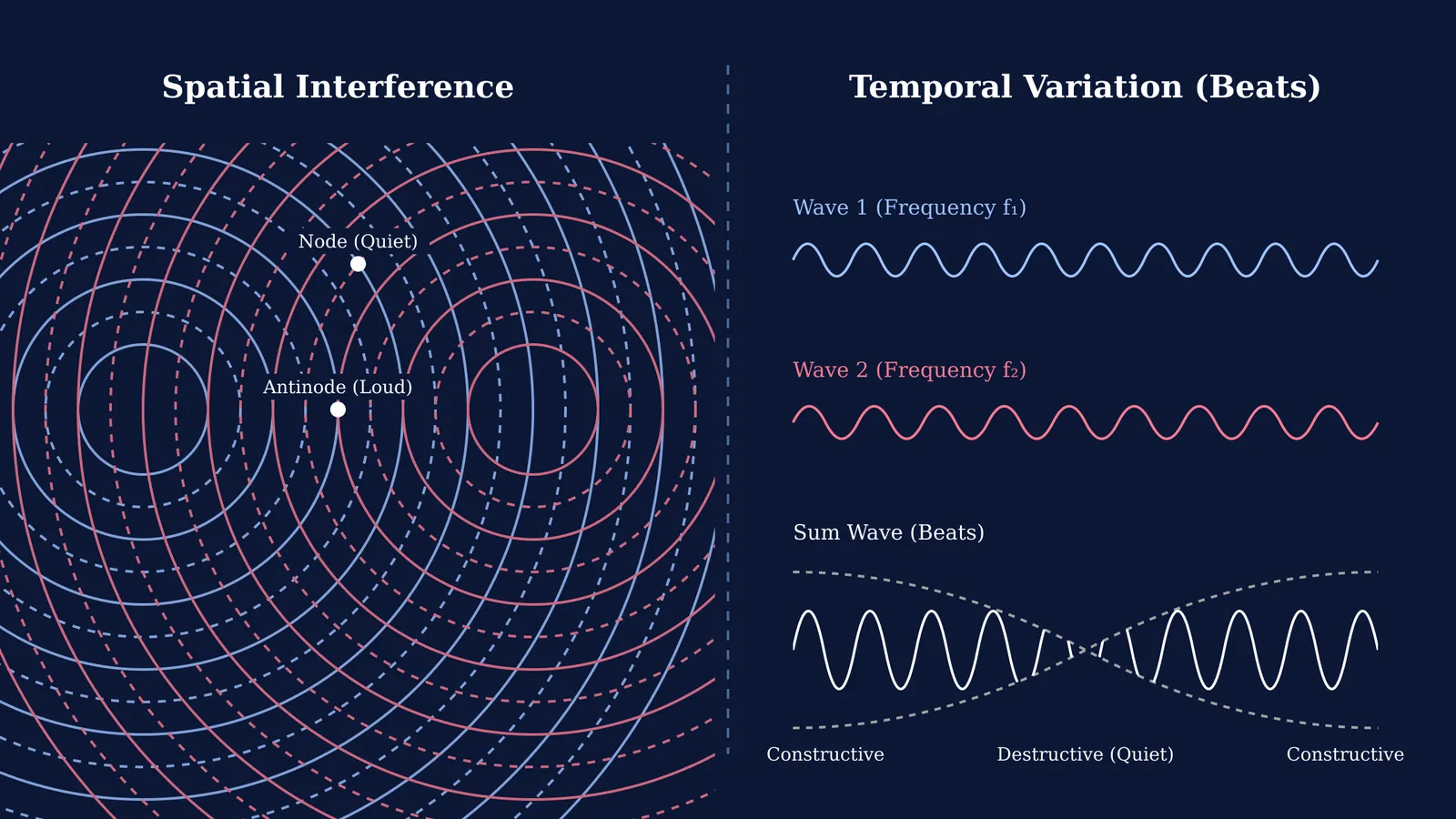
If you have two identical speakers playing the exact same continuous tone (equal frequency), the interference creates a fixed pattern in the room. Walking around, you would find specific locations where the sound is loud and others where it is faint. The pattern exists in space, not in time. If you stand perfectly still in one of the quiet zones, the sound will remain continuously quiet as long as the speakers are playing, because the crests and troughs from the two sources are constantly cancelling each other out at your exact location.
What are beats in sound?
Beats are a specific kind of interference. Instead of waves with the exact same frequency, beats occur when two sound waves with slightly different frequencies overlap. This slight difference in frequency means that the two waves are travelling through the air at slightly different rates of oscillation.
Because the frequencies are not perfectly matched, the waves continuously drift in and out of phase. At one moment, their crests align and the sound is loud. A fraction of a second later, a crest meets a trough and the sound fades. This creates a periodic "throbbing" or wavering in the volume at a single location, rather than a pattern of quiet spots spread across a room. This distinct, rhythmic pulsing is what musicians listen for when tuning instruments together—when the beats disappear, the frequencies are perfectly matched.
The rate at which the volume rises and falls is the beat frequency (f_beat). It is exactly equal to the absolute difference between the two original frequencies (f₁ and f₂): f_beat = |f₁ - f₂|
If a tuning fork rings at 256 Hz and another at 254 Hz, you will hear a beat frequency of 2 Hz, meaning the sound swells and fades twice every second.
What is the difference between beats and interference of sound?
The key differences lie in frequency requirements and how you experience the result.
Frequencies involved: Standard spatial interference requires two sources emitting the exact same frequency. Beats require two sources emitting slightly different frequencies.
Where the pattern forms: Interference creates a stationary pattern of nodes (quiet) and antinodes (loud) distributed through space. Beats create a pattern in time, where the loudness fluctuates at any fixed position.
What you hear: If you sit still during standard interference, the volume you hear is constant. If you sit still during a beat phenomenon, the volume pulses up and down.
If you are struggling to picture how overlapping lines create these patterns, the Fermi Simulation Lab has interactive simulations for the ideas that are easier to see than to read. You can pause the waves and measure the crests directly.
Why is there a 10 Hz limit for human hearing?
While beats happen mathematically for any two frequencies, you cannot always hear the distinct pulses.
According to the NCERT Class 11 Physics textbook, the human ear can only distinguish beats if the frequency difference is 10 Hz or less [[2]](https://ncert.nic.in/ncerts/l/keph214.pdf). This is due to the persistence of hearing—our ears retain a sound impression for about 1/10th of a second. If the beats arrive faster than 10 times a second, they blend together into a rough, continuous tone rather than distinct pulses. When the frequency difference grows even larger, such as 50 Hz or 100 Hz, your brain stops interpreting the sound as a single wavering note. Instead, you begin to hear two entirely distinct musical pitches playing simultaneously, along with a complex buzzing sensation.
If you need a refresher on wave mechanics or frequency ranges, the Fermi Concept Library contains every concept in physics, chemistry, biology, mathematics and computing, each with its own lesson and its place in the map.
If you are confused by how these wave principles overlap with other physics topics, reviewing displacement and pressure waves in sound or understanding phase difference vs path difference can clear up the math.


