

On this page
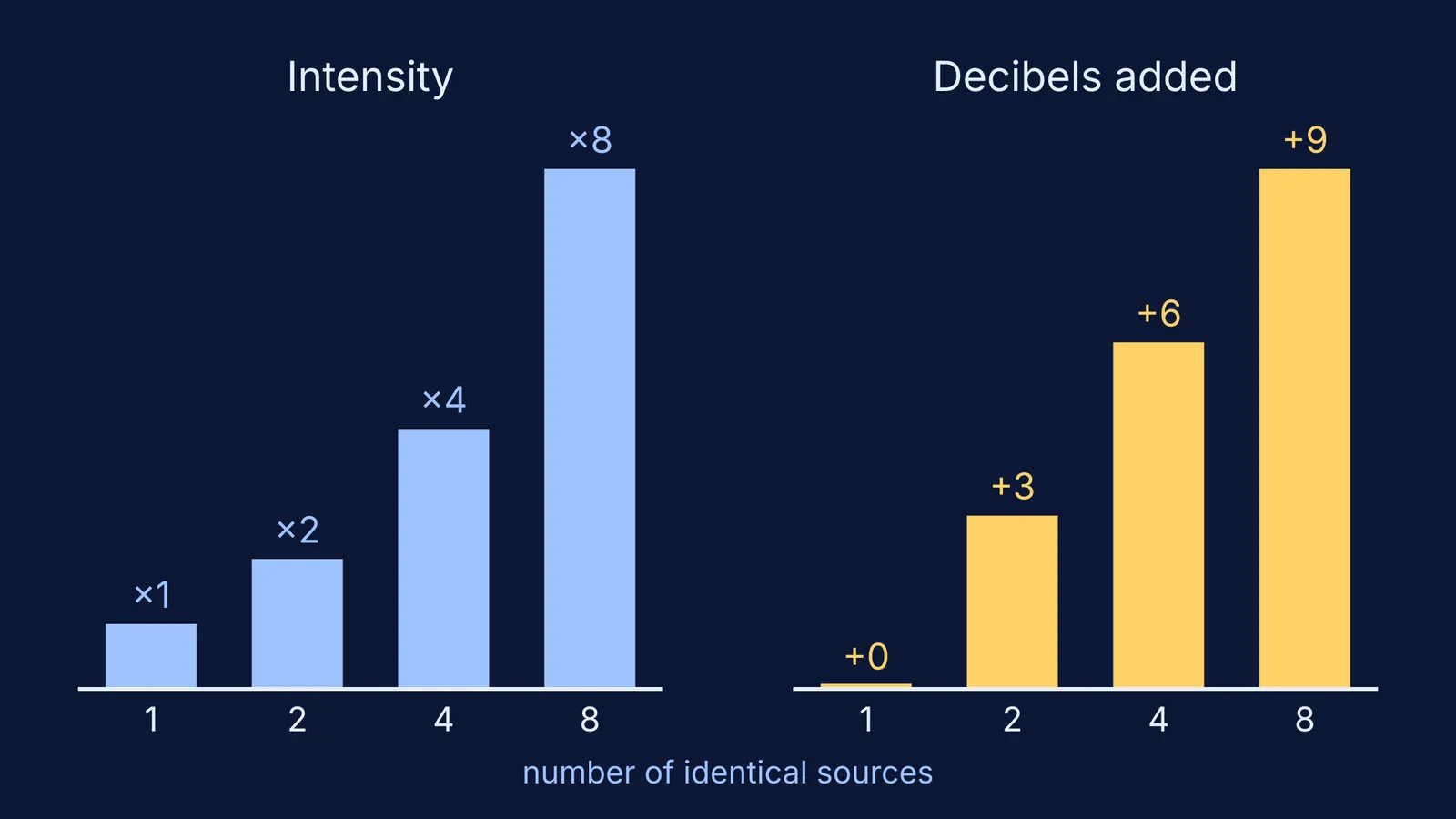
Put two identical speakers side by side, each reading 60 dB on a sound meter, and the meter does not show 120 dB. It shows about 63, because doubling the intensity adds about 3 dB (OpenStax College Physics). Ten speakers give 70. The diagram above shows the whole idea: intensity doubles at each step, while the decibel reading climbs in equal 3 dB steps.
Why is the decibel scale logarithmic?
Sound intensity level is defined as β = 10 log10(I/I0), where I0 = 10^-12 W/m² is the reference intensity, the threshold of hearing at 1000 Hz (OpenStax College Physics). On this scale the threshold of hearing sits at 0 dB, and a nominal threshold of pain sits at about 130 dB, though some sources quote 120 dB (HyperPhysics: Sound intensity).
The reason for the logarithm is range. Sound intensity varies by a factor of about 10^12 between the faintest sound you can hear and a sound that causes damage in seconds (OpenStax College Physics). The logarithm turns every factor of 10 into a step of 10 dB, so that whole range fits between 0 and 120 dB.
Read the formula backwards and every 10 dB is a factor of ten in intensity: 20 dB is 100 times the threshold intensity, and 60 dB is a million times.
How many decibels does doubling the sources add?
Identical, unrelated sources, such as two fans or two people talking, add their intensities, not their decibel values. Two sources give twice the intensity, so the level rises by 10 log10(2) = 3.01 dB, which OpenStax rounds to about 3 dB for any doubling (OpenStax College Physics).
Here is a worked example you can do on paper. The same OpenStax table lists normal conversation at 60 dB and a noisy office or busy traffic at 70 dB. Cover the answers and predict each one first:
Two people talking at 60 dB each: intensity times 2, so 60 + 3 = 63 dB.
Four people: times 4 is two doublings, so 66 dB.
Ten people: times 10, so 70 dB, the level of busy traffic.
A hundred people: times 100, so 80 dB.
Three people: 10 log10(3) = 4.77, so about 64.8 dB.
The classic wrong answer is 60 + 60 = 120 dB. We have a longer walkthrough of why two equal sound sources add 3 dB, and if the log step itself feels shaky, practise solving exponential equations with logarithms first. The same thinking explains distance too: see how the amplitude of a spherical wave varies with distance.
Why does ten times the intensity sound only twice as loud?
Loudness is what your ear and brain report, and it is not the same thing as intensity. HyperPhysics, in what it calls an approximate statement based on a great deal of investigation of average human hearing, says a sound "must be increased in intensity by a factor of ten for the sound to be perceived as twice as loud", and warns that it "is not to be taken as a hard and fast rule" (HyperPhysics: Loudness). Its explanation is that nerve cells have maximum firing rates, so doubling the sound energy reaching the inner ear does not double the nerve signal sent to the brain.
Combine that with the decibel scale and you get a handy rule of thumb: +10 dB sounds about twice as loud. So the ten people in the example (70 dB) sound roughly twice as loud as one person, and a hundred people (80 dB) roughly four times as loud. Doubling the number of sources, +3 dB, is noticeable but nowhere near twice as loud.
What does this mean for your earphones?
Because decibels hide multiplication, small-looking changes are big ones. WHO's safe listening guidance says you can listen at 80 dB for up to 40 hours a week, at 90 dB for about four hours a week, and at 100 dB for about 20 minutes a week (WHO: Safe listening). Ten more decibels means ten times the intensity and roughly a tenth of the safe time.
The US National Institute for Occupational Safety and Health (NIOSH) applies the same logic at work: for every 3 dBA increase in noise, it recommends halving the exposure time (NIOSH: Noise). That is the doubling-adds-3-dB rule in action.
WHO's everyday advice is to set your device volume to no more than 60% of maximum.
How can you practise decibel problems?
Decibels click faster when you predict the number before you calculate it. Use this three-step check on every problem:
Predict: how many times did the intensity change? Count the doublings and the factors of ten.
Compute: add 10 log10 of that ratio to the starting level.
Translate: use +10 dB as roughly twice as loud to say how it would sound.
The Fermi Simulation Lab has interactive simulations for ideas that are easier to see than to read, which suits this predict-then-check habit. If a numerical goes wrong at the log step, the Fermi Problem Library has worked problems with a step-by-step solver that explains the reasoning rather than printing an answer.
Next time someone says two speakers make it twice as loud, you can tell them the real answer: 3 dB louder, and nowhere near twice.


