

On this page
When you study waves in physics, it is easy to confuse how intensity and amplitude behave as they travel away from a source. While intensity drops rapidly for a point source, the wave's amplitude follows a different mathematical rule. Understanding this difference will help you solve problems involving sound, light and electromagnetic fields, and it prevents a common mistake in exam numericals where students apply the inverse-square law to the wrong variable.
What is the inverse-square law for waves?
To understand how amplitude changes, you first need to look at how energy spreads. When a point source—such as a small light bulb or a tiny speaker—emits energy, it spreads outward evenly in three-dimensional space as a spherical wave. As the wave travels outward, its energy is distributed over the surface of a growing sphere.
The surface area of a sphere is given by the formula 4πr², where r is the distance from the source. Because the total power emitted by the source remains constant (assuming no energy is absorbed by the air or space), this fixed amount of power must spread over a surface area that grows as r². Consequently, the intensity of radiation passing through any unit area is inversely proportional to the square of the distance from the point source (source).
This geometric dilution is the essence of the inverse-square law. It means that doubling your distance from the source spreads the same energy over four times the area, dropping the intensity to one-quarter of its original value.
How does the amplitude of a spherical wave vary with distance?
Intensity is defined in physics as the power transferred per unit area (source)). For any wave, whether mechanical or electromagnetic, a fundamental rule states that the intensity of a wave is proportional to the square of its amplitude (source)).
We know two facts:
The intensity of a spherical wave falls as 1/r².
The intensity is proportional to amplitude squared (I ∝ A²).
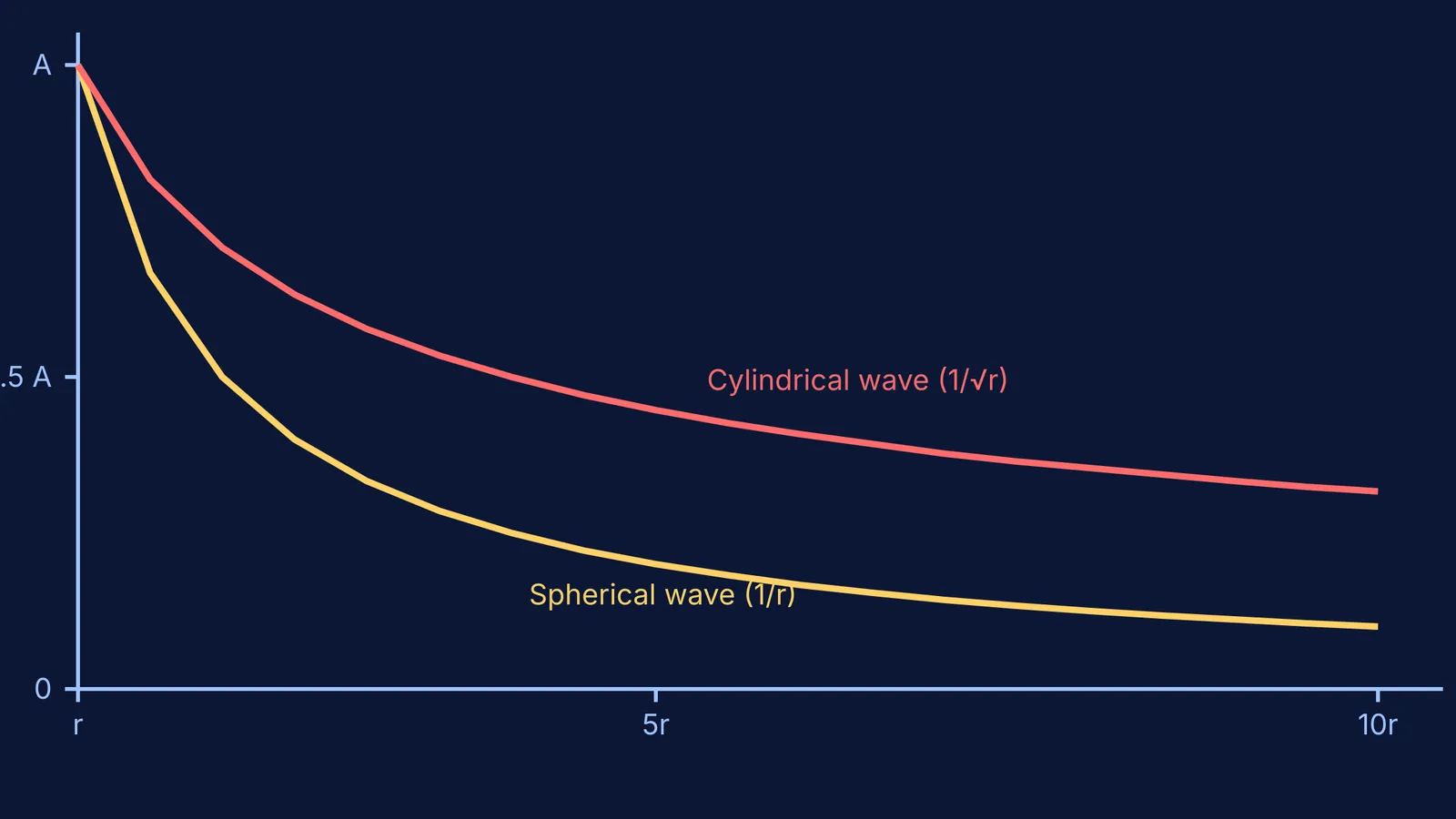
If we combine these, we can set amplitude squared proportional to 1/r². Taking the square root of both sides gives us the crucial result: the amplitude must be proportional to 1/r.
Therefore, the amplitude of a spherical wave varies inversely with the distance from the source. If you move three times further away from a point source, the wave's amplitude becomes one-third of what it was, even though the intensity drops to one-ninth. When a student is trying to piece together how energy and amplitude connect, the Fermi Concept Library explains every concept in physics, chemistry, biology, mathematics and computing, each with its own lesson and its place in the map.
Why does a cylindrical wave go as 1/√r?
Not all waves spread in all directions as spheres. If you have an infinitely long line source—like a straight radio antenna, a linear slit, or a tall stack of loudspeakers—the wave spreads outward as a expanding cylinder.
For a cylindrical wave, the energy is distributed over the curved surface of a cylinder. The area of this curved surface is 2πrL, which grows in direct proportion to the radius r, not the square of the radius. Because the power spreads over an area proportional to r, the intensity of a cylindrical wave is inversely proportional to the distance (1/r) (source).
Since intensity is still proportional to the square of the amplitude (I ∝ A²), the amplitude squared must be proportional to 1/r. Taking the square root reveals that the amplitude of a cylindrical wave falls as 1/√r. Because the energy is only diluting in two dimensions rather than three, a cylindrical wave fades much more slowly than a spherical wave.
A worked example: comparing the drop-off
To see how this works in an exam scenario, let us compare the numbers for a point source and a line source. Imagine two sources that each produce a wave with an amplitude of 100 units at a starting distance of 1 metre.
At 4 metres from the spherical point source: The distance has increased by a factor of 4. The amplitude drops as 1/r, so the new amplitude is 100 / 4 = 25 units. The intensity here has dropped by a factor of 16.
At 4 metres from the cylindrical line source: The distance has increased by a factor of 4. The amplitude drops as 1/√r, so the new amplitude is 100 / √4 = 100 / 2 = 50 units. The intensity here has only dropped by a factor of 4.
At the same distance, the cylindrical wave's amplitude is twice as large as the spherical wave's amplitude, demonstrating why line arrays are used in concerts to throw sound further without losing as much volume.
If you find yourself stuck on when to use which formula, the Fermi Problem Library offers worked problems with a step-by-step solver that explains the reasoning rather than printing an answer. Recognizing the source geometry is a key step, whether you are calculating the Energy density in an electric field: u = ε₀E²/2 worked or dealing with the mathematics of Displacement and pressure waves in sound: the 90° phase shift.


