

On this page
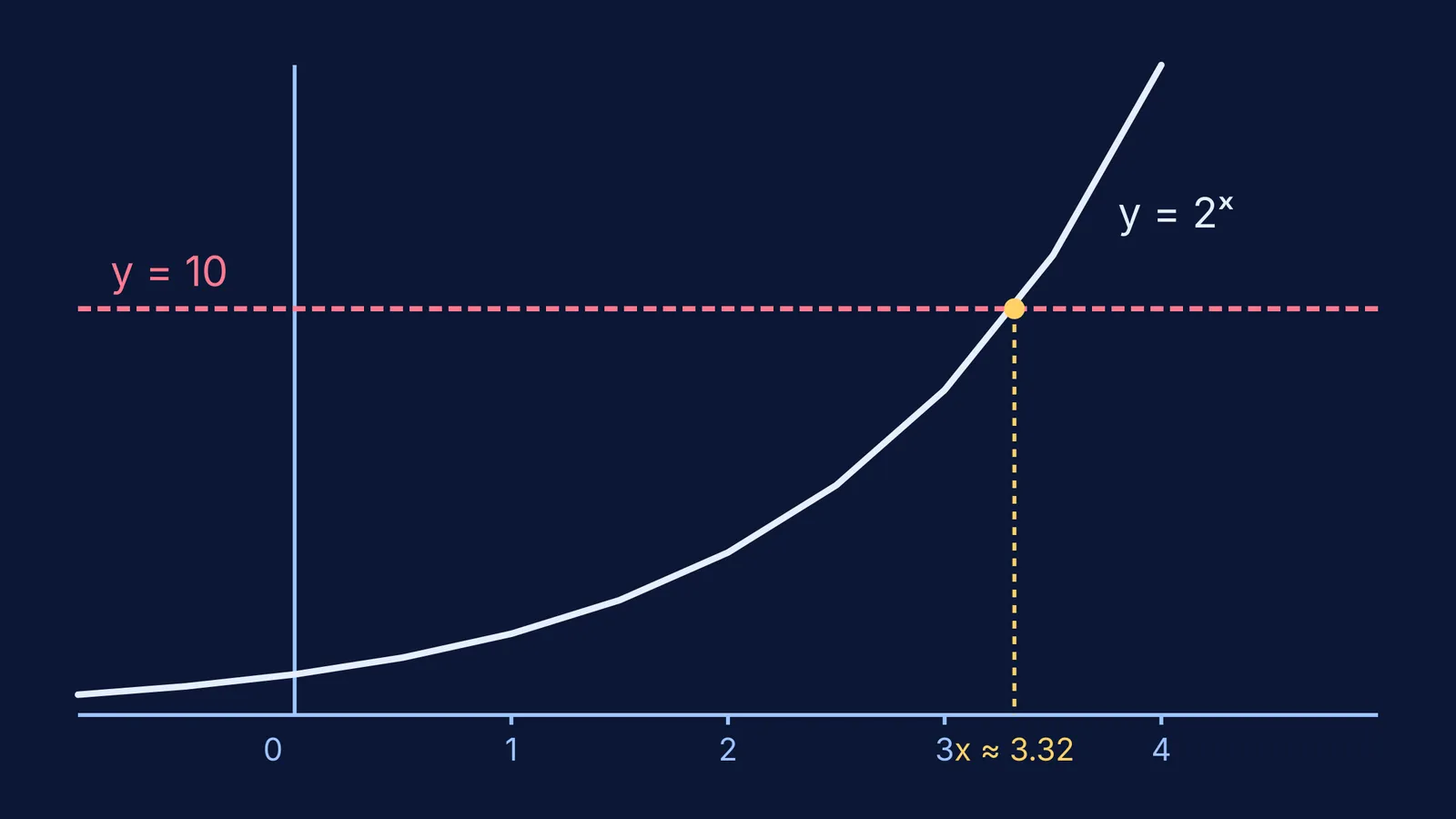
When you have an equation like 2³ = 8 or 2⁴ = 16, finding the exponent is just a matter of knowing your powers. But what if the equation is 2ˣ = 10? The answer is not an integer. We know it must sit somewhere between 3 and 4 because 10 is between 8 and 16, but to find the exact value, we need a mathematical tool to rescue the variable from the exponent.
How do you solve 2 power x equals 10?
The defining feature of a logarithm is its ability to undo an exponent. The logarithm of a number is the exponent by which a base must be raised to produce that number (Wikipedia). We can use this property to bring the unknown down to the main line of the equation, making it possible to solve with standard algebra.
Here is the step-by-step method:
Take the logarithm of both sides: log(2ˣ) = log(10)
Apply the power rule: The logarithmic rule log(aᵇ) = b log(a) allows you to pull the exponent out to the front. This is the crucial step that frees the variable, giving x log(2) = log(10).
Divide to isolate x: Treat log(2) and log(10) just like any other numbers. Divide both sides by log(2) to get x = log(10) / log(2).
If you are using the common logarithm (base 10), log₁₀(10) is exactly 1 because 10¹ = 10. The equation simplifies nicely to x = 1 / log₁₀(2). Plugging this into a scientific calculator gives x ≈ 3.322.
If you make a mistake in these algebraic steps, the Fermi Problem Library has worked problems with a step-by-step solver that explains the reasoning rather than printing an answer, catching algebraic errors before they become ingrained habits.
How do you solve equations with x on both sides?
Equations like 3ˣ = 5ˣ⁻¹ look significantly more complicated, but the core method remains exactly the same. The only difference is that you must collect terms after taking the logs, much like you would when solving a linear equation with x on both sides.
Take the log of both sides: log(3ˣ) = log(5ˣ⁻¹)
Pull down the exponents: Remember to keep the (x − 1) in brackets so you multiply the whole expression by log(5), giving x log(3) = (x − 1) log(5).
Expand the brackets: Distribute the log(5) across the terms inside the parentheses to get x log(3) = x log(5) − log(5).
Collect the x terms: Move all terms containing x to one side of the equation. Subtracting x log(5) from both sides gives x log(3) − x log(5) = −log(5). Alternatively, to avoid negative signs, move x log(3) to the right and −log(5) to the left to get log(5) = x log(5) − x log(3).
Factor out x and solve: Pull x out as a common factor on the right-hand side, log(5) = x (log(5) − log(3)). Finally, divide to leave x isolated: x = log(5) / (log(5) − log(3)).
Does it matter which logarithm base you use?
A common point of confusion is whether to press the "log" button (base 10) or the "ln" button (base e) on your calculator. The answer is that it does not matter, as long as you use the same base on both sides of the equation.
Because of the mathematical change of base formula, calculating ln(10) / ln(2) will yield the exact same numerical result (3.322) as calculating log₁₀(10) / log₁₀(2). In calculus and advanced physics, the natural logarithm is almost always preferred because its derivative is simply 1/x, but for solving basic algebraic equations, the common logarithm works just as well.
What is the general method for exponential equations?
Whenever the variable you need to find is trapped inside an exponent, you can rely on this predictable sequence of steps to solve the equation:
Isolate the base: If there is a coefficient in front of the exponential term, divide by it first. For example, to solve 4 × 2ˣ = 40, divide by 4 to get 2ˣ = 10 before taking any logarithms.
Log both sides: Apply ln or log₁₀ to the left and right sides simultaneously.
Pull down the exponent: Use the logarithmic power rule to turn the exponent into a simple multiplier on the main line.
Collect the terms: Gather every algebraic term containing an x on one side of the equals sign.
Factor and divide: Factor out x and divide by the remaining bracket to completely isolate your final answer.


