

On this page
Stand next to a Punjabi dhol during a festival, and you feel the sound in your chest: a deep, low-frequency boom. By contrast, a tabla's right-hand drum (*dayan*) rings out with a crisp, bell-like tone. Both instruments produce sound through a stretched hide vibrating over an acoustic shell, yet their voices sit at opposite ends of the pitch spectrum. Why a dhol sounds much deeper than a tabla comes down to circular membrane mechanics: diameter, mechanical tension, and surface mass density.
Why does a big dhol sound deeper than a small drum?
In acoustics, bass corresponds to low pitch and treble to high pitch. Pitch depends on fundamental frequency—the number of oscillations per second in hertz (Hz). As explained in the NCERT Class 8 Science curriculum on Sound, a body vibrating rapidly produces a high-pitched note, whereas a body oscillating slowly produces a deep tone. You can review these foundations in our guide to sound, vibration, and pitch in Class 8.
When struck, a drumhead generates transverse waves that reflect from the clamped rim to form standing waves. Physicist Thomas D. Rossing showed that the fundamental frequency of a clamped circular membrane of diameter *D* follows the two-dimensional wave equation (Rossing, 1992):
f = (0.7655 / D) × √(T / σ)
Here, *T* is surface tension in newtons per metre (N/m), and *σ* is surface mass density in kilograms per square metre (kg/m²). The factor 0.7655 equals the first Bessel zero (α₀₁ ≈ 2.4048) divided by π (Rossing, 1992). Because diameter *D* sits in the denominator, a larger drumhead forces the membrane to oscillate more slowly, lowering the pitch.
How do membrane size, tension, and mass determine frequency?
This relationship reveals three physical levers that govern drum pitch:
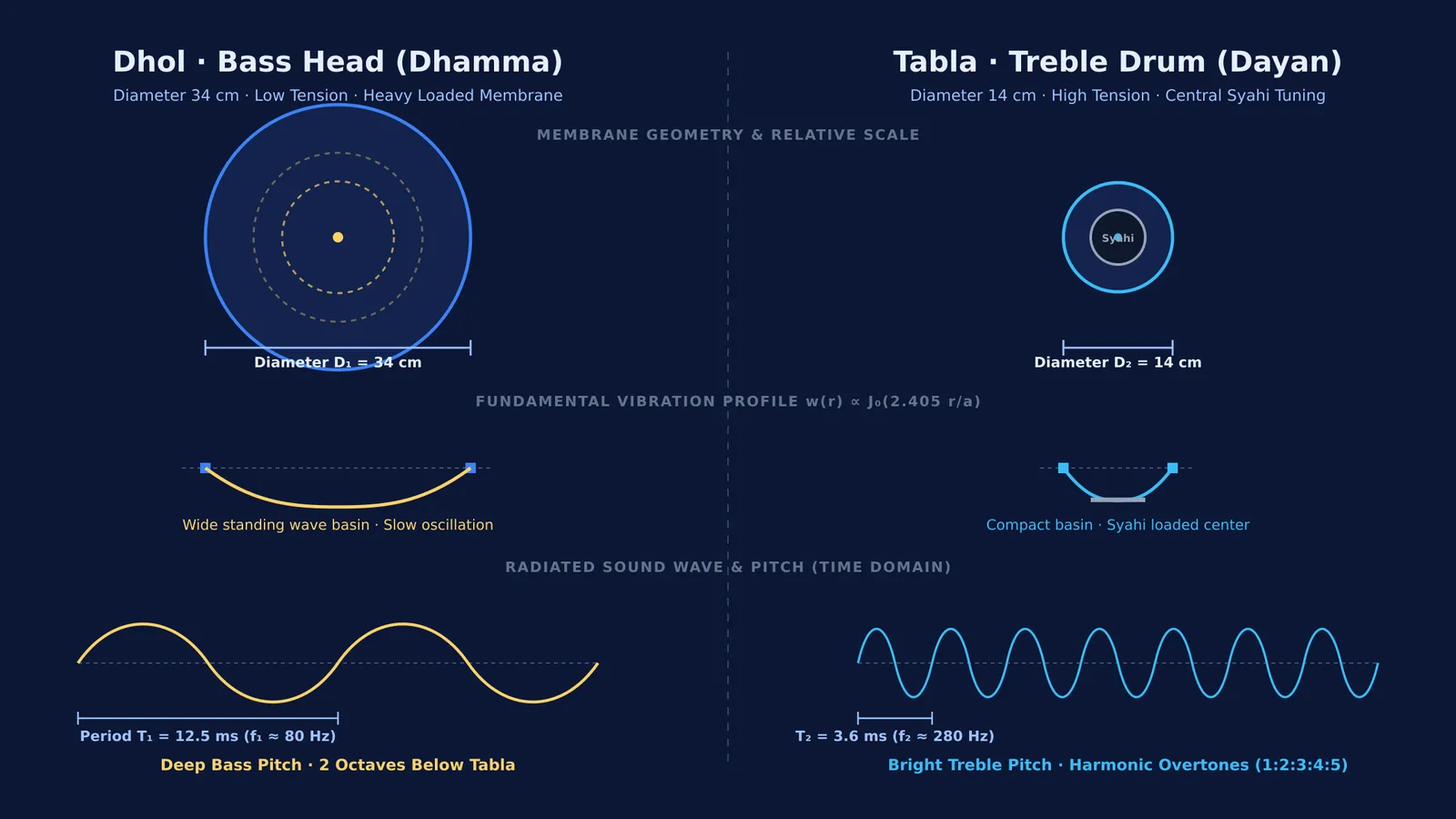
Diameter (*D*): Frequency is inversely proportional to diameter. The bass head (*dhamma*) of a Punjabi dhol measures 30 cm to 38 cm across (Rossing, 1992), while a tabla's *dayan* measures only 13 cm to 15 cm. Doubling diameter cuts fundamental frequency in half on size alone.
Tension (*T*): Frequency scales with the square root of tension. Tabla makers tighten the *dayan* with braided leather straps (*baddhi*) and wooden pegs (*gatta*). A dhol's bass head is laced loosely, creating a weaker restoring force, similar to the tension effects shown in sonometer experiments on frequency and tension.
Surface mass density (*σ*): Frequency is inversely proportional to the square root of skin mass per unit area. A dhol's bass head uses thick hide loaded with *dholak masala*—a heavy paste of oil, soot, and resin. This added inertia lowers the fundamental into the 60 Hz to 100 Hz bass range (Rossing, 1992).
When students struggle to picture how boundary conditions and tension shape two-dimensional vibration modes, the Fermi Simulation Lab provides interactive simulations for the ideas that are easier to see than to read, allowing learners to adjust membrane tension, radius, and density to observe standing waves in real time.
What makes the tabla ring while the dhol thumps?
Size and tension explain pitch height, but not why a tabla rings musically while a dhol produces a thud. That musical difference was solved by Indian physicist C. V. Raman.
In an ordinary membrane, boundary conditions produce inharmonic overtones. In *Nature*, C. V. Raman and Sivakali Kumar showed that uniform circular membranes produce higher modes at irrational frequency ratios—roughly 1.59, 2.14, 2.30, and 2.65 times the fundamental (Raman & Kumar, 1920). Because these frequencies do not form integer ratios, their sound waves clash and decay into a percussive thump.
Raman later showed in the *Proceedings of the Indian Academy of Sciences* how Indian craftsmen overcame this limit (Raman, 1934). By applying a black patch called the *syahi*—made of iron oxide, soot, and starch—in concentric layers to the center of the skin, craftsmen load the membrane non-uniformly. Raman demonstrated that this loading shifts the first nine vibration modes into five harmonic frequencies with integer ratios 1 : 2 : 3 : 4 : 5. The overtones reinforce one another like the harmonics of a string, as explored in our guide to standing waves and harmonic modes.
For students solving physics problems on wave mechanics, the Fermi Problem Library offers worked problems with a step-by-step solver that explains the reasoning rather than printing an answer.
How do real dhol and tabla frequencies compare?
To see how these variables interact, consider a quantitative comparison between a dhol bass head and a tabla *dayan*.
Suppose a Punjabi dhol bass head has diameter D₁ = 0.34 m, surface density σ₁ = 1.20 kg/m², and loose tension T₁ = 1,500 N/m (Rossing, 1992). The membrane wave speed is v₁ = √(1,500 / 1.20) ≈ 35.36 m/s. Its fundamental frequency is:
f₁ = (0.7655 / 0.34) × 35.36 ≈ 79.6 Hz
Now consider a tabla *dayan* with diameter D₂ = 0.14 m, membrane density σ₂ = 0.40 kg/m², and tight tension T₂ = 6,000 N/m. The wave speed is v₂ = √(6,000 / 0.40) ≈ 122.47 m/s. With the central *syahi* loading accounted for, the tuned fundamental note rings near 280 Hz, close to C#4 (Raman, 1934; Rossing, 1992).
Comparing 280 Hz to 79.6 Hz gives a frequency ratio of roughly 3.5 to 1. The dhol vibrates nearly four times more slowly, placing its fundamental pitch two octaves below the tabla.
Next time you hear a dhol and a tabla together, notice how diameter, tension, and skin mass directly shape the sound waves reaching your ears.


