On this page
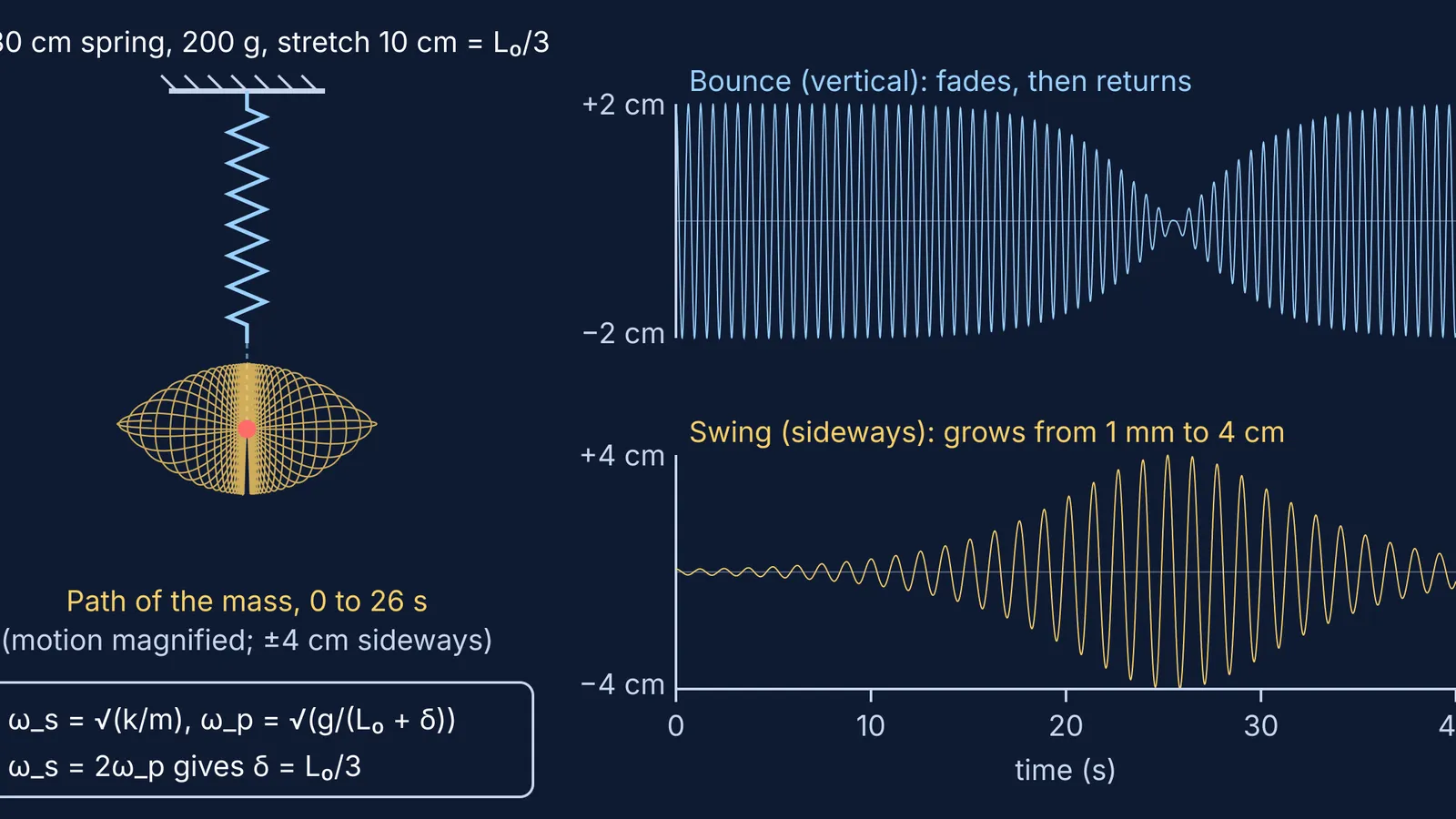
Hang a mass on a soft spring, pull it straight down and let go. You expect it to bounce up and down until friction stops it. With the right mass, it does something stranger. After a few seconds the bounce starts to die and the mass begins to swing from side to side like a pendulum. Then the swing fades and the bounce comes back. Physicists call this the swinging spring, or the elastic pendulum. The condition for it is simple: the weight must stretch the spring by one third of its natural length.
You have met energy passing back and forth between two pendulums joined by a spring. Here one object does it alone, between two kinds of motion. This post gives the frequency condition, works the numbers, and shows a step-by-step simulation.
What two motions can a mass on a spring have?
Take a light spring of natural length L₀ and stiffness k, with a mass m on the end. At rest the weight stretches it by δ = mg/k, so it hangs with length L₀ + δ.
Bouncing (up and down along the spring): ω_s = √(k/m). Since k = mg/δ, this is also ω_s = √(g/δ).
Swinging (side to side, as a pendulum of length L₀ + δ): ω_p = √(g/(L₀ + δ)).
For small motions these two are independent. For larger ones they are linked, because the spring's length changes the pendulum's length and the swing pulls on the spring.
Why does the bounce turn into a swing?
Watch one swing. The mass passes the bottom twice per swing, once going each way. Each time, it moves fastest and the spring is pulled hardest, so the spring tension rises twice per swing. So swinging drives the spring at twice the swing frequency.
The link works the other way too. If the spring bounces at exactly twice the swing frequency, the length of the pendulum changes in step with the swing, twice per cycle. That is the same trick as pumping a swing by standing and squatting: shorten the pendulum as it passes the bottom and lengthen it at the ends, and the swing grows. Here the bounce does the pumping by itself.
So energy flows from bouncing into swinging when
ω_s = 2ω_p
Peter Lynch and Conor Houghton describe exactly this in Physica D (2004): when the elastic and pendular frequencies are in a two-to-one ratio, energy is exchanged regularly between the two motions. The problem goes back to Vitt and Gorelik in 1933, and M. G. Olsson discussed it for students in the American Journal of Physics in 1976.
Why must the stretch be one third of the length?
Square the condition ω_s = 2ω_p:
g/δ = 4g/(L₀ + δ).
L₀ + δ = 4δ.
δ = L₀/3.
The mass and stiffness do not appear separately. Only the stretch matters. Any light spring will do it if you choose the mass so that it hangs one third longer than its natural length.
Worked example: a 30 cm spring and a 200 g mass
Take L₀ = 30 cm and m = 200 g, with g = 9.81 m/s².
Stretch needed. δ = L₀/3 = 10 cm, so the hanging length is 40 cm.
Stiffness needed. k = mg/δ = 0.200 × 9.81/0.10 = 19.6 N/m.
Bounce period. T_s = 2π√(δ/g) = 2π√(0.10/9.81) = 0.634 s.
Swing period. T_p = 2π√(0.40/9.81) = 1.269 s, exactly twice T_s.
Bounce energy. Pull the mass 2.0 cm straight down: ½kA² = ½ × 19.6 × 0.020² = 3.9 mJ.
Swing this could feed. A pendulum swing of amplitude x stores about ½m(g/ℓ)x². Setting this equal to 3.9 mJ with ℓ = 0.40 m gives x = √(2 × 0.0039/(0.200 × 24.5)) ≈ 4.0 cm.
Units check: √(δ/g) is √(m/(m/s²)) = s.
What does a step-by-step simulation show?
We integrated the full equations of motion (spring force along the spring, gravity down, no damping) with a small time step. Start: mass pulled 2.0 cm straight down, nudged 1 mm sideways, released from rest.
For the first 10 s, the sideways swing creeps up from 1 mm to about 4 mm. The bounce stays at 2.0 cm.
From 14 s to 22 s, the swing grows fast: 1.3 cm, then 2.4 cm, then 3.2 cm.
At about 26 s the swing peaks at 4.0 cm, as the energy estimate predicted, and the bounce has shrunk to about 0.5 cm.
Then it runs in reverse. By 40 s the swing is back under 1 cm and the bounce is back near 2 cm.
Now change only the spring, so that δ = 5 cm (L₀/6), with the same start. The bounce period is 0.449 s and the swing period 1.187 s, a ratio of 2.65, not 2. In the simulation the swing never grows beyond the 1 mm it started with, over the full 40 s. Off the 2:1 ratio, the bounce cannot pump the swing.
Why does it not work perfectly with a real spring?
The frequency condition assumes a light spring. A real spring's own mass lowers the bounce frequency (the m/3 correction is one way to estimate it), and the spring also swings as a body rather than as a thread. So the mass that gives resonance is a little different. Joseph Christensen worked out the correction in the American Journal of Physics in 2004.
Two more points:
A perfectly vertical start never swings. The swing has to grow from some small sideways motion. The smaller the nudge, the longer it takes.
Large motions get irregular. With big bounces the motion can wander and even change the plane of swing.
The theory of how the energy flows (a nonlinear coupling) is beyond the JEE syllabus. The frequency condition and the stretch rule are well within it.
The Fermi Problem Library has spring and pendulum problems with a step-by-step solver that explains the reasoning. If you are preparing for JEE Main & Advanced, Fermi Test Prep offers personalised preparation with an AI tutor, live classes, adaptive mocks, mentorship and a study plan that updates based on mastery.
Quick checklist
Bounce: ω_s = √(k/m) = √(g/δ). Swing: ω_p = √(g/(L₀ + δ)).
Energy swaps between them when ω_s = 2ω_p.
That needs δ = L₀/3: the weight stretches the spring by a third of its length.
30 cm spring, 200 g mass: k = 19.6 N/m, T_s = 0.634 s, T_p = 1.269 s.
In the simulation a 1 mm nudge grows into a 4.0 cm swing at about 26 s, then the energy flows back.
With δ = L₀/6 the same start never swings.