

On this page
Most textbook spring problems begin with the words "a light spring" or "a massless spring". That phrase lets you write T = 2π√(m/k). When a question gives you the spring's mass instead, the answer changes in a neat, exam-friendly way.
Why does the mass of a spring increase the time period?
The period depends on how hard the spring pulls back (k) and how much inertia resists that pull. A real spring adds inertia: its coils speed up and slow down with the load, so the system oscillates more slowly.
But not every coil moves as much as the load. The coil at the fixed end does not move at all; the coil touching the block moves with it. So only part of the spring's mass counts.
Where does the one-third come from?
The standard argument, summarised in the Wikipedia article on the effective mass of a spring-mass system), assumes the spring is uniform and stretches evenly, so the speed of each coil is proportional to its distance from the fixed end.
Let the spring have mass m_s and length L. A small slice of length dx at distance x from the fixed end has mass (m_s/L) dx.
If the load moves at speed v, that slice moves at v·x/L.
The spring's kinetic energy is the integral from 0 to L of ½ (m_s/L)(v x/L)² dx, which equals ½ (m_s/3) v², because the integral of x² from 0 to L is L³/3.
The total kinetic energy is therefore ½ (m + m_s/3) v², while the potential energy is still ½ k y², where y is the load's displacement.
Energy of the form ½ M v² + ½ k y² gives ω² = k/M, so T = 2π√((m + m_s/3)/k). The one-third is the average of (x/L)² along the spring. This result is known as Rayleigh's value, after Lord Rayleigh, according to the same Wikipedia article).
How accurate is m + m_s/3?
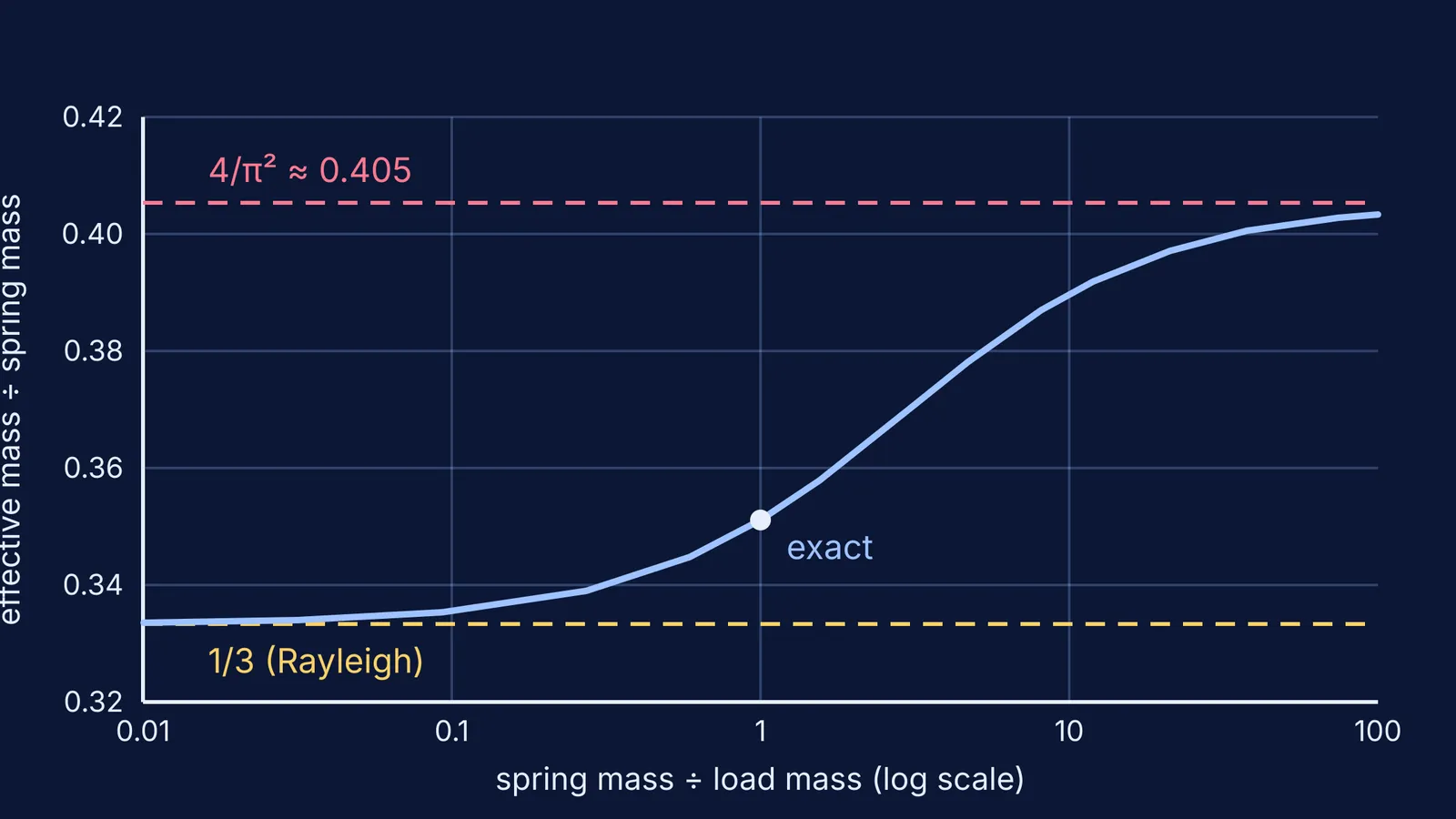
The linear-speed assumption is an approximation. For a spring that is much heavier than the load, the effective mass approaches (4/π²) m_s, about 0.405 m_s, as noted in the Wikipedia article). Ernesto E. Galloni and Mario Kohen discussed the spring's mass in both static stretch and the period, and showed by theory and experiment that the coefficients 2 or 3 commonly used in the literature are not always correct (American Journal of Physics, 1979).
We solved the exact wave equation for an ideal uniform spring (graph above) to see how much this matters.
Spring mass one-fifth of the load: the exact effective mass is about 0.338 m_s, and m + m_s/3 gives the period to within about 0.04%. Ignoring the spring entirely makes the period about 3% too short.
Spring mass equal to the load: the exact value is about 0.351 m_s, and m + m_s/3 is still within about 0.7%. Ignoring the spring makes the period about 14% too short.
For an ideal uniform spring no heavier than the load, m_s/3 gives the period to better than 1%.
When does JEE expect you to include the spring's mass?
Use this decision rule.
"Light", "massless" or no spring mass given: use T = 2π√(m/k).
Spring mass given as a number: use T = 2π√((m + m_s/3)/k), unless the question says otherwise.
"Effective mass" or "take the mass of the spring into account": the examiner wants m_s/3 for a uniform spring.
Static stretch under its own weight: use m_s/2, not m_s/3.
Graph of T² against m from an experiment: T² = (4π²/k)(m + m_s/3), so the line meets the m-axis at m = −m_s/3. The intercept tells you the spring's mass.
Worked example: how much does a 150 g spring change the period?
A block of mass 0.50 kg hangs from a uniform spring of mass 0.15 kg and spring constant 200 N/m. Find the period with and without the spring's mass.
Massless spring: T = 2π√(0.50/200) = 2π × 0.0500 = 0.314 s.
Effective mass, using Rayleigh's m_s/3): 0.50 + 0.15/3 = 0.55 kg.
With the spring's mass: T = 2π√(0.55/200) = 2π × 0.0524 = 0.329 s.
Ratio: 0.329/0.314 ≈ 1.05, so the period is about 5% longer.
Notice that gravity never appears. Hanging the spring vertically shifts the equilibrium point but not the period, the same reason a spring-mass system keeps its period on the Moon.
If the question cuts the spring, both k and m_s change; see the new spring constant after cutting a spring. To test how mass and k change the period, try our mass-spring SHM simulation predictions.
For variants such as a non-uniform spring or a load fixed partway along it, the Fermi Problem Library has worked problems with a step-by-step solver that explains the reasoning rather than printing an answer. For the energy method behind the one-third, open the oscillations lessons in the Fermi Concept Library.


