

On this page
Does the time period of a spring mass system change on the moon? It is one of the most common trick questions in physics exams. Because we naturally associate a swinging pendulum with gravity, it is easy to assume a bouncing spring behaves the same way.
In short
The time period of a spring-mass system does not change on the Moon. Although the Moon's gravity is roughly one-sixth of Earth's, the period depends only on the object's mass and the spring constant. Gravity only affects the resting position of a vertical spring, not the time it takes to complete a bounce.
According to OpenStax University Physics, the period of a mass on a spring depends only on the object's mass and the spring constant, not on gravity. To see why, we have to look at the formula and compare it to a simple pendulum.
Why does the spring formula ignore gravity?
For an object undergoing simple harmonic motion on a spring, the time period T is given by:
T = 2π√(m/k)
Where m is the mass of the block, and k is the spring constant (a measure of stiffness).
Notice what is missing from this equation: g, the acceleration due to gravity. The Moon's gravity is roughly one-sixth of Earth's gravity, but because g is not in the formula, moving the system to the Moon has no effect on the time period. The mass of the object m is an intrinsic property that stays the same everywhere in the universe. The spring constant k depends only on the material and shape of the spring itself.
If you are stuck trying to remember which formulas have a g in them, Fermi's AI tutor can help. Rather than just giving you the final answer, the tutor works out what you already know and builds a plan for the session, holding a line of reasoning to help you derive the formula yourself.
Does a vertical spring change its time period on the Moon?
You might wonder about a vertical spring hanging from a ceiling. Does the weaker gravity on the Moon affect it?
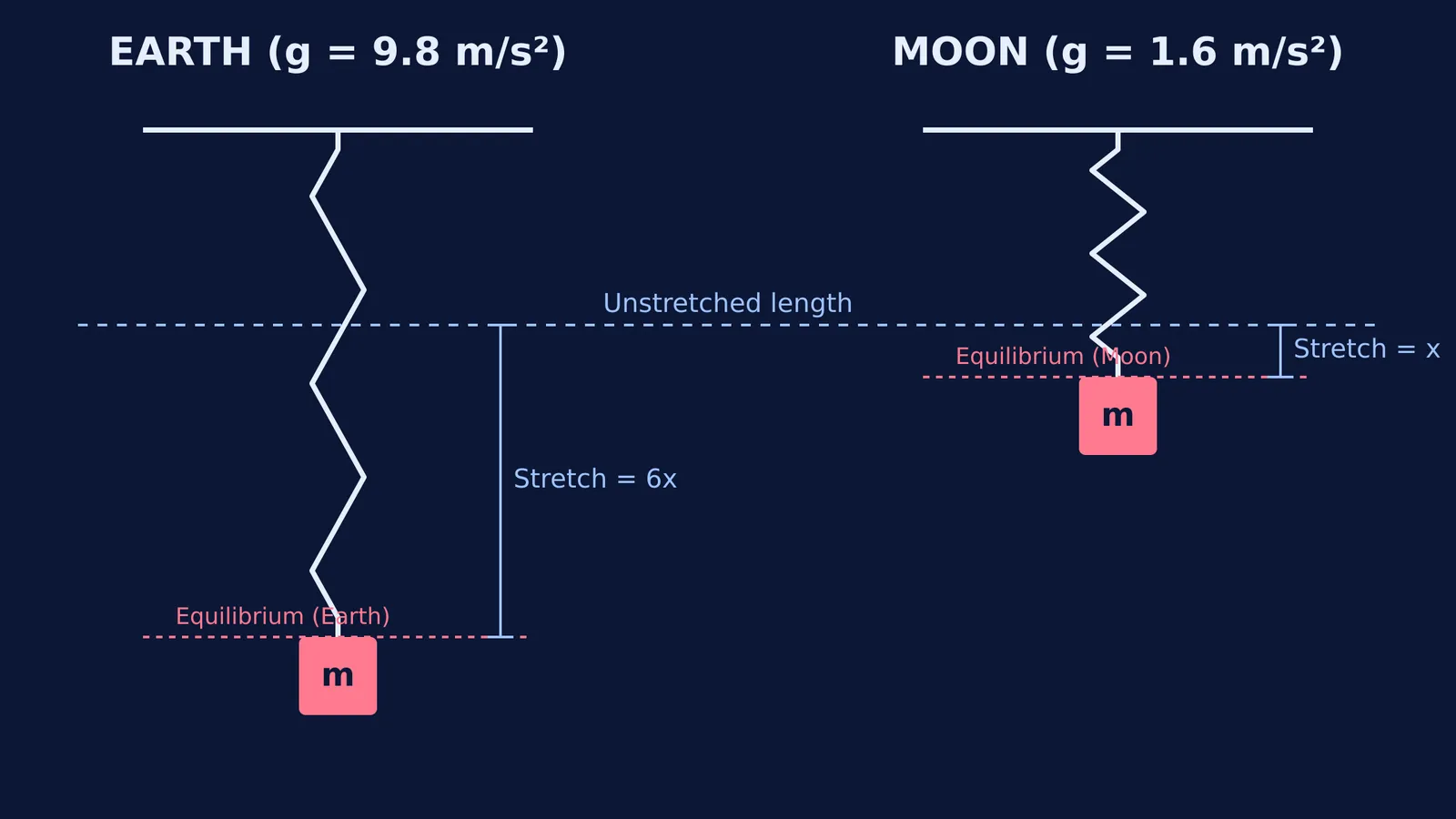
Yes, but only its resting position. When you hang a mass on a vertical spring, gravity pulls it down until the upward force from the spring balances the downward pull of gravity. This resting point is called the equilibrium position.
Because gravity is weaker on the Moon, the spring will not stretch as far before reaching equilibrium. However, once you pull the mass down and let it go, the oscillation around that new equilibrium position is driven purely by the spring's restoring force. The net force still follows Hooke's Law relative to that new equilibrium point, so the time it takes to complete one bounce remains exactly T = 2π√(m/k).
You can explore principles like this in the Fermi Concept Library, which covers every concept in physics, chemistry, biology, mathematics and computing.
What is the pendulum trap?
Examiners love to test this concept by putting a spring-mass system next to a simple pendulum.
Unlike a spring, the restoring force for a swinging pendulum is gravity itself. The time period of a simple pendulum is:
T = 2π√(L/g)
Because g is in the denominator, a pendulum will swing much slower on the Moon. The spring, meanwhile, keeps perfect time. If you want to see how the length of the string affects the swing on Earth, check out our guide on how a seconds pendulum length changes. For more advanced mechanics, you can also calculate the simple pendulum string tension at any angle.
If you need a step-by-step solver that explains the reasoning for these kinds of problems, the Fermi Problem Library has worked examples that break down the math instead of just printing a final answer.


