

On this page
A common JEE Main-style question cuts a spring of constant k into pieces and asks for the new constants or time period. The trap is thinking k belongs to the material, like density does. It doesn't. k describes the whole spring, and a shorter piece of the same spring is stiffer.
Why is k inversely proportional to the length of a spring?
Hang a load on an ideal, light spring and every part of it carries the same tension. Each coil stretches by the same amount, so stretch is shared in proportion to length. Cut off one third of the spring, pull that piece with the same force, and it stretches one third as much. Same force, one third the stretch: three times the spring constant.
The series rule agrees. The original spring is its pieces joined end to end. For springs in series, 1/k(series) = 1/k(1) + 1/k(2), as the University of Maryland physics lecture-demonstration notes state. If each piece has k(i) proportional to 1/L(i), the reciprocals add up to give back k for the full length.
Engineers see it too. For a close-coiled helical spring, the rate is approximately k = Gd⁴/(8D³N), with N the number of active coils, according to this spring-rate explainer from FIRGELLI. Cutting keeps the wire, coil diameter and material but reduces N, so k rises as 1/N.
What happens to the spring constant when a spring is cut unequally?
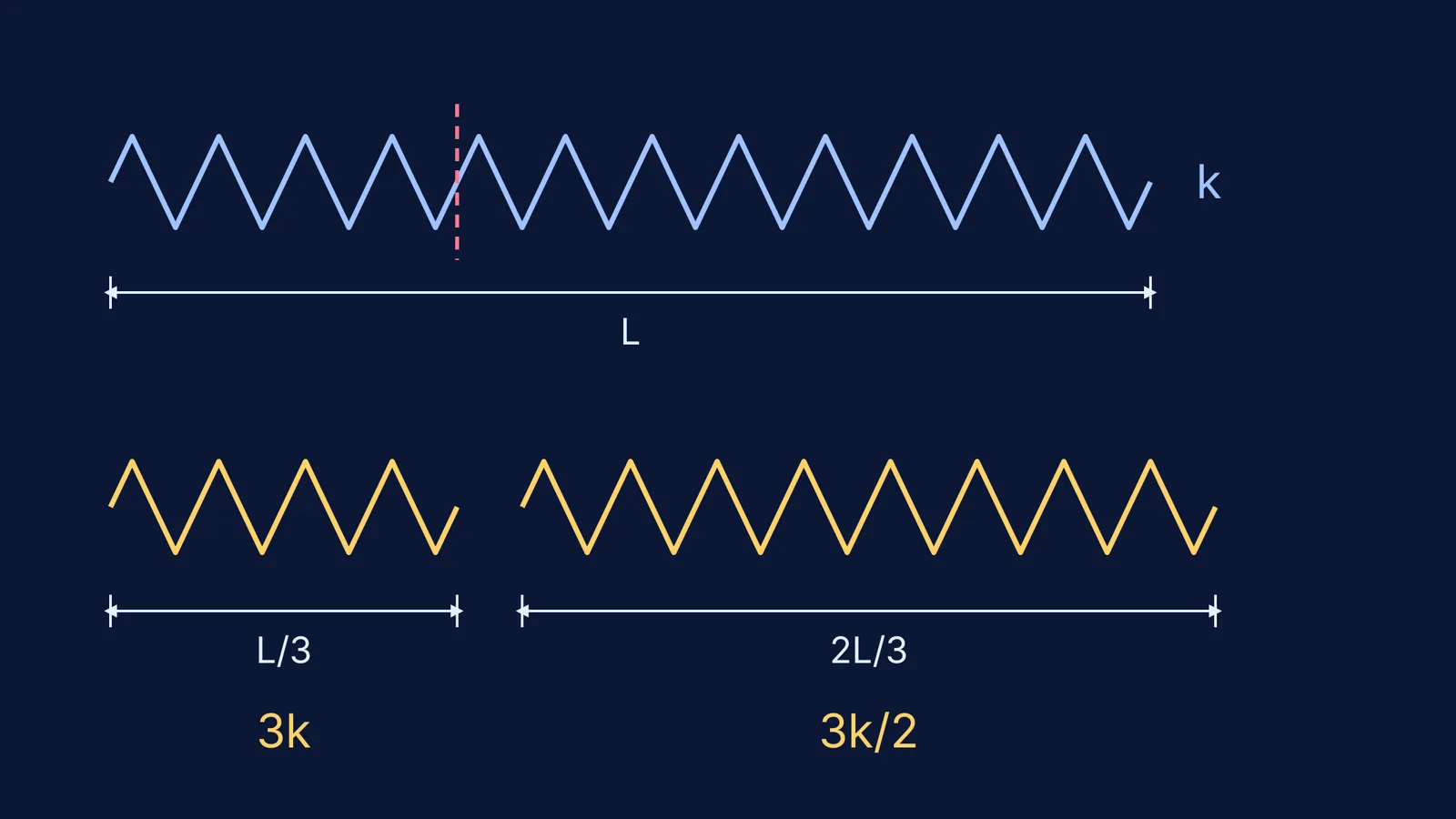
Use k₁L₁ = k₂L₂ = kL. If a spring of length L is cut in the ratio 1 : 2, the pieces have lengths L/3 and 2L/3:
short piece: k₁ = kL ÷ (L/3) = 3k
long piece: k₂ = kL ÷ (2L/3) = 3k/2
Check with the series rule: 1/(3k) + 2/(3k) = 1/k. If the pieces in series do not give back k, you have slipped somewhere.
For a general cut in the ratio m : n, the pieces have k(m+n)/m and k(m+n)/n.
What if the cut pieces are joined in parallel?
Spring constants in parallel add, k(parallel) = k(1) + k(2), according to the same Maryland demonstration notes. So:
two equal halves side by side: 2k + 2k = 4k
the 1 : 2 pieces side by side: 3k + 3k/2 = 9k/2
n equal pieces side by side: n × nk = n²k
A common slip is to stop at "halving doubles k" and answer 2k instead of 4k. For more practice, see our walkthrough of springs in series and parallel.
How does the time period change on each piece?
For a block on a spring, T = 2π√(m/k), and the period depends only on mass and spring constant, not on amplitude, as OpenStax's chapter on simple harmonic motion explains. So T is proportional to 1/√k, and since k is proportional to 1/L, T is proportional to √L.
If the original period is T₀:
on half a spring: T₀/√2
on the 1 : 2 short piece (3k): T₀/√3
on the 1 : 2 long piece (3k/2): T₀√(2/3)
on two halves in parallel (4k): T₀/2
on the 1 : 2 pieces in parallel (9k/2): T₀√2/3
How do you find the new period with real numbers?
A 60 cm spring has k = 300 N/m. It is cut into 20 cm and 40 cm pieces, and a 0.5 kg block hangs on each in turn. Use k × L = constant and the OpenStax period formula.
Original: T₀ = 2π√(0.5/300) ≈ 0.257 s.
20 cm piece: k₁ = 300 × 60/20 = 900 N/m, so T₁ = 2π√(0.5/900) ≈ 0.148 s.
40 cm piece: k₂ = 300 × 60/40 = 450 N/m, so T₂ = 2π√(0.5/450) ≈ 0.209 s.
Both pieces in parallel: k = 900 + 450 = 1350 N/m, so T = 2π√(0.5/1350) ≈ 0.121 s.
Check step 2 against the ratio method: 0.257 ÷ √3 ≈ 0.148 s. Getting the same answer by two routes is how you catch errors in an exam. Our post on a mass on a vertical spring shows why gravity shifts the equilibrium but not the period.
A quick checklist for any cut-spring question
Write k × L = constant and find each piece's k.
Decide whether the pieces act in series (same force) or parallel (same stretch).
Combine the constants, then put them into T = 2π√(m/k).
Check: do the pieces in series give back the original k?
If you get stuck setting up the problem, the Fermi Problem Library has worked problems with a step-by-step solver that explains the reasoning rather than printing an answer. If k as a property of the whole spring still feels slippery, the Fermi Concept Library gives each physics concept its own lesson and its place in the map. For proving SHM from scratch, see how to prove SHM and find the period.


