

On this page
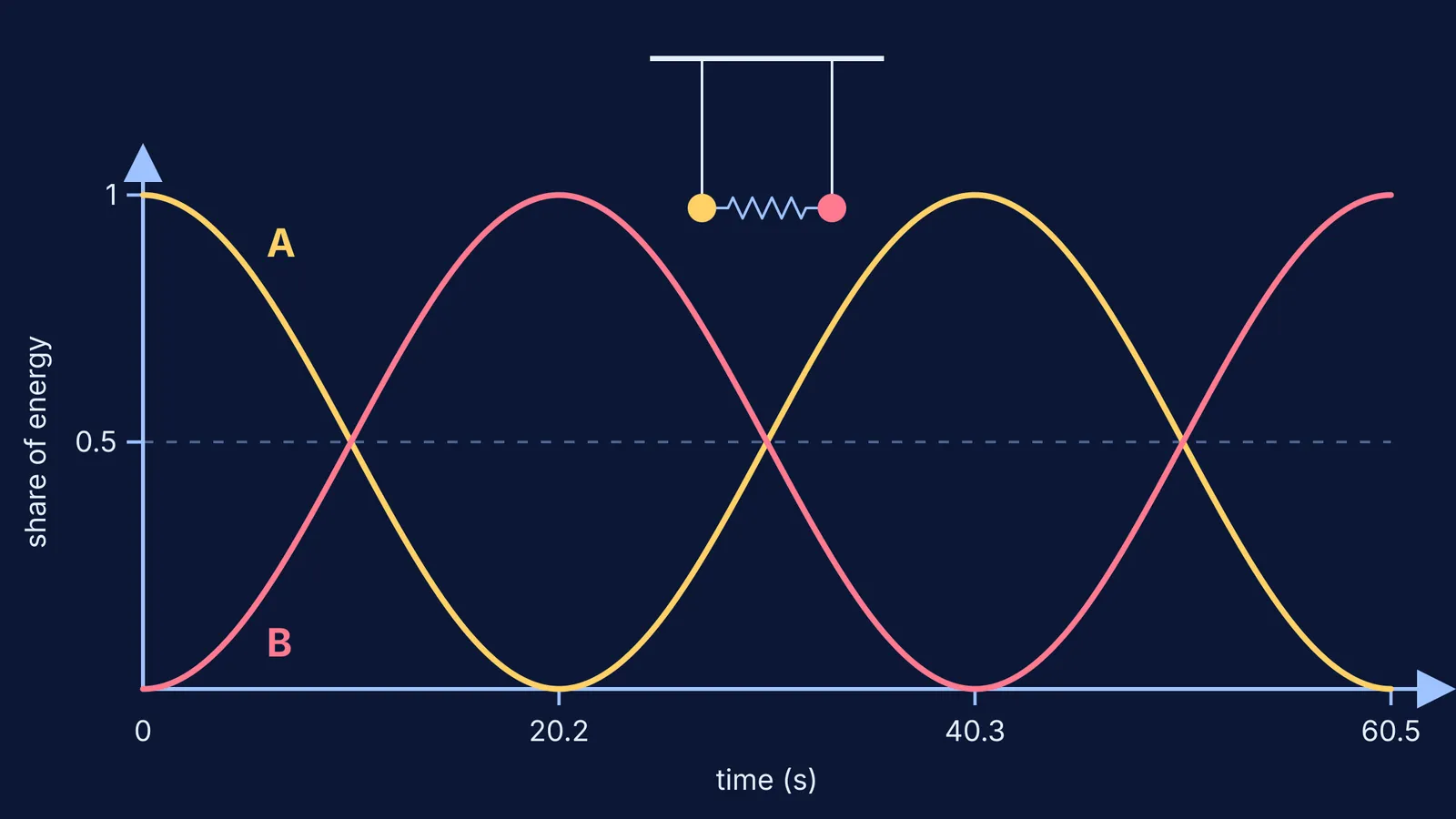
Hang two identical pendulums side by side, join the bobs with a light spring, pull one aside and let go. The first pendulum's swing slowly dies away as the second starts moving. Then it runs in reverse. The University of Colorado Boulder's lecture demo page describes it in one line: "Displacing one pendulum causes oscillation energy to transfer completely to the other and back" (CU Boulder physics demos).
What are the two normal modes of coupled pendulums?
Guy Wilkinson's Oxford wave-motion lecture notes define it this way: "A normal mode of an oscillating system is a pattern of oscillation in which all parts of system move with the same frequency and with a fixed phase relation" (Oxford lecture notes, PDF). For two pendulums of length l and mass m joined by a spring of stiffness k, the same notes derive two modes:
In step: both bobs swing the same way together. The spring never stretches, so each bob feels only gravity and ω₁² = g/l, exactly as for a lone pendulum.
Opposite: the bobs swing towards and away from each other. When each bob moves a distance x, the spring stretches by 2x, which adds restoring force, so ω₂² = g/l + 2k/m. This mode is always the faster one.
The notes also show that total energy is the sum of the two mode energies: the modes never trade energy, only the pendulums do.
Why does energy swap back and forth between the pendulums?
Pulling pendulum A aside while B hangs at rest starts both modes with equal amplitude, a/2 each, according to the Oxford notes. At first the modes add up at A and cancel at B. The faster opposite mode gradually pulls ahead, and once it is half a cycle ahead they cancel at A and add up at B: A hangs still and B swings fully. Then they drift back.
The notes write A's motion as x = a cos((ω₁ + ω₂)t/2) cos((ω₁ − ω₂)t/2) and call the result beats. The slow cosine sets A's amplitude. It first reaches zero when (ω₂ − ω₁)t/2 = π/2, so:
one swap, from A to B, takes t_swap = π/(ω₂ − ω₁)
the full round trip, back to A, takes 2π/(ω₂ − ω₁)
How does spring stiffness set the swap time?
A worked example you can type into any simulation: take l = 1.0 m, m = 0.2 kg and g = 9.8 m/s². Then ω₁ = √9.8 = 3.130 rad/s, a period of 2.01 s whatever the spring. Using ω₂² = g/l + 2k/m from the Oxford notes:
k = 0.05 N/m: ω₂ = 3.209 rad/s, swap time 39.8 s
k = 0.1 N/m: ω₂ = 3.286 rad/s, swap time 20.2 s
k = 0.2 N/m: ω₂ = 3.435 rad/s, swap time 10.3 s
k = 0.4 N/m: ω₂ = 3.715 rad/s, swap time 5.4 s
Each time you double the spring constant, the swap time roughly halves. For a weak spring, ω₂ − ω₁ ≈ k/(mω₁), so t_swap ≈ πmω₁/k. That gives 19.7 s for k = 0.1 N/m, close to the exact 20.2 s. At k = 0.1 N/m, A makes about ten swings before resting; at 0.4 N/m, fewer than three.
A surprise follows: in that weak-spring formula t_swap grows with ω₁ = √(g/l), so longer strings give faster swaps. With l = 2.0 m and k = 0.1 N/m the exact swap time drops to 14.6 s.
How should you use a coupled pendulums simulation?
Predict before you watch. When Crouch, Fagen, Callan and Mazur compared ways of running physics demonstrations, students who simply watched understood no better than students who never saw the demo, while those who predicted the outcome first showed significantly greater understanding (American Journal of Physics, 2004).
So for each run, write "I predict ___ because ___" before you start, then compare. With the numbers above:
Pull both bobs the same way and release. Predict: no swapping, period 2.01 s.
Pull them equally in opposite directions. Predict: no swapping, a slightly shorter period (1.91 s at k = 0.1 N/m).
Pull only A. Predict the swap time from π/(ω₂ − ω₁), then time it from release to A's first stop.
Double k. Predict a swap time about half as long.
Double both string lengths. Predict a shorter swap, about 14.6 s at k = 0.1 N/m.
Make one string slightly longer than the other. Does A ever stop completely?
The Fermi Simulation Lab has interactive simulations for the ideas that are easier to see than to read, and the same predict-then-watch routine works with any oscillation you open there. If the algebra of normal modes is where you get stuck, Fermi's AI tutor can work out what you already know and build a plan for the session.
Read on: what PhET research says interactive physics simulations are good for, LC oscillations, where energy swaps between capacitor and inductor, and two blocks joined by a spring.


