

On this page
Nobody pushes you, yet the swing climbs higher with every pass. The energy comes from your legs, and the trick is the timing.
How does pumping a swing add energy?
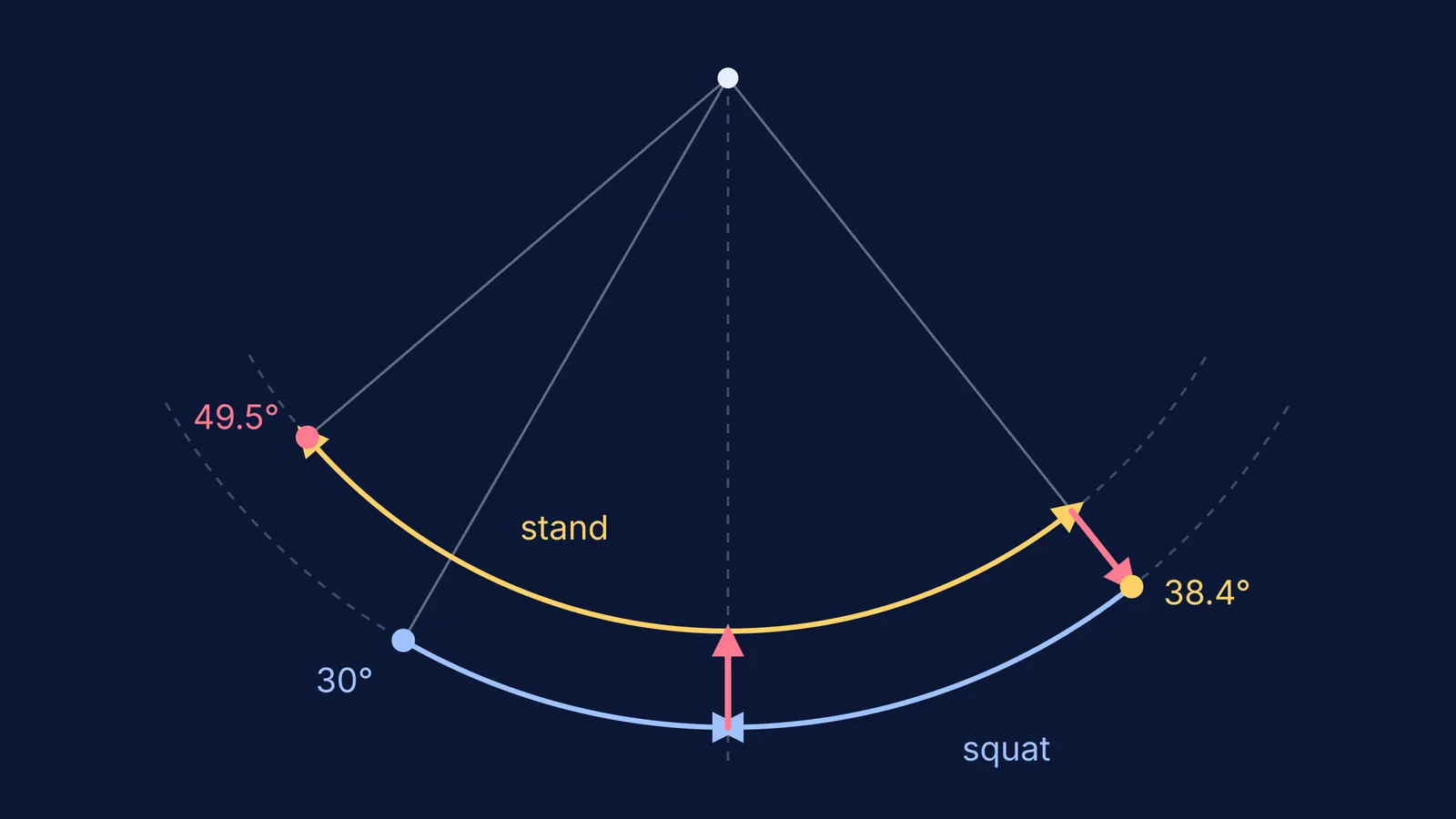
Physicists model a standing rider as a pendulum whose length, the distance from the pivot to your centre of mass, can change. In their 1998 paper How to Pump a Swing in The College Mathematics Journal, Stephen Wirkus, Richard Rand and Andy Ruina describe the standing strategy, following earlier work by Tea and Falk: crouch at the high points, then stand up suddenly as the swing passes the lowest point.
The pendulum is long at the ends and short at the bottom, and the swing gains energy on every crouch-stand cycle, forward and back.
The two moves are not mirror images:
Standing at the bottom: you are moving fastest, so you lift your body against gravity and the outward pull of the circular motion.
Squatting at the ends: the swing is momentarily at rest, so lowering your body gives back less energy than standing put in.
Why does standing at the bottom make you go faster?
At the lowest point the rope is vertical, so gravity has no torque about the pivot, and the rope's tension points straight through the pivot. With no torque, angular momentum about the pivot, mL²ω, stays the same while you stand up. In the Wirkus, Rand and Ruina paper this gives ω(after) = (L_squat / L_stand)² × ω(before).
Shorter length, faster rotation: the same idea as a skater spinning faster when they pull their arms in. The extra speed carries you to a higher angle on the far side.
Combining this with energy conservation on the stretches where your position does not change, the paper derives (1 − cos θ_new) = (L_squat / L_stand)³ × (1 − cos θ_old). For small angles this becomes θ_new ≈ θ_old × (L_squat / L_stand)^1.5.
Worked example: how much energy does one pump add?
Take the lengths Wirkus, Rand and Ruina used for one of their figures: L_squat = 2.7 m, L_stand = 2.3 m and g = 9.8 m/s² (paper). We add a 50 kg rider starting at 10°, with no friction.
Speed at the bottom while squatting: v² = 2gL_squat(1 − cos 10°) = 2 × 9.8 × 2.7 × 0.0152 ≈ 0.80 m²/s², so v ≈ 0.90 m/s and kinetic energy ≈ 20.1 J.
Stand up. Angular momentum mLv is conserved, so v rises by the factor 2.7/2.3: v ≈ 1.05 m/s and kinetic energy ≈ 27.7 J.
Work done by your legs = gain in kinetic energy (7.6 J) + lifting your centre of mass 0.4 m (50 × 9.8 × 0.4 = 196 J) ≈ 204 J.
Rise on the shorter pendulum: 1 − cos θ = (2.7/2.3)³ × 0.0152 ≈ 0.0246, so θ ≈ 12.7°.
Squat at the top. You are at rest, so lowering your centre of mass by 0.4 m × cos 12.7° gives back about 191 J.
Net energy kept in one half-swing: about 204 − 191 ≈ 12 J.
Keep going and the angle runs 10° → 12.7° → 16.2° → 20.7° over three half-swings. You do about 204 J of work to keep about 12 J; the rest you lift and lower again. The energy kept grows with 1 − cos θ, so each pump adds more as the swing gets bigger.
Is standing or sitting better for swinging higher?
Seated pumping, where you rotate your body at the high points, adds a roughly fixed amount to the amplitude each half-swing; standing pumping multiplies it. The authors conclude that seated pumping is better at low amplitudes, and above a certain amplitude standing works better (paper). For the seated version on a jhula, see our explainer on how to swing higher without being pushed.
Two limits. The model ignores friction and air resistance, so on a real swing your pumping first has to cover those losses. And timing matters: crouch at the bottom instead, and the same angular momentum argument says you lengthen the pendulum and slow down.
How do you use this in a JEE problem?
The method carries over to any problem where a body suddenly changes its distance from a pivot:
Find the instant when the external torque about the pivot is zero (here, rope vertical).
Conserve angular momentum across the sudden change: L₁²ω₁ = L₂²ω₂, or L₁v₁ = L₂v₂.
Use energy conservation only on the stretches where nothing changes length.
Treat the work done by the internal agent (your legs) as the difference in mechanical energy across the jump.
To check your steps on problems like this, the Fermi Problem Library has worked problems with a step-by-step solver that explains the reasoning rather than printing an answer. For another way well-timed pushes build amplitude, read about resonance in damped and forced oscillations, or explore the Fermi Simulation Lab, with interactive simulations for ideas easier to see than to read.


