

On this page
The playground jhula is more than a piece of equipment; it is a human-powered pendulum. When you sit on a swing that is perfectly still, no amount of wiggling will get you moving. But once you have a tiny bit of motion, you can pump yourself to spectacular heights without anyone pushing you.
How does the body act as an engine to power a swing? The answer lies in how you move your mass relative to the pivot. Physicists divide the motion into two distinct techniques: the standing method and the seated method.
How do you swing higher on a swing without being pushed?
To add energy to any pendulum, you have to do work against the forces acting on it. On a swing, your body is the mass. By changing your shape—standing, squatting, leaning or extending your legs—you shift your centre of mass.
When you shift your centre of mass at precisely the right moments in the cycle, you transfer energy from your muscles into the swing's mechanical energy. This is not about random movement; it is a strictly timed injection of energy that relies on the principles behind Centre of mass problems: finding it and using it to simplify motion.
Why does standing up on a swing make you go higher?
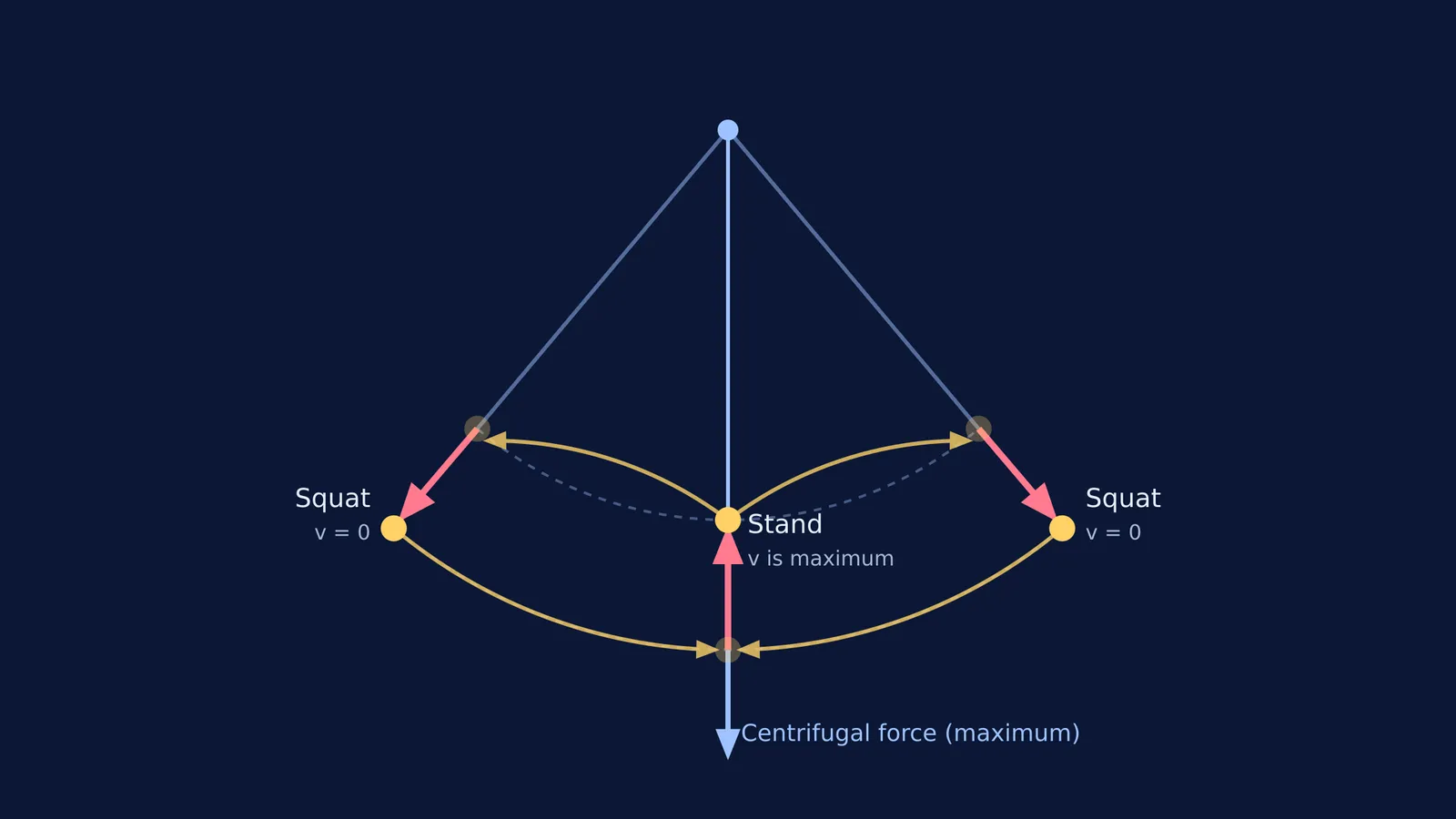
The most efficient way to gain height on a swing is to stand on the seat and use a squat-to-stand motion. This technique alters the effective length of the pendulum (the distance from the pivot to your centre of mass).
Here is the exact timing required to build height:
At the bottom of the arc: As the swing passes through its lowest point, it is moving at its maximum speed. Here, you feel the heaviest because the centrifugal force pulling you outward is at its peak. When you stand up at this exact moment, you raise your centre of mass. Lifting your body against gravity and this strong centrifugal pull requires significant work. This work is converted directly into the swing's energy.
At the peaks of the arc: When the swing reaches its highest point at either end, it stops for a fraction of a second. The velocity is zero, which means there is no centrifugal force. When you squat down here, you lower your centre of mass. You lose a little bit of potential energy, but far less than you gained at the bottom.
Because you stand up twice during one full back-and-forth cycle (once on the way forward, once on the way back), you are injecting energy at twice the swing's natural frequency. A 1968 paper by P. L. Tea and H. Falk in the *American Journal of Physics* formally described this as doing net work against the centrifugal force to increase the swing's energy. Physicists call this double-frequency phenomenon *parametric resonance*.
How do you pump a swing while sitting down?
While standing is highly efficient for large amplitudes, it is terrible for starting from rest. If you are sitting down, you likely use a different method entirely.
When seated, you pump by leaning your torso back and extending your legs on the forward swing, then leaning forward and tucking your legs on the backswing. A 1990 analysis by W. B. Case and M. A. Swanson in the *American Journal of Physics* modelled this seated method and found it acts as a driven harmonic oscillator.
Instead of changing the length of the pendulum, leaning back shifts your centre of mass tangentially. This creates a torque around the pivot point. You are effectively using your body's rotation to push against the chains. Unlike the standing method, you perform this cycle at the exact same frequency as the swing itself. It provides the initial kick that gets you moving from a near standstill.
A framework for mastering oscillations
Understanding a jhula is a perfect gateway into formal physics. You can map the playground experience directly to the equations for Simple pendulum string tension at any angle: mg cos θ + mv²/l.
If you are studying for the JEE or NEET, recognising these real-world links turns abstract formulas into intuitive rules. Try this three-step framework to lock in the concepts when facing a pendulum problem:
Identify the forces at the extremes: Where is velocity highest? (The bottom). Where is tension highest? (Also the bottom, due to the mv²/r term). Knowing where forces peak tells you where work is most effective.
Track the work done: Energy only enters the system when a force moves a mass over a distance. On a swing, standing up provides that radial distance against the tension, proving that internal work drives the amplitude.
Visualise the timing: If the timing of parametric resonance is hard to picture from a textbook, you can load the Fermi Simulation Lab.
Running an interactive simulation lets you change the variables yourself—such as adjusting the timing of the centre of mass shift—and watch how the amplitude responds. Fermi's AI tutor can hold a line of reasoning across the session, helping you connect the maths of a driven pendulum to the physical forces you feel on a playground.


