

On this page
When you watch an ice skater perform a scratch spin, you see them start with their arms outstretched and then pull them tightly to their chest. As they do, their spin blurs into a dizzying blur.
This is a classic demonstration of the conservation of angular momentum, a topic tested frequently in exams from school boards to the JEE. But a common question trips up many students: if angular momentum is conserved, why does the skater's rotational kinetic energy increase?
Understanding the source of this extra energy is the key to mastering rotational motion and work-energy principles. It is not just about the formulas; it is about understanding where the physical effort in the real world goes.
The physics of pulling your arms in
When a skater pulls their arms and legs inward, they bring their mass closer to the axis of rotation, which decreases their moment of inertia (I). Because there is negligible net torque from the ice (friction is near zero), their angular momentum (L) must remain constant.
The relationship between these variables is given by the formula L = Iω.
To compensate for the decrease in I, their angular velocity (ω) must increase, causing them to spin faster. If you halve your moment of inertia, your angular velocity must exactly double so that the product of the two remains the same.
Why does rotational kinetic energy increase?
The formula for rotational kinetic energy (K) is K = 1/2 Iω².
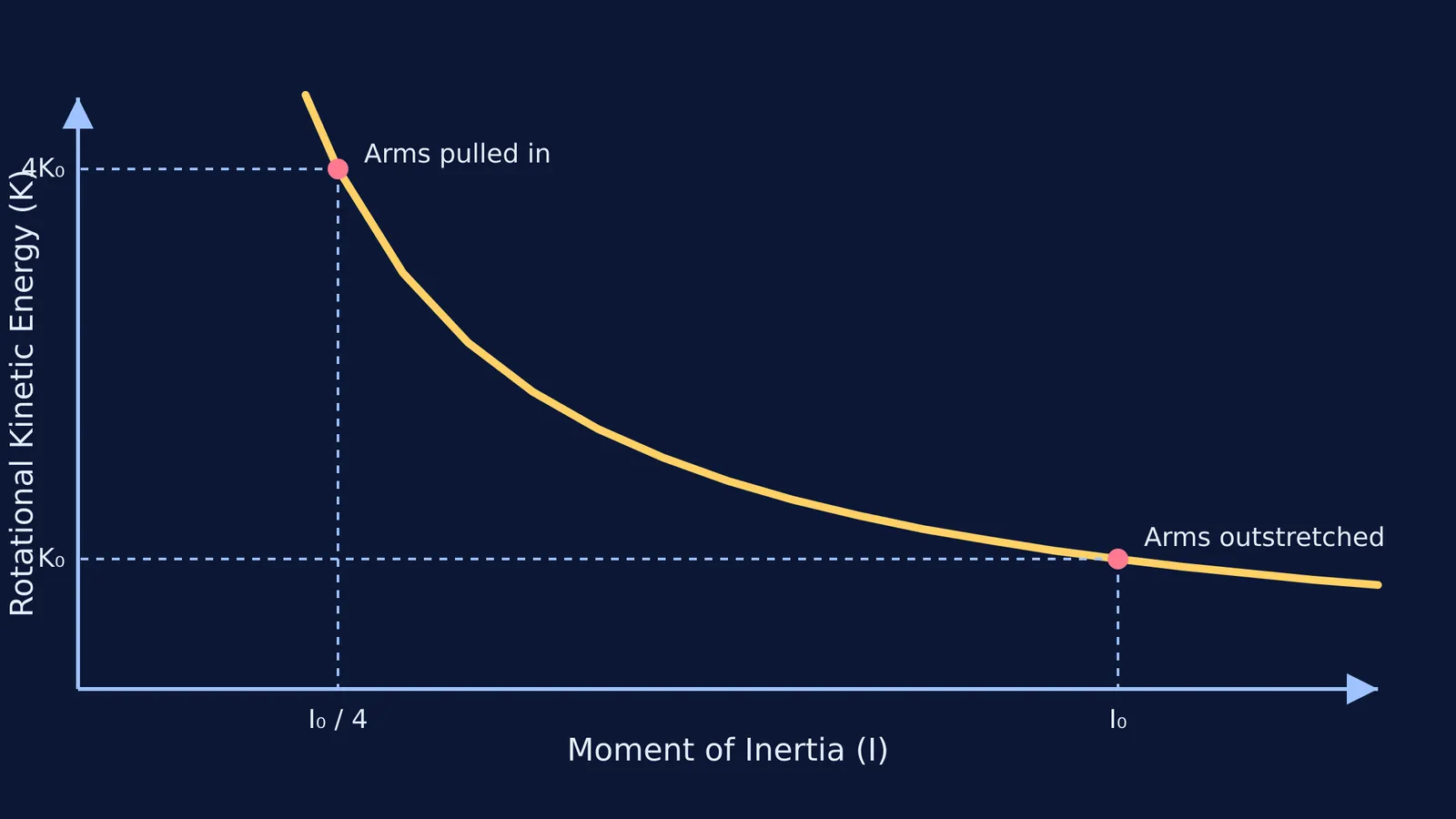
Because L = Iω, we can substitute this to express kinetic energy strictly in terms of angular momentum and moment of inertia: K = L² / (2I)
Since angular momentum (L) is constant, the numerator L² stays fixed. Therefore, as the moment of inertia (I) in the denominator decreases, the total value of the fraction must increase.
"Because her moment of inertia has decreased, her final rotational kinetic energy has increased," explains University Physics, a standard textbook by OpenStax.[1]
If the skater halves their moment of inertia, the denominator is halved, meaning the kinetic energy is doubled. If they reduce it to a quarter, the kinetic energy is multiplied by four.
Where does the extra energy come from?
The principle of energy conservation states that energy cannot be created from nothing. So, if the skater's rotational kinetic energy has doubled or quadrupled, where did the extra energy come from?
The answer lies in human biology and Newton's laws. As the skater spins, their arms are moving in a circle. By Newton's first law, the mass in their arms "wants" to travel in a straight line. In the rotating frame of the skater, this feels like an outward centrifugal force pulling their arms away from their body.
To pull their arms inward, the skater must actively use their muscles to exert an inward force over a distance.
In physics, applying a force over a distance is the exact definition of work (W = F × d). The skater performs internal mechanical work to pull their limbs inward against the outward pull.[1] This muscular work converts biochemical energy (from the food the skater ate earlier) into the additional rotational kinetic energy that makes them spin faster.
If you struggle to spot where work is being done in complex systems, the Fermi Concept Library explains every concept in physics so you can master the intuition before memorising formulas.
A worked example: the gymnast dismount
This same principle applies whenever a rotating body changes its shape, such as a gymnast tucking for a dismount or a bead on a rotating rod being pulled in by a string.
Consider the numerical example provided in University Physics of a gymnast on a high bar:[1]
Initial state (extended): The gymnast has an initial moment of inertia I₀ = 21.6 kg·m² and an initial rotation rate of 1.0 rev/s (which is 2π rad/s).
Final state (tucked): By pulling their knees tightly to their chest, they reduce their moment of inertia to I_f = 5.4 kg·m².
Because angular momentum is conserved, their new rotation rate is (21.6 × 1.0) / 5.4 = 4.0 rev/s (which is 8π rad/s).
Now, let us calculate the rotational kinetic energy before and after the tuck (K = 1/2 Iω²):
Initial kinetic energy: 0.5 × 21.6 × (2π)² ≈ 426 J
Final kinetic energy: 0.5 × 5.4 × (8π)² ≈ 1705 J
The kinetic energy has increased by a factor of exactly 4 (from 426 J to 1705 J). The difference of 1279 J is exactly the amount of physical work the gymnast's core and arm muscles did to pull their body into the tight tuck position against the outward rotational forces.
When solving these problems on an exam, always pause to check whether energy conservation or angular momentum conservation applies to the system as a whole.


