

On this page
The problem of a bead sliding on a rotating rod is a classic test of how well you understand non-inertial reference frames in physics. While it looks like a simple setup, the resulting motion is anything but uniform. Instead of moving at a constant speed, the bead accelerates outward exponentially.
If you are reviewing mechanics for the JEE, mastering these setups is as important as understanding the string tension in a simple pendulum or the equation of trajectory for a projectile. Here is a breakdown of the forces at play, the equation of motion, and why the solution involves the hyperbolic cosine function (cosh).
What forces act on a bead sliding on a smooth rotating rod?
To make sense of the motion, it is easiest to view the system from the rotating frame of reference—that is, from the perspective of someone spinning along with the rod.
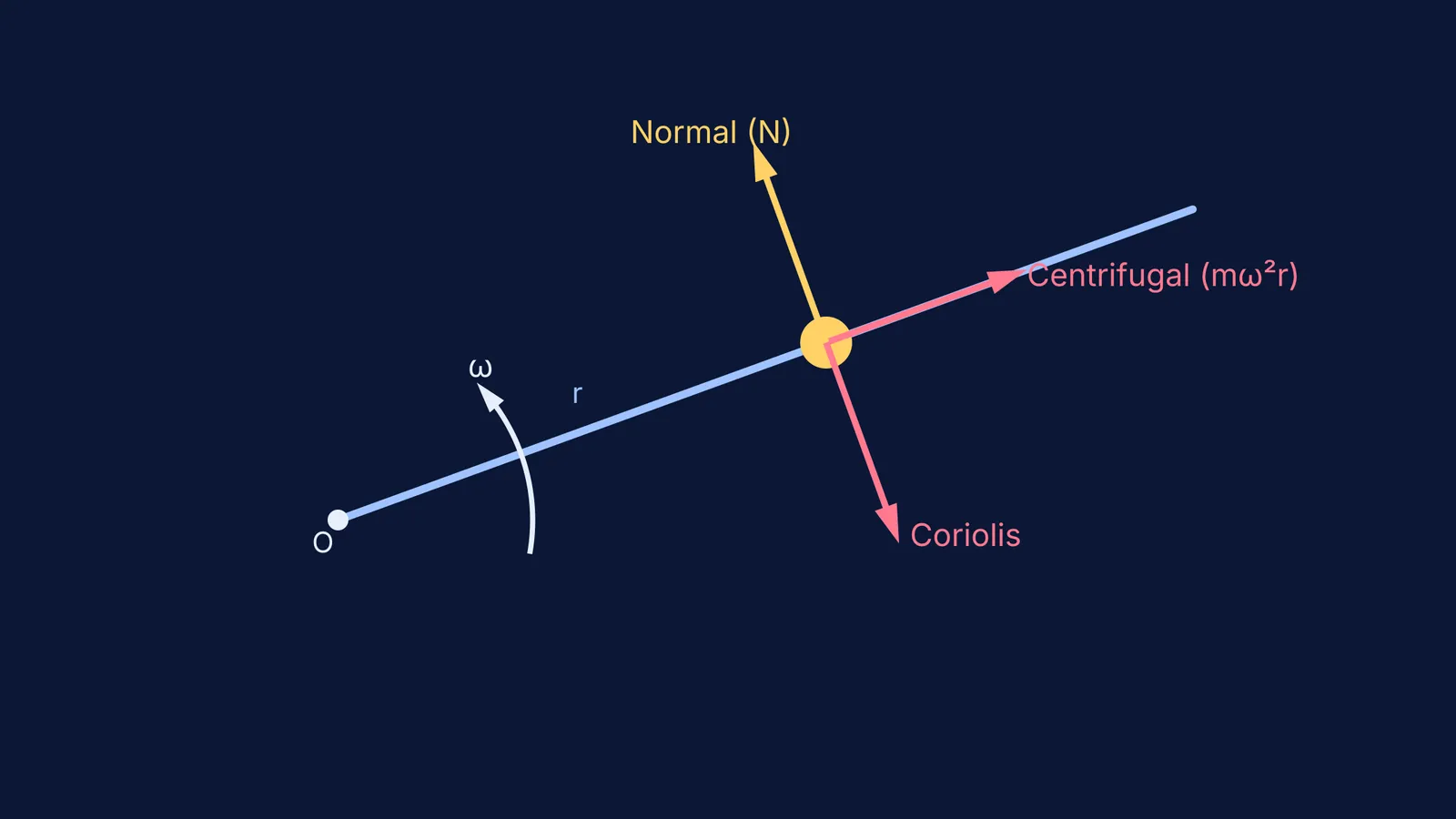
In this rotating frame, two "fictitious" forces appear:
Centrifugal force: This force pushes the bead radially outward along the rod. Its magnitude is F_c = mω²r, where m is the mass of the bead, ω is the constant angular velocity of the rod, and r is the distance from the pivot.
Coriolis force: As the bead slides outward with velocity v = dr/dt, the Coriolis effect pushes it sideways, perpendicular to the rod.
Because the rod is smooth (frictionless) and rigid, it restricts the bead's motion to a straight line along its length. To keep the bead on this straight path, the rod must exert a normal force (N) that perfectly cancels out the Coriolis force.
How do you find the equation of motion?
Since the normal force handles the sideways Coriolis push, we only need to look at the radial direction to find the equation of motion. The only force acting along the rod is the centrifugal force.
Using Newton's second law (F = ma) in the radial direction, we get: m d²r/dt² = mω²r
Dividing both sides by the mass m gives the differential equation: d²r/dt² = ω²r
This equation tells us that the bead's outward acceleration is directly proportional to its distance from the pivot. The further out it goes, the harder it is pushed, and the faster it accelerates.
Why does the solution use a cosh curve?
The general solution to the differential equation d²r/dt² = ω²r involves exponential functions. In physics, when the second derivative of a function is proportional to the function itself with a positive constant (ω²), the solution takes the form of exponential functions.
You can guess a solution of the form r(t) = e^(λt). Differentiating this twice gives d²r/dt² = λ²e^(λt). Substituting this back into our equation yields λ²e^(λt) = ω²e^(λt), which simplifies to λ² = ω². This means λ can be either ω or -ω.
The general solution is therefore a combination of both possibilities: r(t) = A e^(ωt) + B e^(-ωt)
To find the constants A and B, you must apply the initial conditions. If the bead is released from rest at an initial distance r₀ from the pivot (so r = r₀ and v = 0 at t = 0), the math simplifies beautifully.
Plugging in t = 0 for the position gives: r₀ = A e^(0) + B e^(0) = A + B
Next, we differentiate the general solution to find the velocity: v(t) = dr/dt = Aω e^(ωt) - Bω e^(-ωt)
Applying the initial velocity condition at t = 0 gives: 0 = Aω - Bω This tells us that A = B.
Since A + B = r₀ and A = B, it follows that A = r₀/2 and B = r₀/2. Substituting these back into our general solution gives the exact position function for this setup: r(t) = (r₀/2) e^(ωt) + (r₀/2) e^(-ωt) = r₀ [ (e^(ωt) + e^(-ωt)) / 2 ]
This bracketed term is exactly the definition of the hyperbolic cosine function, which is why the position is written elegantly as r(t) = r₀ cosh(ωt).
A 2021 study by physicist Rod Cross in *Physics Education* confirms that for a horizontal rod, the sliding speed in the radial direction increases exponentially with time, provided the rotation is fast enough to overcome friction. Initially, the motion is slow, but as t grows, the e^(ωt) term dominates, leading to a rapid, exponential outward fling.
Why does the Lagrangian method give the same result?
While drawing free-body diagrams in the rotating frame is intuitive, many university-level mechanics courses prefer the Lagrangian approach, which avoids fictitious forces altogether. The Lagrangian (L) is defined as the difference between the kinetic energy (T) and potential energy (V) of the system.
For a horizontal rod, the potential energy V is zero because the height does not change. The kinetic energy T of the bead has two components: the radial kinetic energy from sliding along the rod, and the tangential kinetic energy from rotating with the rod. T = (1/2) m (dr/dt)² + (1/2) m (ωr)²
Since L = T - V = (1/2) m (dr/dt)² + (1/2) m ω²r², we can apply the Euler-Lagrange equation for the radial coordinate r: d/dt (∂L / ∂(dr/dt)) - ∂L / ∂r = 0
First, take the partial derivative of L with respect to the radial velocity (dr/dt), which gives m (dr/dt). Taking the time derivative of this yields m d²r/dt². Next, the partial derivative of L with respect to r is mω²r.
Substituting these into the Euler-Lagrange equation gives: m d²r/dt² - mω²r = 0 m d²r/dt² = mω²r
This perfectly matches the equation derived using Newton's laws in the rotating frame. The Lagrangian method confirms that the outward push is a natural consequence of the geometry of the motion.
How do you visualise non-inertial frames?
Rotating reference frames and the resulting fictitious forces can be deeply unintuitive. If you struggle to picture why the Coriolis force acts perpendicular to the rod, or how the centrifugal force scales with distance, Fermi's AI tutor can help.
Instead of just handing you the final r₀ cosh(ωt) equation, Fermi teaches through it. Bring a problem about a bead on a rotating hoop or rod to the Fermi Problem Library. The tutor will hold a line of reasoning across the session, checking your understanding of the free-body diagram before moving on to the differential equations. If the forces are still hard to see, you can switch to the Fermi Simulation Lab to watch the centrifugal and Coriolis vectors change in real time as the bead accelerates outward.
By breaking the problem down into manageable steps—identifying the frame, drawing the forces, and solving the math—you can master even the most complex mechanics topics in the Fermi Concept Library.


