On this page
Put a block on a rough slope that is tilted at exactly its angle of repose, so that μ = tan θ. Left alone, it stays put. Pushed straight down, it slides at a steady speed. Now shove it sideways, across the slope, at 4 m/s. It curves downhill, slows, and settles into sliding straight down the slope at exactly 2 m/s, half its starting speed, for as long as the slope lasts. It never stops and never speeds up again. The reason takes three lines, and it is one of the cleanest friction problems you can meet.
Which way does friction point on a slope?
This is the step most students miss. Kinetic friction points against the velocity, not up the slope. On a slope, the block's velocity can point any way in the plane of the slope, so friction can too.
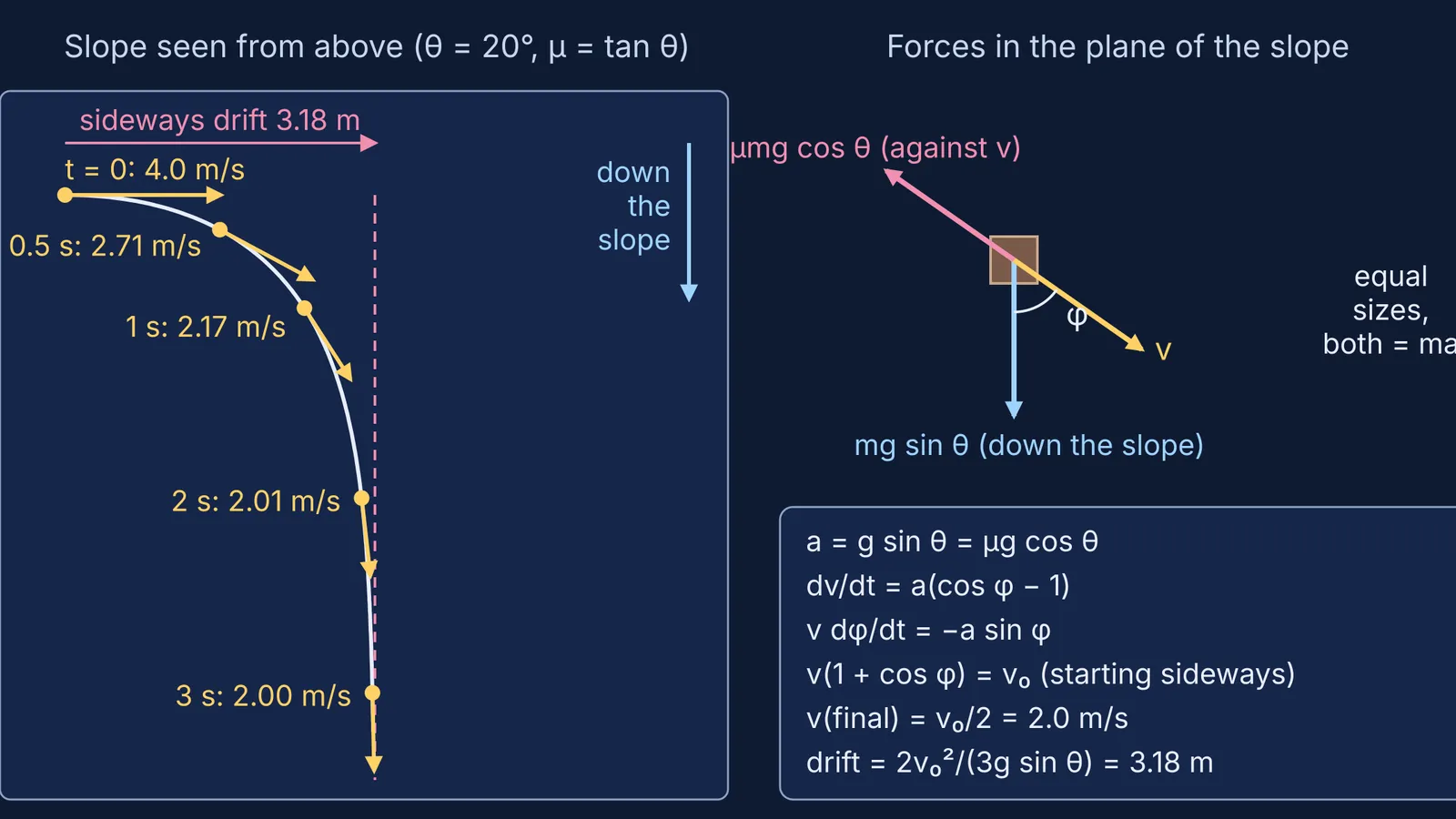
Only two forces act in the plane of the slope:
The downhill part of gravity, mg sin θ, always pointing straight down the slope.
Kinetic friction, μN = μmg cos θ, always pointing opposite to the velocity.
The normal force balances mg cos θ across the slope and does nothing else. If μ = tan θ, then μmg cos θ = mg sin θ. The two forces have the same size, a = g sin θ per unit mass. You met tan θ = μ as the angle of repose in can the coefficient of friction be greater than 1. There the block moves straight down and the two forces cancel. Here they point in different directions, and that is what makes the path curve.
What stays constant while the block curves?
Let φ be the angle between the velocity and the straight-downhill direction. At the start φ = 90°.
Resolve along the velocity. Gravity's part along v is a cos φ and friction is −a, so the speed changes as
dv/dt = a(cos φ − 1)
Now resolve along the downhill direction. Gravity gives +a and friction's downhill part is −a cos φ, so the downhill velocity component u changes as
du/dt = a(1 − cos φ)
Add the two. The right sides cancel:
d(v + u)/dt = 0
So v + u stays constant: the speed plus the downhill component of the velocity. Since u = v cos φ, you can also write it as v(1 + cos φ) = constant. A peer-reviewed paper in the European Journal of Physics by Aghamohammadi and Aghamohammadi derives the same conserved sum, and notes that the special case μ = tan θ is treated in Irodov's Fundamental Laws of Mechanics and in Gnädig, Honyek and Riley's 200 Puzzling Physics Problems.
Three things follow at once.
Final speed. At the start, v = v₀ and u = 0, so v + u = v₀. Across the slope, friction slows the sideways motion and has nothing to balance it, while downhill the two forces almost cancel. So the motion swings round towards straight down, where v = u. Then 2v = v₀, so v(final) = v₀/2.
The speed only falls. dv/dt = a(cos φ − 1) is never positive, so the block never speeds up, and it can never fall below v₀/2.
It never stops. Since v(1 + cos φ) = v₀ and 1 + cos φ is at most 2, the speed is always at least v₀/2.
How far does it drift sideways?
Across the velocity, only gravity has a part, a sin φ, and it turns the velocity towards downhill:
v dφ/dt = −a sin φ
The sideways velocity is v sin φ. Using the equation above, a small sideways step is dy = v sin φ dt = −(v²/a) dφ. Put in v = v₀/(1 + cos φ) and add up the steps from φ = 90° down to 0. The substitution tan(φ/2) = s turns the integral into ½∫(1 + s²) ds from 0 to 1, which is 2/3. So
drift = 2v₀² / (3g sin θ)
Check the units: (m/s)² ÷ (m/s²) gives metres.
Worked example: a block shoved at 4 m/s across a 20° slope
Take θ = 20°, μ = tan 20° = 0.364, v₀ = 4.0 m/s across the slope, g = 9.81 m/s². These are illustrative values.
Size of each force per kilogram. a = g sin θ = 9.81 × 0.342 = 3.36 m/s². Friction per kilogram is μg cos θ = 0.364 × 9.81 × 0.940 = 3.36 m/s². Equal, as they should be.
Final speed. v = v₀/2 = 2.00 m/s, straight down the slope.
Sideways drift. 2 × 4.0² ÷ (3 × 3.36) = 3.18 m.
Along the way. A step-by-step simulation, with friction always against the velocity, gives:
after 0.5 s: 2.71 m/s, 62° from straight down;
after 1 s: 2.17 m/s, 33° from straight down;
after 2 s: 2.01 m/s, 6.6° from straight down;
after 3 s: 2.00 m/s, about 1° from straight down.
Check the constant. At 0.5 s, 2.71 × (1 + cos 62°) = 4.0 m/s. In the simulation v(1 + cos φ) stayed at 4.000 m/s throughout.
Notice how fast the speed falls at first and how slowly the direction settles. Friction is fully against the motion from the start, while gravity has to turn the velocity round.
What if μ is not exactly tan θ?
The neat answer needs kinetic μ to be exactly tan θ.
μ a little larger. Friction beats the downhill pull, the speed keeps falling, and the block stops. Static friction then holds it.
μ a little smaller. Once the block is heading downhill, the downhill pull wins and it speeds up without limit.
Static friction plays no part once the block is moving. Only kinetic μ matters.
The same idea, friction opposite a velocity whose direction keeps turning, shows up in a particle sliding round a rough circular wall. And choosing axes along and across the slope, as here, is the trick behind a ball bouncing down a smooth incline.
For more friction and vector-component problems in this style, the Fermi Problem Library has a step-by-step solver that explains the reasoning. For a full plan, Fermi Test Prep offers personalised preparation for JEE Main & Advanced with an AI tutor, live classes, adaptive mocks, mentorship and a study plan that updates based on mastery.
Quick checklist
Kinetic friction opposes the velocity, not the slope.
With μ = tan θ, friction and mg sin θ have equal size, a = g sin θ.
Speed: dv/dt = a(cos φ − 1). Downhill component: du/dt = a(1 − cos φ).
So v + u, that is v(1 + cos φ), is constant.
Shoved sideways at v₀, the block ends straight downhill at v₀/2.
Sideways drift: 2v₀²/(3g sin θ), 3.18 m for 4 m/s on 20°.
The result needs μ exactly tan θ.