

On this page
Many mechanics problems in competitive exams like the JEE introduce situations where the forces acting on a moving object are not constant. A classic and highly instructive example is a particle moving along the inside of a rough, horizontal circular wall.
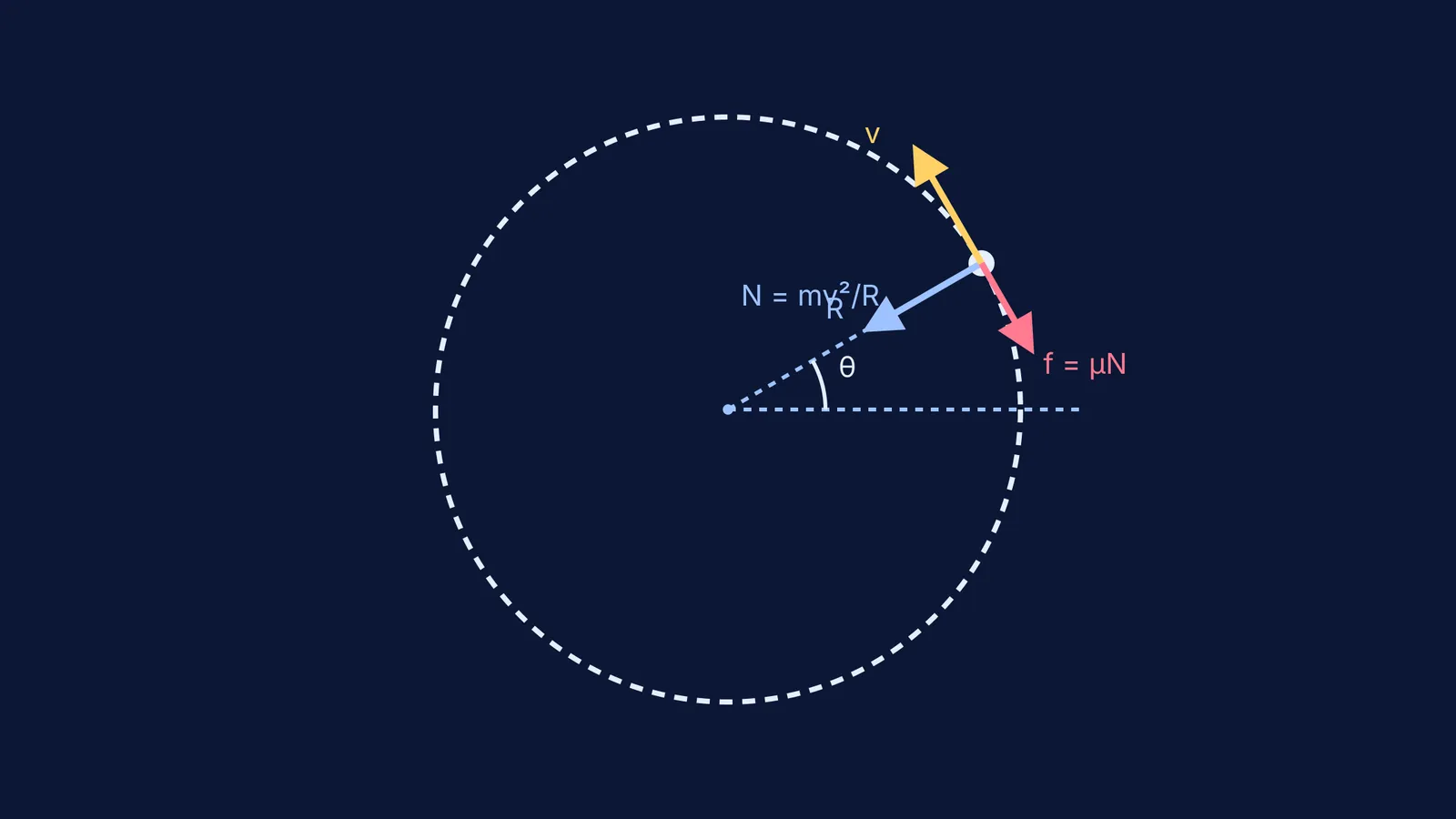
Imagine a particle of mass m sliding along the inside of a horizontal, rough circular track of radius R. It starts with an initial speed v₀. Because the wall is rough, friction acts against the motion and slows the particle down over time. We assume for this derivation that the particle rests on a smooth horizontal floor, so the only friction comes from the wall.
Unlike sliding on a flat floor where friction is constant and solely depends on the object's weight, a particle on a circular track experiences a friction force that changes continuously as it slows down. Here is how to set up the equations and derive the decay in speed.
What are the forces on the particle?
To move in a circular path, the particle requires a centripetal force directed toward the center of the track. In this horizontal setup, that force is entirely provided by the normal force N from the vertical wall. The normal force required for circular motion is N = mv²/R (HyperPhysics).
The only force acting along the tangent of the circle is kinetic friction f. Friction always opposes the direction of motion, and its magnitude depends on the normal force pressing the surfaces together:
f = μN = μ(mv²/R)
where μ is the coefficient of kinetic friction between the particle and the wall. Notice that as the speed v decreases, the normal force N decreases, which in turn reduces the frictional force f.
How does the speed decay with distance?
According to Newton's second law, the tangential acceleration a_t is caused by the frictional force opposing the motion:
m(a_t) = −f
m(a_t) = −μ(mv²/R)
The mass m cancels out, leaving:
a_t = −μv²/R
If you are unsure how to handle variable acceleration given as a function of v, the trick is to express the acceleration in terms of position. The tangential acceleration can be written as a_t = v(dv/ds), where s is the distance traveled along the circular arc.
Substituting this into our equation gives:
v(dv/ds) = −μv²/R
Divide both sides by v (assuming v is not zero):
dv/ds = −μv/R
Now, we can separate the variables to integrate:
dv/v = −(μ/R) ds
Integrate both sides from the initial state (speed v₀ at s = 0) to a later state (speed v at distance s):
∫ dv/v = −(μ/R) ∫ ds
ln(v/v₀) = −μs/R
Take the exponential of both sides to solve for v:
v = v₀e^(−μs/R)
Since the distance along the arc is directly related to the angle swept from the center by the formula s = Rθ, you can substitute this in to get the speed as a function of the angle θ:
v = v₀e^(−μθ)
How does the work-energy theorem apply here?
You can also solve this problem by looking at the kinetic energy. The kinetic energy of the particle is K = mv²/2. The work done by friction over a small distance ds is dW = −f ds = −μ(mv²/R) ds.
Since mv² = 2K, we can rewrite the work done as dW = −μ(2K/R) ds.
The work-energy theorem states that the change in kinetic energy equals the work done (dK = dW), so:
dK = −(2μK/R) ds
Separating the variables gives:
dK/K = −(2μ/R) ds
Integrating from the initial kinetic energy K₀ to K:
ln(K/K₀) = −2μs/R
K = K₀e^(−2μs/R)
Because kinetic energy is proportional to the square of the speed (K ∝ v²), taking the square root of both sides immediately returns our earlier result: v = v₀e^(−μs/R). This approach shows that the rate of energy loss is directly proportional to the current energy, which is the defining characteristic of exponential decay.
Why is the decay exponential?
When an object slides on a flat table, the normal force is just its weight (mg), which remains constant. This constant friction leads to a steady, linear decrease in speed.
However, inside a circular wall, the normal force is the centripetal force. The faster the particle moves, the harder it pushes against the wall. The harder it pushes, the stronger the friction becomes. As it slows down, it pushes less, and the friction drops. Because the rate at which it loses speed is proportional to the speed itself, the speed decays exponentially rather than linearly.
To practice setting up the limits for these integrals and understanding the work done by varying forces, you can work through guided examples in the Fermi Problem Library. The AI tutor can help you separate the variables and perform the integration step-by-step.
How does the speed decay with time?
You might also need to find the particle's speed after a certain time t. Instead of substituting a_t = v(dv/ds), you use the standard time derivative definition a_t = dv/dt:
dv/dt = −μv²/R
Separate the variables to group the v terms with dv and the t terms with dt:
dv/v² = −(μ/R) dt
Integrate from the initial speed v₀ at t = 0 to a final speed v at time t:
∫ v⁻² dv = −(μ/R) ∫ dt
[−1/v] = −μt/R
1/v − 1/v₀ = μt/R
Rearranging this equation gives the speed as a function of time:
v(t) = v₀ / (1 + μv₀t/R)
While the speed decays exponentially with distance traveled, it decays hyperbolically with time. If you compare this with problems like the angle of repose and angle of friction, you will notice that the coefficient μ dictates the intensity of the decay regardless of the variable you use to measure it. As time approaches infinity, the speed slowly approaches zero, though theoretically it never completely stops in this mathematical model.


