On this page
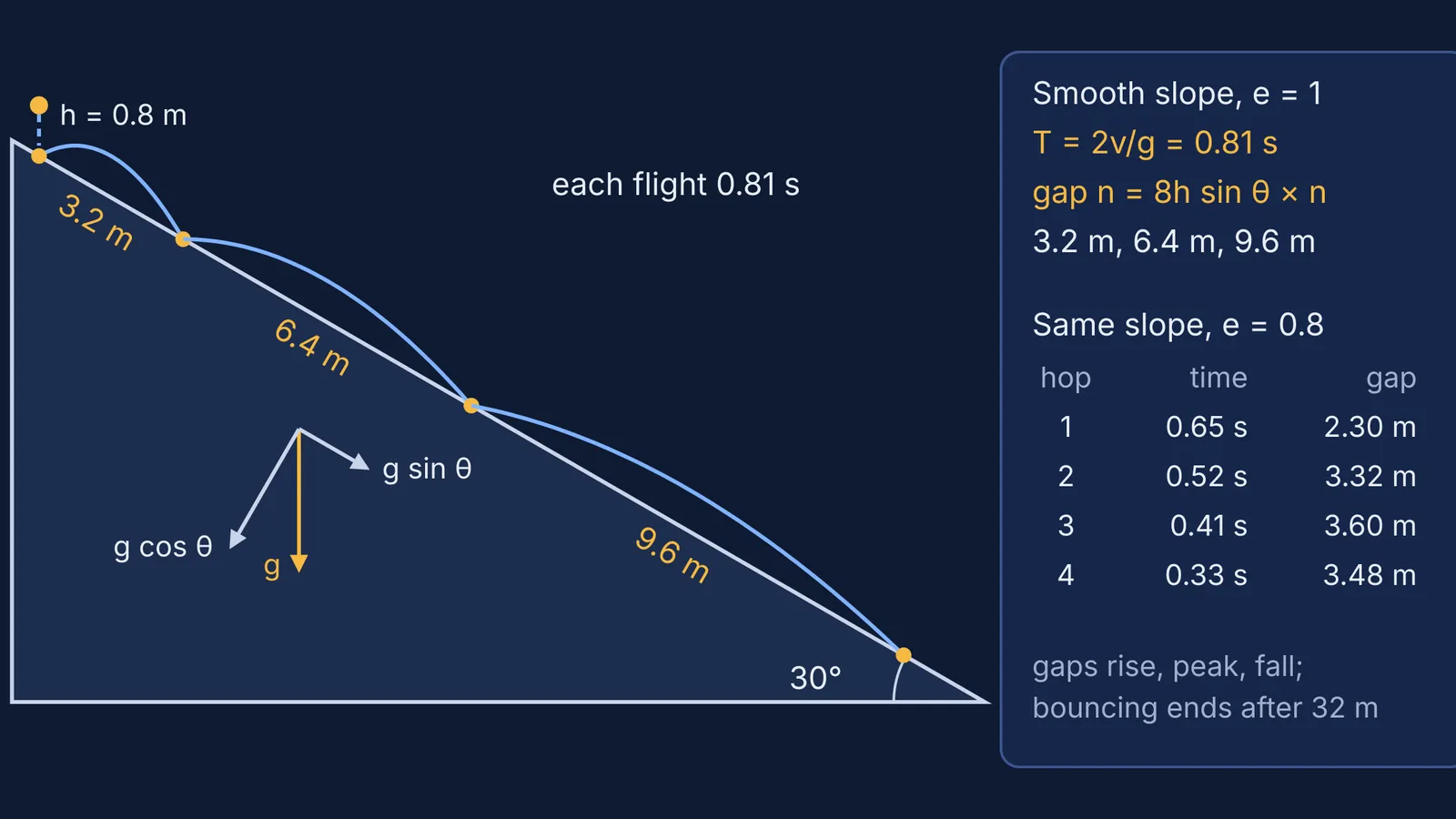
Drop a ball onto a smooth slope and it does not bounce in place. It hops down the slope, and each hop is longer than the last. With perfect bounces on a 30° slope, a ball dropped from 0.8 m lands 3.2 m, then 6.4 m, then 9.6 m further down, and every hop takes the same 0.81 s. It is a JEE Advanced-pattern setup that is messy with horizontal axes and short with tilted ones.
Why use axes along and across the incline?
Gravity points down, but the bounces happen against the slope. So take x down the slope and y out of it.
Along the slope, the acceleration is g sin θ, down the slope, all the time.
Across the slope, the acceleration is g cos θ, towards the slope, all the time.
The bounce only acts across the slope. A smooth surface exerts no force along itself.
The tilted-axis method for a single launch from a slope is in projectile range up a slope. Here the new part is what happens bounce after bounce.
What does the coefficient of restitution change at each bounce?
The coefficient of restitution e compares speeds normal to the surface: the speed of separation is e times the speed of approach. On level ground the normal is vertical, which is why the level-ground results in bouncing ball problems: total distance, time and nth height use the vertical speed only.
On a slope, the normal is tilted. So at each impact:
The velocity component across the slope reverses and is multiplied by e.
The velocity component along the slope is unchanged, because a smooth slope cannot push along itself.
So nothing slows the ball along the slope, and g sin θ keeps speeding it up.
Why is every hop the same time when e = 1?
Let the ball fall a height h onto the slope. It arrives with speed v = √(2gh), straight down. Split it:
Across the slope: v cos θ, into the slope.
Along the slope: v sin θ, down the slope.
After a perfect bounce the across-slope component is v cos θ outwards. The ball now behaves like a projectile in the y direction with deceleration g cos θ. It returns to the slope after
T = 2(v cos θ)/(g cos θ) = 2v/g
The cos θ cancels. Every bounce sends the ball out with the same v cos θ, so every hop lasts the same time T, whatever the angle.
Why do the gaps grow as 1 : 2 : 3?
Along the slope, the ball starts the first hop at v sin θ and accelerates at g sin θ. In time T = 2v/g it covers
s₁ = (v sin θ)T + ½(g sin θ)T² = 2v² sin θ/g + 2v² sin θ/g = 4v² sin θ/g
Since v² = 2gh, this is s₁ = 8h sin θ.
During each hop the along-slope speed rises by (g sin θ)T = 2v sin θ, and the bounce does not take it away. So hop n starts at (2n − 1)v sin θ. The ½(g sin θ)T² term is the same every time, so each gap is longer than the one before by a fixed amount, 2v sin θ × T = 8h sin θ. The result is
sₙ = 8h sin θ × n
The gaps are in the ratio 1 : 2 : 3 : 4, an arithmetic progression, and the total distance after n hops is 8h sin θ × n(n + 1)/2.
Worked example: a ball dropped 0.8 m onto a smooth 30° incline
A small ball is released from rest 0.8 m above a point on a smooth incline of angle 30°. Collisions are perfectly elastic. Find the time between bounces and the distances between the first four impact points. Take g = 9.8 m/s².
Impact speed. v = √(2 × 9.8 × 0.8) = √15.68 = 3.96 m/s, straight down.
Components. Across the slope: 3.96 × cos 30° = 3.43 m/s. Along the slope: 3.96 × sin 30° = 1.98 m/s.
Accelerations. Across: g cos 30° = 8.49 m/s². Along: g sin 30° = 4.90 m/s².
Time of each hop. T = 2 × 3.43/8.49 = 0.808 s. Check: 2v/g = 2 × 3.96/9.8 = 0.808 s.
First gap. s₁ = 1.98 × 0.808 + ½ × 4.90 × 0.808² = 1.60 + 1.60 = 3.20 m. Check: 8h sin θ = 8 × 0.8 × 0.5 = 3.20 m.
Second gap. Along-slope speed at the start of hop 2: 1.98 + 4.90 × 0.808 = 5.94 m/s. s₂ = 5.94 × 0.808 + 1.60 = 6.40 m.
Third and fourth gaps. Starting speeds 9.90 m/s and 13.86 m/s give s₃ = 9.60 m and s₄ = 12.80 m.
So the impact points are 3.2 m, 6.4 m, 9.6 m and 12.8 m apart, 0.81 s apart in time.
What changes if the bounces are not perfect?
With e = 0.8 on the same smooth slope, each hop lasts 0.8 times as long as the one before, while the along-slope speed keeps growing. The two effects fight:
Hop 1: 0.65 s, gap 2.30 m.
Hop 2: 0.52 s, gap 3.32 m.
Hop 3: 0.41 s, gap 3.60 m.
Hop 4: 0.33 s, gap 3.48 m.
The gaps rise, peak at the third hop and then shrink, because the hop time is now shrinking faster than the slope speed grows. The hop times form a geometric series, so the bouncing stops after a total of 0.646/(1 − 0.8) = 3.23 s. In that time the ball moves 1.98 × 3.23 + ½ × 4.90 × 3.23² = 32.0 m down the slope. After that it slides on down the smooth slope with no more bounces.
How to find e for a real ball from bounce heights on level ground is covered in testing restitution from bounce heights.
A real slope is not smooth. Friction at each impact slows the along-slope motion and spins the ball, so real gaps are shorter. Check that the question says "smooth".
How do you practise problems like this for JEE?
The same method handles a ball thrown at a slope or bouncing off a wall: axes along and across the surface, e on the normal component only, two motions written separately.
If you want more tilted-axis and restitution problems with each step explained, the Fermi Problem Library has a step-by-step solver that explains the reasoning rather than just printing an answer. If you are preparing for JEE Main and Advanced, Fermi Test Prep offers personalised preparation with an AI tutor, live classes, adaptive mocks, mentorship and a study plan that updates based on mastery.
Quick checklist
Axes along and across the slope: accelerations g sin θ and g cos θ.
e acts only on the velocity component perpendicular to the slope.
On a smooth slope, the along-slope velocity is unchanged at each bounce.
With e = 1, every hop takes T = 2v/g, independent of θ.
Gaps are 8h sin θ × n: in the ratio 1 : 2 : 3.
With e < 1, hop times fall geometrically and the gaps rise and then fall.