On this page
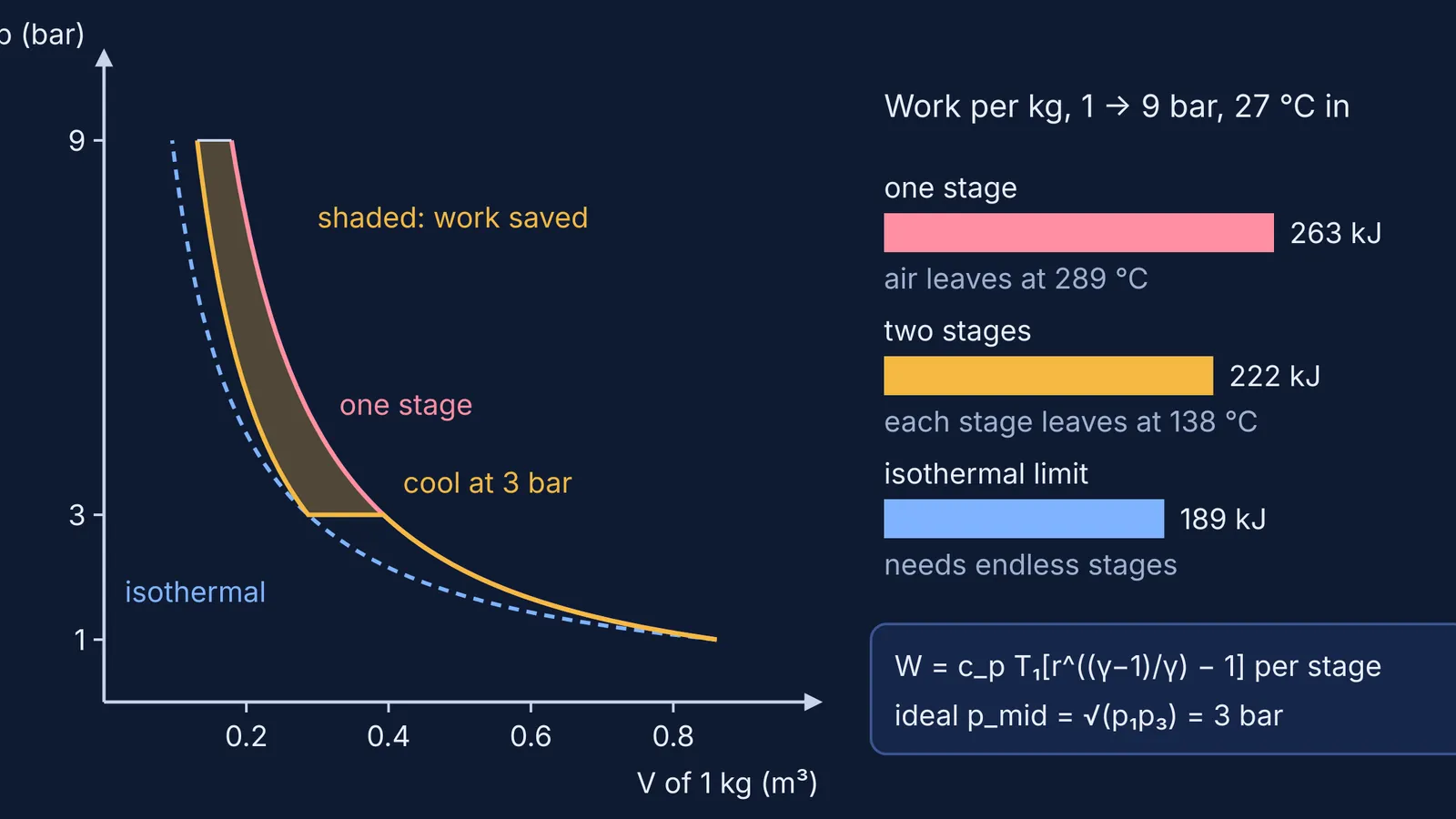
Look at the compressor in a tyre shop or a garage and you will often see two cylinders of different sizes joined by a finned pipe. Air is squeezed partly in the big cylinder, cooled in the finned pipe, then squeezed the rest of the way in the small one. This is not just a design habit. Squeezing hot air takes more work than squeezing cool air, so cooling it halfway through saves energy. For 1 kg of air taken to 9 bar, one stage needs about 263 kJ and two stages with cooling need about 222 kJ, roughly 16% less.
Why does air get hot when it is compressed?
A workshop compressor squeezes the air in a fraction of a second. There is no time for much heat to leak out through the cylinder walls, so the compression is close to adiabatic. All the work done on the gas goes into its internal energy and its temperature rises.
For an ideal adiabatic process, T p^((1−γ)/γ) stays constant, so
T₂ = T₁ (p₂/p₁)^((γ−1)/γ)
For air, γ = 1.4 and (γ − 1)/γ = 0.2857. Starting at 27 °C (300 K) and 1 bar, compressing to 9 bar gives T₂ = 300 × 9^0.2857 = 562 K, or about 289 °C. The same idea in the form TV^(γ−1) = constant, for a closed cylinder, is worked in finding the temperature after adiabatic compression.
Why does hot air take more work to compress?
At a given pressure, hot air takes up more volume than cool air. A compressor that works by pushing air through in a steady stream does work equal to the area between the curve and the pressure axis on a p–V diagram, and that area is larger when the volumes are larger.
The ideal limit is the isothermal process: compress so slowly, or cool so well, that the air stays at 27 °C throughout. The curve is then pV = constant, which is the lowest curve you can follow from 1 bar to 9 bar. How the two curves compare on a p–V graph is shown in adiabatic vs isothermal on the PV graph.
A real compressor cannot be isothermal, because it has to be fast. Staging is the practical compromise: compress adiabatically part of the way, cool the air back to room temperature at constant pressure in an intercooler, and compress again. The path zig-zags between the adiabatic curve and the isothermal curve.
How much work does each stage need?
For steady flow through a compressor, the work per kilogram equals the rise in enthalpy, c_p ΔT. This is not the c_v ΔT you use for gas sealed in a closed cylinder, because the compressor also has to push the air in and out. For an ideal adiabatic stage with pressure ratio r:
W = c_p T₁ [r^((γ−1)/γ) − 1]
The isothermal limit for steady flow is W = RT ln(p₂/p₁).
Worked example: 1 kg of air to 9 bar in one stage and in two
Take 1 kg of air at 1 bar absolute and 27 °C (300 K), compressed to 9 bar absolute. Use γ = 1.4, c_p = 1,005 J/kg K and R = 287 J/kg K. Treat the compressors as ideal (no friction, no leaks, no valve losses).
One stage. r = 9, so 9^0.2857 = 1.873. W = 1,005 × 300 × (1.873 − 1) = 263,300 J, about 263 kJ. The air leaves at 562 K (289 °C).
Choose the middle pressure. Use the geometric mean of 1 and 9 bar: √(1 × 9) = 3 bar. Each stage then has r = 3.
First stage, 1 → 3 bar. 3^0.2857 = 1.369. W₁ = 1,005 × 300 × 0.369 = 111,200 J. The air leaves at 410.6 K, about 138 °C.
Intercooler. The air is cooled back to 300 K at 3 bar. It gives up c_p ΔT = 1,005 × 110.6 = 111 kJ of heat to the fins.
Second stage, 3 → 9 bar. It starts at 300 K with r = 3 again, so W₂ = 111.2 kJ and the air leaves at about 138 °C.
Total. W = 111.2 + 111.2 = 222.3 kJ, which is 15.6% less than one stage.
Isothermal limit. W = 287 × 300 × ln 9 = 189.2 kJ.
Units check: c_p T is (J/kg K) × K = J/kg, so each answer is per kilogram of air.
Two stages save 41 kJ, more than half of the 74 kJ gap between one stage and the isothermal ideal. A third stage, at a ratio of 9^(1/3) = 2.08 each, brings the total down to 210.5 kJ: a further 12 kJ, a smaller gain for a third cylinder and a second intercooler. The gain from each extra stage keeps shrinking, which is one reason workshop machines usually stop at two.
Why is the ideal middle pressure the geometric mean?
Try other choices with the same formulas. With the intercooler at 2 bar, the stages have ratios 2 and 4.5, and the total is 227.9 kJ. With it at 4.5 bar, the ratios are 4.5 and 2, and the total is again 227.9 kJ. At 3 bar it is 222.3 kJ, the lowest.
The reason is symmetry. When the air is cooled back to the same starting temperature, the work of each stage depends only on its pressure ratio. The total is least when the two ratios are equal, which means p_mid/p₁ = p₃/p_mid, or p_mid = √(p₁p₃). For N stages, each stage takes the Nth root of the overall ratio. This is the standard result for ideal intercooled compression; a 2021 paper in Entropy by Lugo-Méndez and co-authors on interstage pressures of a multistage compressor states it and notes that minimum work occurs for isothermal compression, which would need an infinite number of intercoolers.
What changes in a real compressor?
Real compression is not perfectly adiabatic and not frictionless. Valves, leaks and friction add work, and the intercooler does not get the air all the way back to room temperature, so a real machine needs more than these ideal figures. The ideal numbers are still the right way to compare one stage with two.
Manufacturers make the same split in practice. The compressor maker ABAC explains in its guide to choosing a two-stage air compressor that the air is compressed to an intermediate pressure, cooled in an intercooler and compressed again. It describes single-stage machines as commonly reaching about 8 bar and two-stage machines about 10–11 bar, or up to 15 bar depending on the model.
Lower delivery temperature also matters for the machine. ABAC notes that staging reduces thermal stress; ideal one-stage air would leave at 289 °C, while two stages keep each outlet near 138 °C in the ideal case. The use of an intercooler in a car engine, where the aim is denser air rather than less work, is covered in how a turbocharger works.
If adiabatic and isothermal processes, c_p and c_v still feel slippery, the Concept Library explains each idea in thermodynamics from the start.
Quick checklist
Fast compression is close to adiabatic: T₂ = T₁ r^((γ−1)/γ).
Hot air takes more work to compress; isothermal is the minimum.
Steady-flow work per stage: c_p T₁[r^((γ−1)/γ) − 1].
Cool back to the inlet temperature between stages.
Ideal middle pressure: √(p₁p₃), equal ratios in each stage.
Always use absolute pressures.