On this page
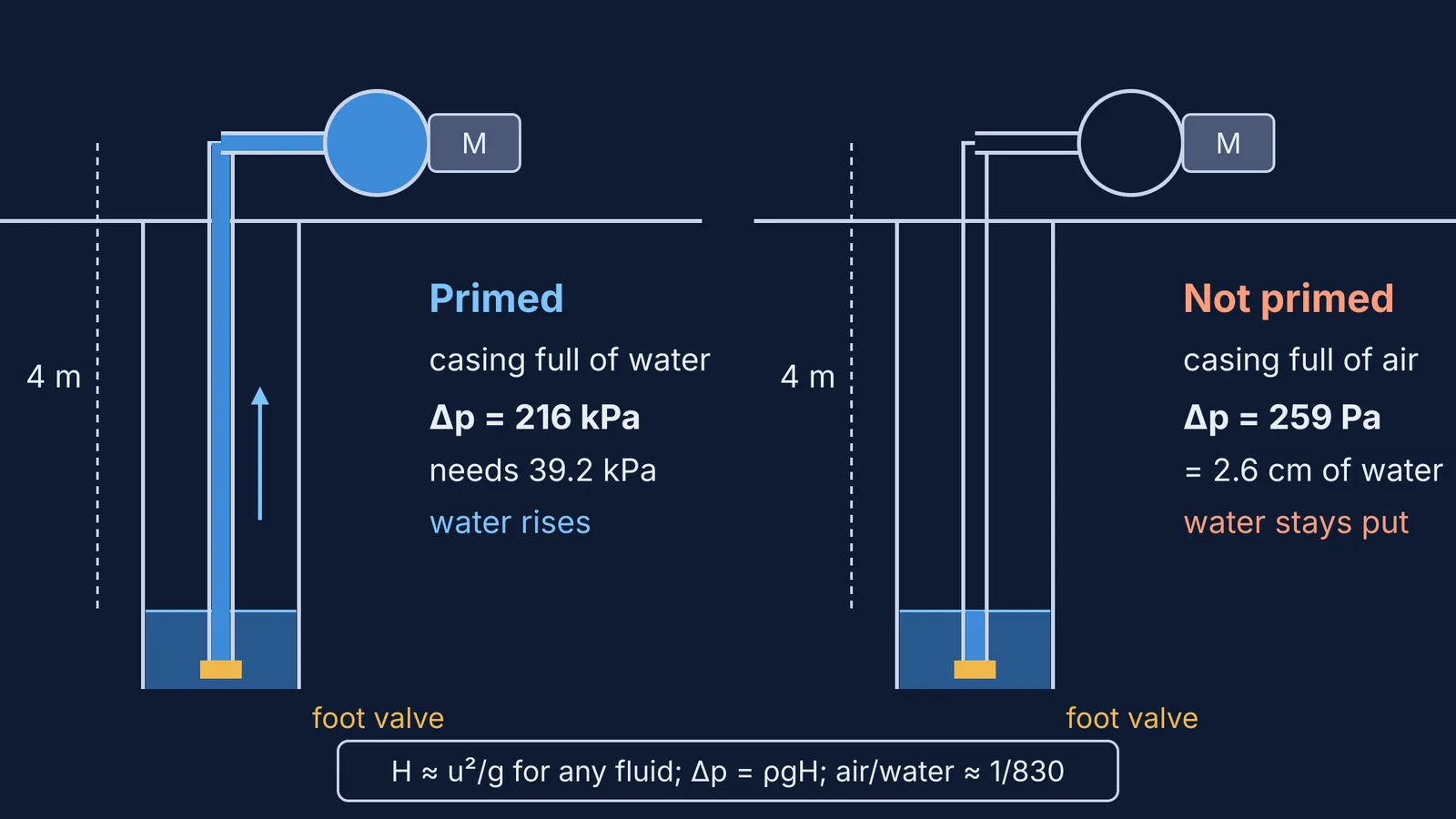
Before starting a monoblock pump on a farm well, you pour water into the casing through the priming plug until it overflows. Skip that step and the motor hums, the shaft spins, and not a drop comes out. The pump is not broken. It is spinning air, and a centrifugal impeller that can push water up 22 m can push air only hard enough to hold up about 2.6 cm of water.
What does a centrifugal pump actually do to the water?
A centrifugal pump has an impeller spinning inside a spiral casing. Water enters at the centre (the eye), is flung outwards by the vanes, and the casing turns its speed into pressure.
The useful way to measure what a pump gives the liquid is head, H: the energy added per unit weight of liquid, measured in metres. For an ideal impeller with radial vanes, Euler's turbine equation gives a head of about u²/g, where u is the speed of the impeller's rim (its tip speed). Real impellers lose some of this to vane shape, leakage and friction, so their head is lower.
The pressure rise across the pump then follows from the hydrostatic relation:
Δp = ρgH
One metre of head in water is about 9.8 kPa.
Why does the head not depend on the liquid, but the pressure does?
Look at the formula for head again: u²/g. It contains the tip speed and g, and nothing about the liquid. That is because head is energy per unit weight. Every kilogram that passes through the impeller is given at most about u² joules of energy (u in m/s), whatever it is made of. Double the density and you double both the energy delivered and the weight it is shared over, so the ratio stays the same.
The pressure rise is a different story. Δp = ρgH is directly proportional to density. Air at room temperature has a density of about 1.2 kg/m³ and water about 1,000 kg/m³, so air is roughly 830 times lighter. With the same head, a pump full of air makes about 830 times less pressure than a pump full of water.
This is the same ρu² scaling behind the fan affinity laws. A water pump spinning in air is a very poor fan.
Why can a pump full of air not lift water up the suction pipe?
The pump does not suck water up. The atmosphere pushes it. For water to rise h metres up the suction pipe, the pressure at the impeller eye must fall below atmospheric pressure by ρ_water × g × h. Air at the eye has to be pumped out to create that low pressure.
With water in the casing, the impeller easily makes that pressure difference. With air, the difference is so tiny that the water in the pipe barely moves. Pump manufacturer KSB puts it plainly: ordinary centrifugal pumps are unable to evacuate the air from an inlet line that runs down to a liquid level below the pump. Engineering references describe the same failure as the impeller becoming gas-bound and incapable of pumping.
That is why the casing and suction pipe are filled before starting, and why the pipe has a foot valve at its bottom end. This one-way valve lets water in but stops it draining back to the well when the pump stops, so the pump stays primed.
How much pressure does an air-filled pump make? A worked example
Take a pump with an impeller 125 mm across, driven at 2,900 rpm, which is typical of a two-pole motor on 50 Hz mains. Assume the real head is 60% of the ideal u²/g. This 60% is an illustrative round value, not a datasheet figure.
Tip speed. u = πDN/60 = π × 0.125 m × 2,900 / 60 = 19.0 m/s.
Ideal head. u²/g = 19.0² / 9.81 = 36.7 m.
Real head. 0.60 × 36.7 m = 22.0 m. Same for water or air.
Pressure rise with water. Δp = ρgH = 1,000 × 9.81 × 22.0 = 216 kPa, a little over two atmospheres.
Pressure rise with air. Δp = 1.2 × 9.81 × 22.0 = 259 Pa.
Express that in water. 259 Pa / (1,000 × 9.81) = 0.026 m, or 2.6 cm of water.
What the suction pipe needs. Say the water in the well is 4 m below the pump. The pressure at the eye must drop by 1,000 × 9.81 × 4 = 39.2 kPa.
Compare. 39.2 kPa / 259 Pa = 151. The air-filled pump falls short by a factor of about 150.
Units: kg/m³ × m/s² × m = N/m² = Pa. The 60% guess does not matter: even at the full ideal head of 36.7 m, an air-filled pump makes only 432 Pa, about 4.4 cm of water.
If you want to see how pressure, density and depth connect, the Concept Library explains each idea in fluids step by step.
How high can a primed pump lift water from a well?
Even a primed pump cannot pull water from more than about 10.3 m below it, because atmospheric pressure, about 101 kPa, can only hold up a water column of that height: 101,325 / (1,000 × 9.81) = 10.3 m.
In practice the limit is lower: water's vapour pressure (about 2.3 kPa at 20 °C), pipe friction and the pressure margin each pump needs at its eye to avoid cavitation all eat into it. Manufacturers give this margin as the pump's required NPSH, and KSB's lexicon explains how NPSH limits the suction side. The safe suction lift for a given pump comes from its datasheet. For deeper water tables, submersible pumps sit below the water and push it up instead.
A piston hand pump moves a fixed volume each stroke, so it can pull out air too; see how a hand pump lifts water. To work out the power a primed pump needs once water is flowing, see pump power to lift water to a rooftop tank.
What are self-priming pumps, and why should a pump never run dry?
A self-priming pump keeps a reserve of water in a chamber of its casing. On starting, the impeller mixes that water with air from the suction pipe, the air separates out and leaves, and the water recirculates. It does not break the rule; it carries its own priming water, which must be filled before the first start.
Never run a centrifugal pump dry. The shaft seal is cooled and lubricated by the water around it, and with only air it overheats and can crack. If a pump loses its prime, switch it off, refill it, and look for a leaking foot valve or a loose suction joint.
Quick checklist
Head from an impeller is about u²/g at most, and it is the same for water and air.
Pressure rise is Δp = ρgH, so air gives about 830 times less than water.
An air-filled pump making 22 m of head lifts only about 2.6 cm of water.
The atmosphere pushes water up the suction pipe; the pump only lowers the pressure.
Priming fills the casing so the impeller works on water; a foot valve keeps it full.
Suction lift is always below 10.3 m; check the pump's NPSH on its datasheet.