

On this page
Across India, a motor hums each morning to fill the tank on the roof. How much power does it need? The answer has two parts, and it is easy to forget the second.
What formula gives the power of a pump lifting water?
Power is work done divided by the time taken, and one watt is one joule per second, as OpenStax University Physics defines it. A pump does two jobs on every kilogram of water it moves:
It raises the water through a height h, giving it potential energy mgh.
It pushes the water out of the pipe at speed v, giving it kinetic energy ½mv².
Add the two and divide by the time t:
P = (mgh + ½mv²) / t
This is the same energy bookkeeping as Bernoulli's equation, which OpenStax describes as conservation of energy for an incompressible fluid without friction, with ½ρv² as kinetic energy per unit volume and ρgh as potential energy per unit volume.
If the water flows at a volume rate Q (cubic metres per second) and has density ρ, then m/t = ρQ, and the formula becomes:
P = ρQ(gh + v²/2)
How do you convert litres per minute into kilograms per second?
One litre is exactly 0.001 cubic metres, according to the NIST guide to SI conversion factors.
The density of water is 0.9998395 g/mL at 4 °C, which the USGS Water Science School notes is usually rounded to 1 g/mL. That is 1000 kg per cubic metre, so one litre of water has a mass of about 1 kg.
Divide by 60 to go from per minute to per second.
So 60 litres per minute is 60 kg per minute, which is 1 kg per second. Write the flow as Q = 0.001 m³/s before you touch the formula.
Worked example: how much power to fill a rooftop tank at 60 litres per minute?
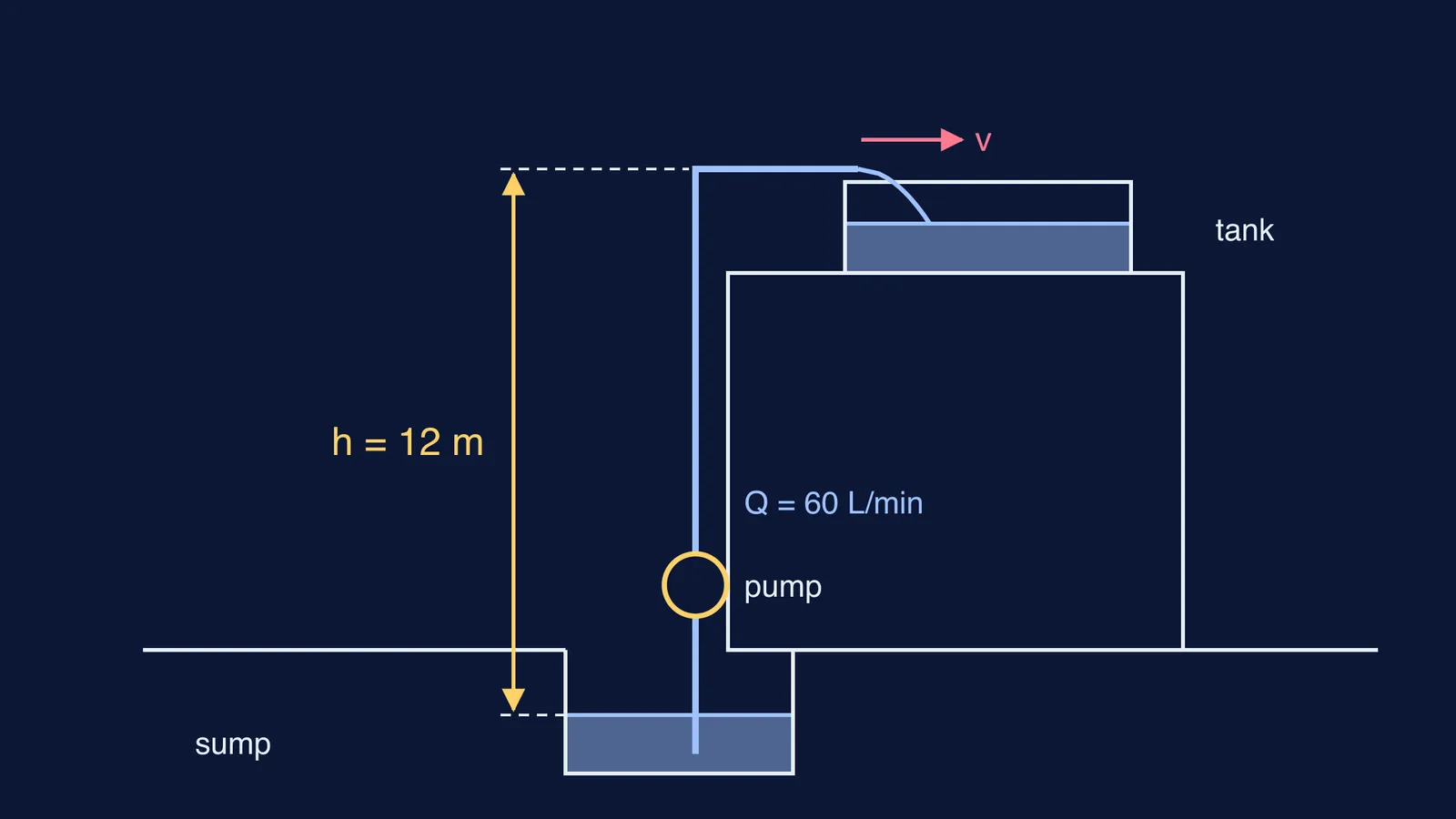
A pump draws water from a ground-level sump and delivers it through a pipe of internal diameter 2 cm to a tank whose inlet is 12 m above the water surface in the sump. It delivers 60 litres per minute. Ignore friction. Take g = 9.8 m/s², rounded from the standard value of 9.80665 m/s² listed by NIST, and water density 1000 kg/m³ from the USGS figure above.
Step 1: mass per second. m/t = 1000 × 0.001 = 1 kg/s.
Step 2: power to lift. (m/t)gh = 1 × 9.8 × 12 = 117.6 W.
Step 3: outflow speed. The pipe's area is π × (0.01)² = 3.14 × 10⁻⁴ m². Speed v = Q / A = 0.001 / 0.000314 = 3.18 m/s.
Step 4: power to give kinetic energy. ½ × (m/t) × v² = ½ × 1 × 3.18² = 5.1 W.
Step 5: add. P = 117.6 + 5.1 = 122.7 W, or about 123 W.
To fill a 1000-litre tank at this rate takes 1000 ÷ 60 = 16.7 minutes, and the useful energy delivered is about 123 kJ. To turn that into electricity-bill units, see the difference between a kilowatt and a kilowatt-hour.
Why does the pipe size change the answer?
The lifting term depends only on mass flow and height. The outflow term depends on v², and v rises as the pipe narrows. Keep the same 60 litres per minute from the example above and halve the pipe diameter to 1 cm:
the area falls to a quarter, so v becomes 12.7 m/s;
v² rises sixteen-fold, so the kinetic term jumps from 5.1 W to about 81 W;
the total becomes about 199 W, though the height has not changed.
When a question gives the pipe area, check whether the second term is still small.
What about efficiency and horsepower?
The 123 W above is the power delivered to the water. A real pump loses energy to pipe friction and motor heat, so it draws more. If a question says the pump is 60% efficient, divide: input power = 122.7 ÷ 0.6 ≈ 204 W. For more on this step, see our guide to power and efficiency problems with motors, pumps and lifts.
One horsepower (550 ft·lbf/s) is 745.6999 W, per the NIST conversion table. So 122.7 W is about 0.16 hp. Practise more with our horsepower-to-watts walkthrough.
If your answer keeps coming out a thousand times too big, the litre conversion is usually the culprit. The Fermi Problem Library has worked problems with a step-by-step solver that explains the reasoning rather than printing an answer, so you can see which step went wrong. If the idea of energy per unit volume still feels shaky, the Fermi Concept Library gives each concept its own lesson.
Try it: work out the power for your own building at 30 litres per minute.


