

On this page
Many power numericals hide one conversion that costs marks: horsepower to watts. Multiply horsepower by 746 to get watts; divide watts by 746 to get horsepower. The rest is finding power in watts: work in joules divided by time in seconds.
How do you convert horsepower to watts?
The US National Institute of Standards and Technology lists one horsepower (550 ft·lbf/s) as 745.6999 W and the “electric horsepower” as exactly 746 W (NIST SP 811, Appendix B.9). School problems usually use the rounded value, 1 hp = 746 W. The same NIST table lists a metric horsepower of 735.4988 W, so if a question states its own value, use that one.
hp to W: multiply by 746. A 2 hp motor delivers 2 × 746 = 1492 W.
W to hp: divide by 746. A 3730 W engine is 3730 ÷ 746 = 5 hp.
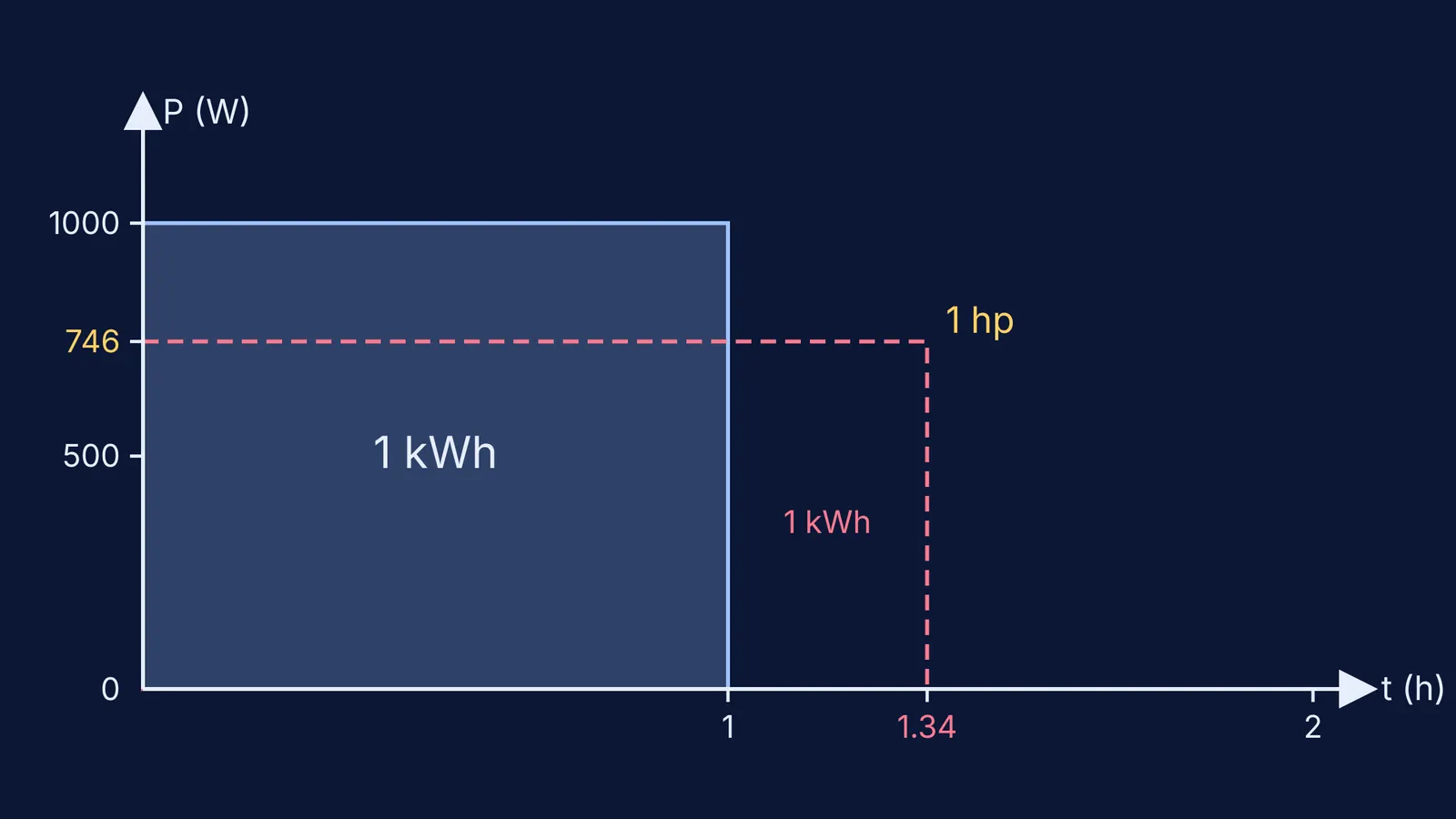
kW to hp: multiply by 1000 first, then divide by 746. So 1 kW is about 1.34 hp.
What is the formula for power from work and time?
Power is the rate of doing work. In the SI, the watt is one joule per second, 1 W = 1 J/s (BIPM SI Brochure, concise summary, Table 2). So P = W / t.
Watch two things. Time must be in seconds: 5 minutes is 300 s, not 5. And when a force F moves something at a steady speed v, the work done each second is F × v, so P = Fv. If work itself feels shaky, start with our guide to work, energy and power in Class 9.
Worked example 1: how much horsepower does a water pump need?
A pump lifts 600 litres of water (600 kg) to a tank 15 m up in 5 minutes. Take g = 9.8 m/s². Find the output power in W and hp, and the input power if the pump is 60% efficient. Use 1 hp = 746 W (NIST).
Work done against gravity: W = mgh = 600 × 9.8 × 15 = 88,200 J.
Time in seconds: 5 min = 300 s.
Output power: P = 88,200 ÷ 300 = 294 W.
In horsepower: 294 ÷ 746 ≈ 0.39 hp.
Input power: 294 ÷ 0.60 = 490 W, about 0.66 hp.
Efficiency gets a fuller treatment in our post on power and efficiency problems with motors, pumps and lifts.
Worked example 2: what power does a lift motor need?
A lift and its passengers have a total mass of 1500 kg. The lift rises at a constant 2.0 m/s against a frictional force of 2000 N. Find the minimum motor power in kW and hp (g = 9.8 m/s², 1 hp = 746 W as listed by NIST).
At constant speed, the motor's pull equals weight plus friction: F = 1500 × 9.8 + 2000 = 16,700 N.
Use P = Fv: P = 16,700 × 2.0 = 33,400 W = 33.4 kW.
In horsepower: 33,400 ÷ 746 ≈ 44.8 hp.
The usual slips are leaving out friction, or using the mass (1500) instead of the weight (14,700 N).
Is kW the same as kWh?
No. A kilowatt (kW) is power, a rate. A kilowatt-hour (kWh) is energy, a total. NCERT's Class 10 science chapter on electricity calls the kilowatt hour the commercial unit of electric energy, commonly known as a “unit”, and works out that 1 kWh = 3.6 × 10⁶ J (NCERT Class 10 Science, Chapter 11: Electricity). Since 1 h = 3600 s (BIPM SI Brochure, Table 4), 1000 W × 3600 s = 3,600,000 J.
Back to the pump: it draws 490 W and runs 5 minutes per fill, twice a day, for 30 days.
Running time: 10 minutes a day is 1/6 h, so 30 days is 5 h.
Energy: 490 W × 5 h = 2450 Wh = 2.45 kWh, or 2.45 “units” on the bill.
The motor's power (490 W) never changes; the kWh grows the longer it runs. For bill-style numericals, see our guide to the heating effect of current, power and energy bills.
What steps solve any power numerical?
Convert every quantity to SI: kg, m, s, N.
Find the work or energy in joules (mgh, Fd or ½mv²).
Divide by the time in seconds, or use P = Fv at constant speed.
Apply efficiency only after that: input = output ÷ efficiency.
Convert last: divide watts by 746 for hp or by 1000 for kW, and multiply kW by hours for kWh.
If one step keeps going wrong, work through similar problems in the Fermi Problem Library, where the step-by-step solver explains the reasoning rather than printing an answer. If the gap is the idea of power itself, the Fermi Concept Library gives each physics concept its own lesson.


