

On this page
If you have ever used a hand pump to draw water from a well, it feels like the pump is sucking the water up the pipe. But physics tells a different story.
A pump does not pull water; it only removes air. The real heavy lifting is done by the weight of the air around us, pushing down on the ground. Because the Earth's atmosphere has a finite weight, this "push" has a strict limit. No matter how powerful the pump, it can never lift water higher than about 10.3 metres (Wikipedia).
Why doesn't a hand pump suck water?
To understand a hand pump, you have to look at the invisible ocean of air we live in. Air has weight. At sea level, atmospheric pressure exerts a force of about 14.7 pounds on every square inch of surface (Wikipedia).
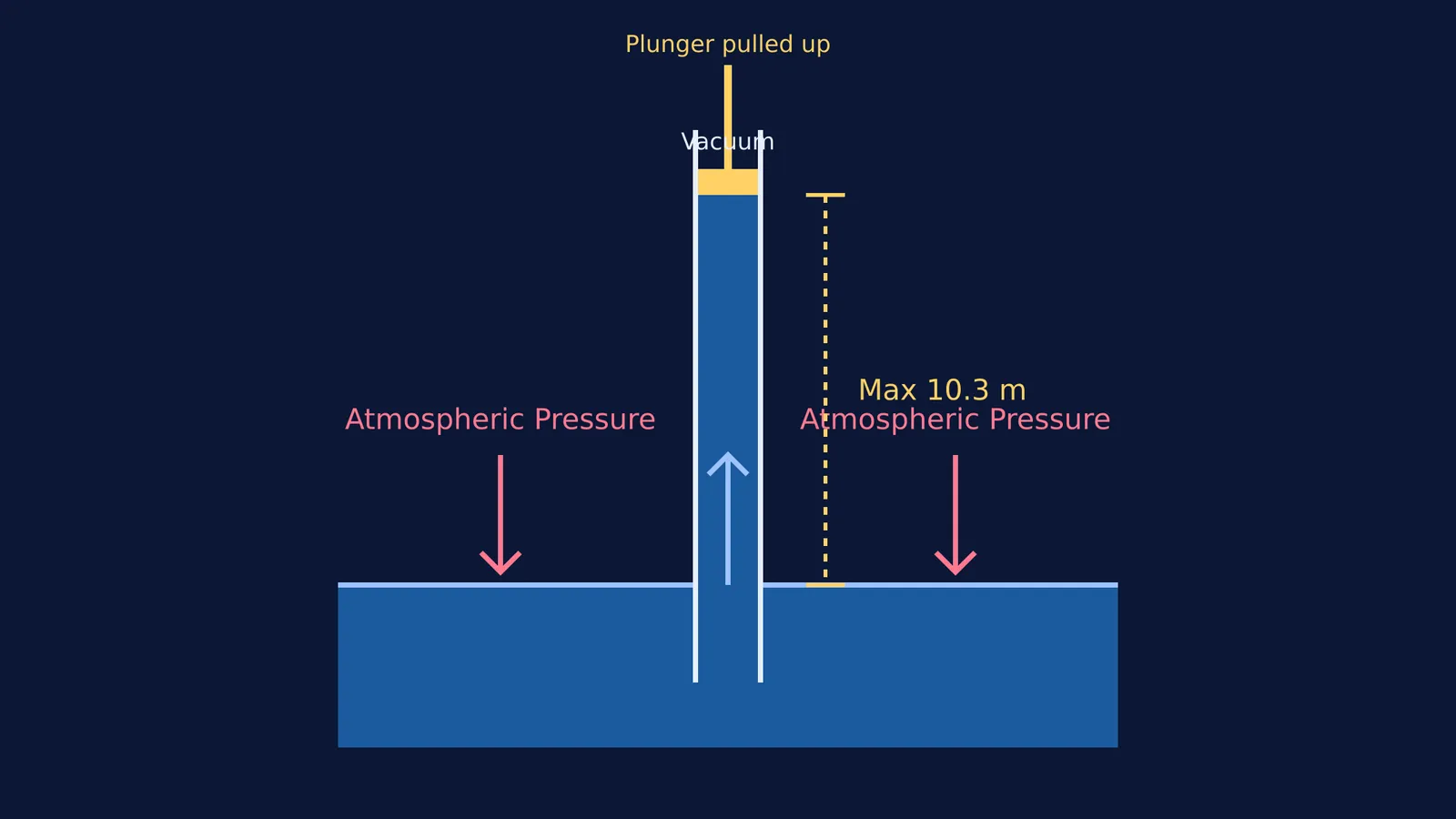
When a hand pump is resting, the air pressure inside the pipe and the air pressure outside on the well water are exactly the same. The water stays put, resting at the level of the water table.
When you pull the pump handle down, a plunger inside the cylinder rises. This increases the volume below the plunger, creating a partial vacuum—a zone of low pressure. Now, the pressure inside the pipe is significantly lower than the atmospheric pressure outside.
The atmosphere continues to press down on the exposed water in the well. Because there is less resistance inside the pipe, the atmosphere pushes the water up into the pipe to fill the empty space. The pump merely clears the way; the atmosphere does the actual lifting.
Drinking from a straw: a miniature hand pump
This mechanism is not unique to heavy machinery. When you drink from a straw, you are doing exactly what a hand pump does. Your mouth does not magically pull the liquid up. Instead, your lungs and cheeks expand, creating a partial vacuum inside your mouth. The atmospheric pressure pushing down on the surface of the drink in your glass then forces the liquid up the straw.
If you were to use a straw longer than 10.3 metres (Wikipedia), no matter how hard you tried to "suck", the liquid would never reach your mouth. The atmospheric pressure simply isn't strong enough to push a column of water that high. This is also why tall trees cannot rely on atmospheric pressure alone to transport water from their roots to their leaves, relying instead on capillary action and transpiration pull.
Why is there a 10-metre limit on suction pumps?
Because a suction pump relies entirely on atmospheric pressure, it is limited by how much the atmosphere can push.
Using the hydrostatic pressure formula, we can calculate this hard ceiling. A standard atmospheric pressure divided by the density of water and gravity gives a theoretical maximum height of 10.3 metres (about 33.9 feet) at sea level (Wikipedia).
Even a pump that creates a perfect vacuum cannot draw water from deeper than 10.3 metres. The atmosphere simply does not have enough weight to push the water column any higher. In the real world, friction against the pipe walls, imperfect seals, and water beginning to evaporate (cavitation) at low pressures mean most hand pumps max out at less than 7 metres (Wikipedia).
If you live in a city at a high altitude, the atmospheric pressure is inherently lower because there is less air above you. Consequently, the maximum lifting height of a suction pump drops even further as you go up into the mountains.
Galileo, Torricelli and the "horror vacui"
In the early 1600s, Italian well-diggers brought a problem to Galileo Galilei: their suction pumps consistently failed to lift water deeper than 10 metres. Galileo was puzzled, initially suspecting that the "rope of water" was breaking under its own weight, much like a physical string snapping. At the time, scientists believed in *horror vacui*, the idea that "nature abhors a vacuum", but this did not explain the strict limit.
It was his student, Evangelista Torricelli, who solved the mystery in 1643. Torricelli reasoned that the lift was caused by the weight of the air. To test this without needing a massive 10-metre glass tube, he used mercury, which is about 13.5 times denser than water. He demonstrated that the atmosphere could only support a mercury column about 76 centimetres (30 inches) high (Wikipedia). By doing this, Torricelli had invented the barometer and conclusively proved that "suction" was just the measurable push of the atmosphere.
This was further confirmed in 1648 when Blaise Pascal measured pressure on a mountain, showing that as altitude increases and atmospheric weight drops, the column of liquid in a barometer falls correspondingly.
How do we pump water from deep wells?
If a well is very deep, a suction pump at the surface is mathematically useless. To solve this, engineers use submersible pumps or deep-well jet pumps.
Instead of sitting at the top and lowering the pressure, a submersible pump is lowered entirely to the bottom of the well. It takes the water and forcefully pushes it upward. While atmospheric pressure puts a hard ceiling on pulling water, there is no physical limit to how hard a motor can push water from below.
If you want to explore the relationship between pressure, depth, and fluid mechanics, you can try it yourself in the Fermi Simulation Lab. Seeing a live, interactive model of a pump balancing atmospheric pressure often makes these abstract mathematical limits click instantly.


