On this page
Drive past a large solar park in India and you may see rows of panels that are not fixed. In the morning they face east, at noon they lie flat, and by evening they face west. These are single-axis trackers. Each row turns about a north–south axis so that it keeps facing the Sun as it crosses the sky. The physics question is simple: how much more sunlight does that turning collect? The answer comes in two steps, one from pure geometry and one from the air the light passes through.
How much sunlight does a fixed panel miss?
A panel collects the beam in proportion to the cosine of the angle between the sunlight and the panel's normal. That cosine rule, and how tilt changes it at one moment, is covered in solar panel tilt angle in India. Here we add it up over a whole day.
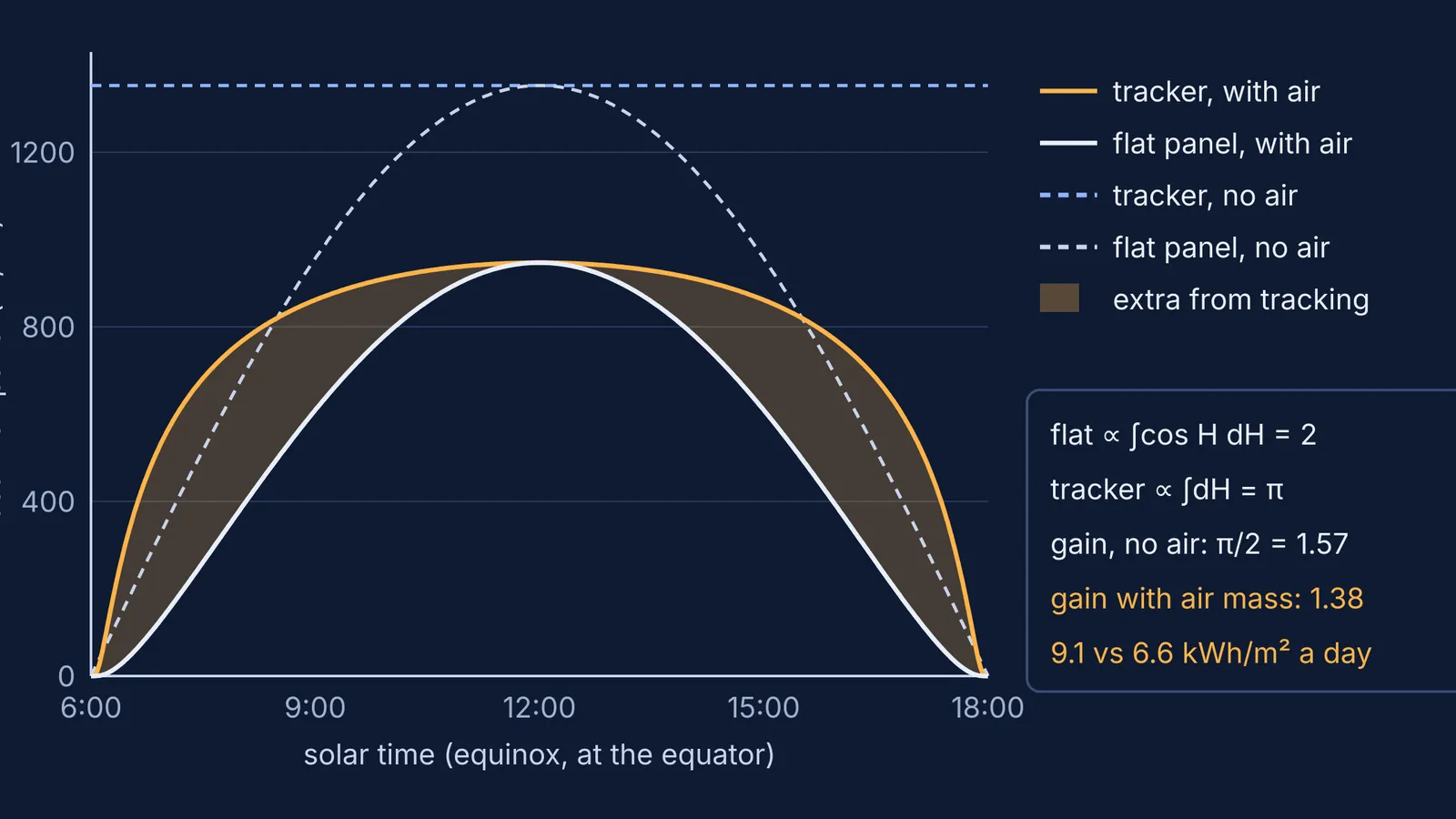
Take the simplest case: the equator on an equinox. The Sun rises due east at 6:00, passes straight overhead at noon and sets due west at 18:00. Its hour angle H grows by 15° every hour, from −90° at sunrise to +90° at sunset.
A flat panel facing straight up meets the beam at angle H, so it collects the beam × cos H.
A tracker turns to face the Sun all day, so it always collects the full beam.
Why does geometry alone give a 57% gain?
Suppose the beam had the same strength all day, as it would with no air. Energy collected is power × time, and time is proportional to H, so add up over H from −π/2 to +π/2:
Flat panel: ∫cos H dH = sin(π/2) − sin(−π/2) = 2.
Tracker: ∫1 dH = π.
Ratio: π/2 = 1.571.
So by geometry alone a tracker collects 57% more than a flat panel. With a beam of 1,353 W/m² (the solar constant used in the model below) for 12 hours, the flat panel would get 10.3 kWh/m² and the tracker 16.2 kWh/m². The gain comes entirely from the mornings and evenings, when cos H is small. At noon both panels collect the same.
Why does the air cut the gain to about 38%?
Early and late in the day, sunlight crosses far more air. The air mass, AM, is the path length through the atmosphere compared with the path when the Sun is overhead. For a flat atmosphere, AM = 1/cos(zenith angle), and at the equinox on the equator the zenith angle equals H.
A widely used clear-sky fit from Meinel and Meinel (1976), given on PVEducation's air mass page, is:
I = 1,353 × 0.7^(AM^0.678) W/m²
The 0.7 says that roughly 70% of the beam gets through one air mass. Treat this as a model of a clear day, not a measurement for any one place.
Worked example: one clear equinox day at the equator
Noon, H = 0°. AM = 1, I = 1,353 × 0.7 = 947 W/m². Flat panel and tracker both get 947 W/m².
9:00, H = −45°. AM = 1/cos 45° = 1.414. I = 1,353 × 0.7^(1.414^0.678) = 862 W/m². The tracker gets 862 W/m²; the flat panel gets 862 × cos 45° = 609 W/m².
7:00, H = −75°. AM = 3.86. I = 555 W/m². The tracker gets 555 W/m²; the flat panel gets only 144 W/m².
Add up the day. Integrating both curves from sunrise to sunset (numerically, with python3) gives 9.1 kWh/m² for the tracker and 6.6 kWh/m² for the flat panel.
Gain. 9.11/6.61 = 1.38, so the tracker collects about 38% more beam light, not 57%.
The reason is plain from step 3. The hours where the tracker wins most are exactly the hours when the beam is weakest, because the light has crossed several air masses. Near sunrise the formula AM = 1/cos(zenith) even runs to infinity, which overstates the loss, but the beam is so weak then that it barely changes the daily total.
How much more energy do trackers give in India?
Less again. A measured comparison comes from a 25 MW plant in Andhra Pradesh, where 3 MW of horizontal north–south single-axis trackers sit beside 22 MW of fixed arrays tilted at the local latitude (15.6°). Kinsey and co-authors reported an energy gain of roughly 15% for the trackers. Their PV Tech technical briefing gives annualised yields of 1,810 kWh/kW for the trackers and 1,570 kWh/kW for the fixed arrays, a ratio of about 1.15.
Why so much less than 38%?
Diffuse light. Light scattered by the sky reaches a panel from all directions. PVEducation notes that diffuse light is about 10% of the direct beam even on a clear day, and much more on hazy or cloudy days. Turning the panel gains little of it.
Clouds and haze. Our worked example is a clear day. Monsoon months cut the beam that a tracker relies on.
The fixed panel is tilted, not flat. A latitude-tilted fixed array already faces the Sun better than a flat one away from the equator, and a horizontal tracker at 15.6° latitude does not face the Sun exactly.
Rows shade each other. Near sunrise and sunset, tracker rows turn back toward flat so they do not shade the row behind, the same winter shading problem worked for fixed rows in solar panel row spacing.
Trackers also cost more, use motors and must be turned flat in high winds. A park uses them only where the extra energy pays for that.
When must a solar system track the Sun?
For ordinary flat panels, tracking is optional. For concentrator systems it is not: a lens or mirror can only focus the direct beam, so the system has to point at the Sun at all times. Why concentrating light raises a cell's voltage only a little is explained in concentrator solar cells.
If the cosine factor is easier to see than to read about, the Simulation Lab has interactive simulations for ideas like this.
Quick checklist
Power on a panel = beam × cos(angle from the panel's normal).
Equator, equinox, constant beam: flat ∝ ∫cos H dH = 2, tracker ∝ π, gain π/2 = 1.57.
Air mass AM = 1/cos(zenith); clear-sky beam I ≈ 1,353 × 0.7^(AM^0.678) W/m².
With air mass the beam gain falls to about 1.38 (9.1 against 6.6 kWh/m² a day).
Diffuse light, clouds, tilt and row shading bring measured gains in India nearer 15%.
Concentrators must track; flat panels track only when it pays.