On this page
We wrote these 14 questions from Chapter 4 of NCERT Class 11 Biology, Animal Kingdom (Reprint 2026-27). In the NEET (UG) 2026 syllabus, it sits in Biology Unit 1, Diversity in Living World. None comes from a past paper or predicts one.
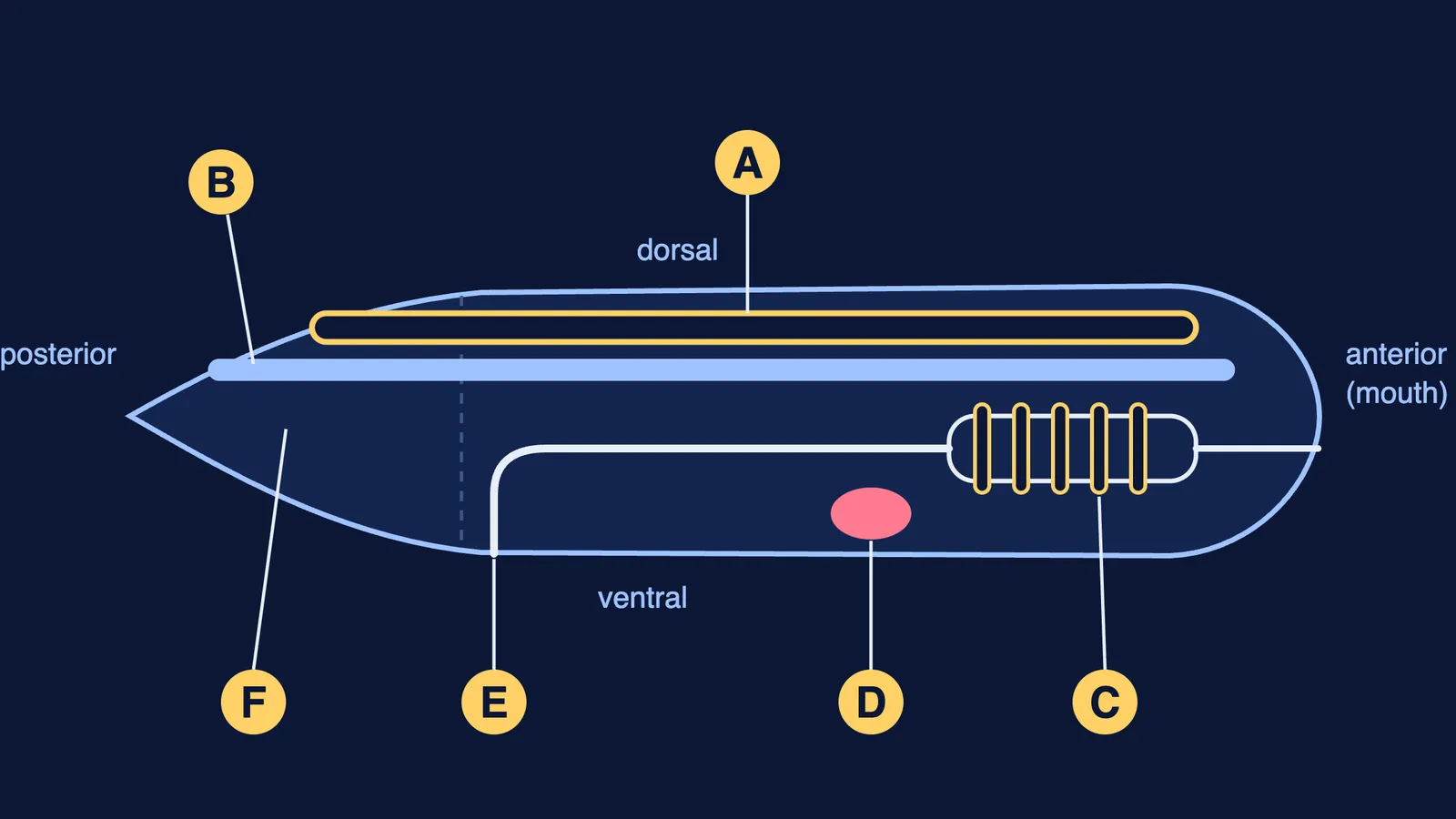
Why is the chordate body plan the lettered figure here?
Most figures in this chapter outline whole animals, such as *Sycon* or *Pavo*. Figure 4.16 instead lays out the features every chordate shares (NCERT kebo104). Our hero redraws that plan from the side, head to the right, with six parts lettered A to F; the heart comes from Table 4.1.
The letters serve Q1 to Q6; Q7 to Q14 work from words.
What is the quickest way into a lettered body plan?
Find the axes before any letter: dorsal, ventral, and the mouth end. In this chapter, position does half the work: nerve cord and heart swap sides between chordates and non-chordates.
Then sort parts by shape: a hollow tube, a solid rod and a row of slits each match one NCERT feature.
Two-statement options used throughout: (1) I and II both stand (2) I and II both fall (3) I stands, II falls (4) I falls, II stands.
Which chordate features are marked A to F?
Q1. In NCERT's account of Amphibia, which lettered part "may be present in some" members only? (1) A (2) D (3) F (4) B
Q2. NCERT's Figure 4.16, Chordata characteristics, labels four of our six parts. Which four? (1) A, B, C, F (2) A, B, D, F (3) B, C, D, E (4) A, C, E, F
Q3. Statement I: In adult *Petromyzon*, the cranium and the vertebral column that replaces B are both cartilaginous. Statement II: Cyclostomes live in fresh water and migrate to the sea to spawn.
Q4. An animal never forms B at any stage of its life. It could be: (1) *Ascidia* (2) *Asterias* (3) *Petromyzon* (4) *Branchiostoma*
Q5. In which animal does D have just one auricle and one ventricle? (1) *Catla* (2) *Rana* (3) *Crocodilus* (4) *Columba*
Q6. Statement I: NCERT lists paired appendages among the features all chordates share, alongside A, B, C and F. Statement II: In reptiles, limbs, when present, are two pairs.
Answer key for the lettered diagram
A: dorsal hollow nerve cord. B: notochord. C: pharyngeal gill slits. D: heart. E: anus. F: post-anal part (tail).
Q1: (3). NCERT gives a tail to some amphibians only; all have a nerve cord, an embryonic notochord and a heart.
Q2: (1). The figure labels nerve cord, notochord, gill slits and post-anal part; the ventral heart is in Table 4.1.
Q3: (3). Cyclostomes are marine and migrate to fresh water to spawn.
Q4: (2). Porifera to echinoderms are non-chordates; the other three are chordates.
Q5: (1). Bony fishes have a two-chambered heart; *Rana* has three chambers, crocodiles and birds four.
Q6: (4). NCERT gives paired fins or limbs to vertebrates, not to all chordates; Statement II is its reptile text.
Can you answer the other Animal Kingdom figures from a description?
Q7. Figure 4.1(a) shows a body that any plane through its central axis cuts into two identical halves. Which pair both have this plan? (1) *Nereis* and *Locusta* (2) *Adamsia* and *Pleurobrachia* (3) *Sycon* and *Spongilla* (4) *Fasciola* and *Ascaris*
Q8. Figure 4.2 compares germ layers. Statement I: In panel (a), the layer between ectoderm and endoderm is an undifferentiated mesoglea. Statement II: The embryo of *Taenia* would match panel (a).
Q9. Figure 4.3(b) is a section where mesoderm sits as scattered pouches between ectoderm and endoderm. Which animal fits it? (1) *Taenia* (2) *Hirudinaria* (3) *Octopus* (4) *Ancylostoma*
Q10. Figure 4.7 shows a cnidoblast. Which is not one of its uses in NCERT? (1) Anchorage (2) Defence (3) Capturing prey (4) Osmoregulation
Q11. Figure 4.6 shows two cnidarian body forms. Pair each genus with its feature. List-I: G. *Aurelia* H. *Adamsia* J. *Obelia* K. *Meandrina* List-II: (i) Coral with a calcium carbonate skeleton (ii) Umbrella-shaped and free-swimming (iii) Sessile and cylindrical (iv) Polyps make medusae asexually and medusae make polyps sexually (1) G-iii, H-ii, J-iv, K-i (2) G-ii, H-iii, J-iv, K-i (3) G-ii, H-iii, J-i, K-iv (4) G-iv, H-iii, J-ii, K-i
Q12. Figure 4.8 shows *Pleurobrachia* bearing eight outer rows of ciliated comb plates. Statement I: The rows help it move. Statement II: It reproduces both asexually and sexually.
Q13. Figures 4.19 and 4.20 show cartilaginous and bony fishes. Statement I: The fishes in Figure 4.20, such as *Hippocampus*, have an air bladder that regulates buoyancy. Statement II: The fishes in Figure 4.19, such as *Scoliodon*, must keep swimming to avoid sinking.
Q14. Which animal in Figure 4.24 lays eggs? (1) *Macropus* (2) *Pteropus* (3) *Balaenoptera* (4) *Ornithorhynchus*
Answers and NCERT reasons for Q7 to Q14
Q7: (2). Coelenterates and ctenophores are radial; annelids and arthropods are bilateral; sponges are mostly asymmetrical.
Q8: (3). Flatworms are triploblastic, so *Taenia* matches panel (b).
Q9: (4). *Ancylostoma*, the hookworm, is an aschelminth, a pseudocoelomate.
Q10: (4). NCERT lists anchorage, defence and prey capture only.
Q11: (2). Medusa, polyp, metagenesis and a calcium carbonate coral skeleton, in that order.
Q12: (3). Ctenophores reproduce only by sexual means.
Q13: (1). Bony fishes have an air bladder; cartilaginous fishes lack one, so they swim constantly.
Q14: (4). NCERT names the platypus as the oviparous mammal.
What should you redraw after this set?
From memory, sketch a chordate and a non-chordate side by side and mark the nerve cord and heart on each.
Tag every miss by figure and by cause: position, shape or function.
Redo the misses in two days and check them against the NCERT chapter.
Want questions without figures? Work through our Animal Kingdom statement and match-the-list practice, then the Animal Kingdom assertion-reason questions. For terms you keep mixing up, see our Animal Kingdom key terms glossary.
Which of these figures still feels shaky? Fermi's AI tutor works out what you already know and builds a plan for the session.