On this page
This glossary follows the NCERT Class 11 Biology chapter on Animal Kingdom (2026-27 reprint), and the scope set for Chapter 4 in the CBSE Class 11 Biology syllabus 2026-27: non-chordates up to phylum level and chordates up to class level. Definitions are ours; examples are NCERT's. For the whole chapter in one place, see our Animal Kingdom Class 11 chapter guide.
What are the bases of animal classification?
Cellular level of organisation: cells form a loose group with some division of labour but no tissues. Example: sponges.
Tissue level of organisation: cells doing the same job are grouped into tissues. Example: coelenterates such as Hydra.
Organ and organ-system level: tissues form organs (Platyhelminthes); organs work together as systems (roundworms, annelids and every later phylum up to chordates). Don't confuse with: tissue level, where there are no organs.
Open circulatory system: blood is pumped out of the heart and bathes cells directly. Example: arthropods. Don't confuse with: closed circulation, where blood stays inside arteries, veins and capillaries, as in annelids and chordates.
Radial symmetry: any plane through the central axis cuts the body into two identical halves. Example: coelenterates, ctenophores and adult echinoderms.
Bilateral symmetry: only one plane gives identical left and right halves. Example: annelids, arthropods. Sponges are mostly asymmetrical.
Diploblastic: the embryo has two germ layers, outer ectoderm and inner endoderm, with an undifferentiated layer, the mesoglea, between them. Example: coelenterates.
Triploblastic: the embryo has a third germ layer, mesoderm, between ectoderm and endoderm. Example: every phylum from Platyhelminthes to Chordata.
What is the difference between coelom and pseudocoelom?
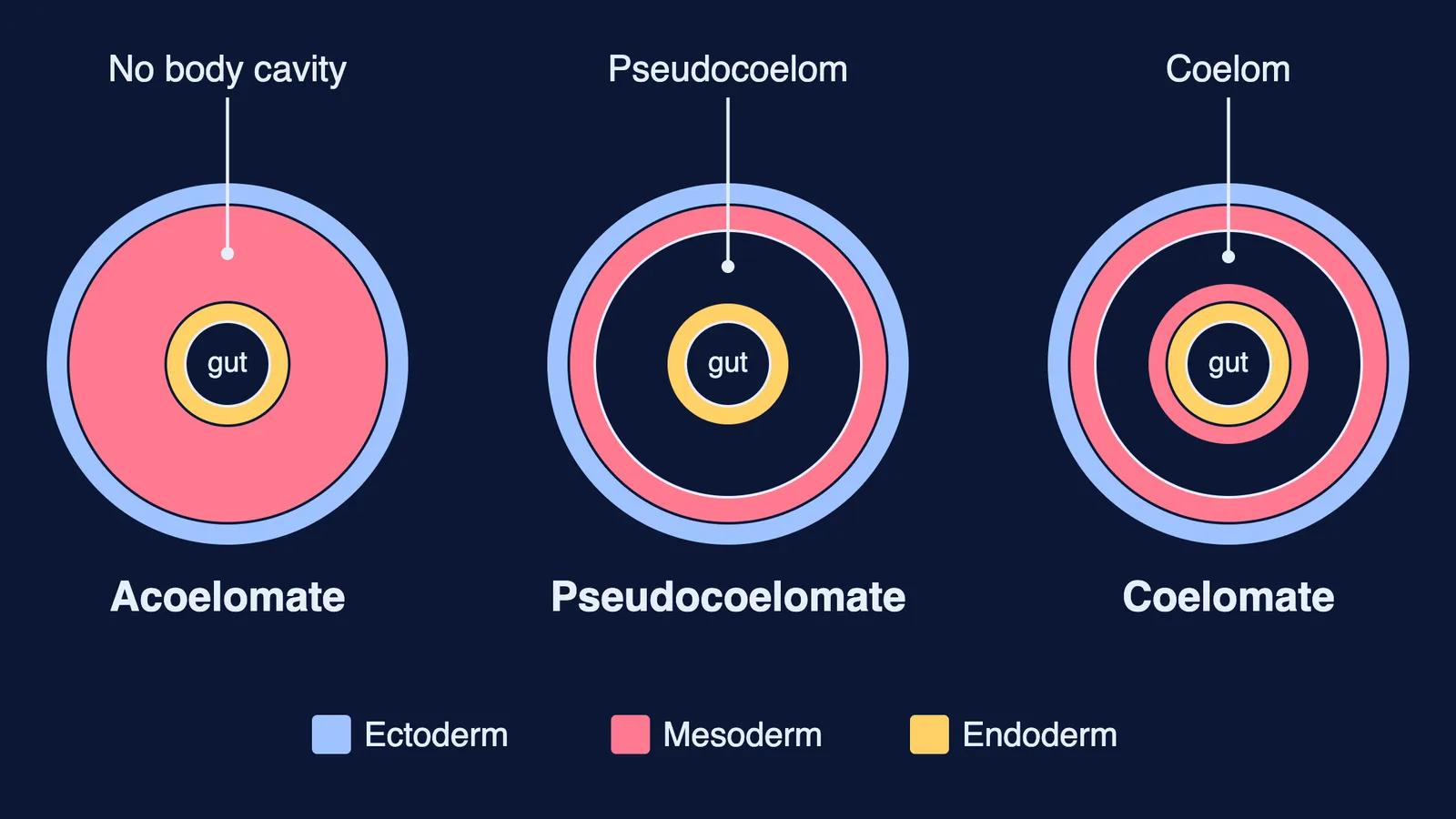
Coelom: a body cavity between body wall and gut that is fully lined by mesoderm. Example of coelomates: annelids, molluscs, arthropods, echinoderms, hemichordates, chordates.
Pseudocoelom: a body cavity without a complete mesoderm lining; NCERT describes the mesoderm as only scattered pouches between ectoderm and endoderm, so no mesoderm layer wraps the gut. Example: Aschelminthes such as Ascaris.
Acoelomate: an animal with no body cavity at all. Example: flatworms such as Taenia. Don't confuse with: pseudocoelomate, which has a cavity, just not a mesoderm-lined one.
Metameric segmentation (metamerism): the body is divided outside and inside into repeating segments, with some organs repeated in each. Example: earthworm.
Notochord: a rod-like support formed from mesoderm on the dorsal side of the embryo. Animals that form it are chordates; Porifera to Echinodermata are non-chordates.
Which special structures mark each non-chordate phylum?
Arthropods make up over two-thirds of all named species on Earth, says the NCERT Animal Kingdom chapter.
Canal system: the water route through a sponge. Water flows in through ostia (tiny pores in the body wall), passes through the central spongocoel and exits by the osculum. Choanocytes, flagellated collar cells lining the canals and spongocoel, beat to keep the water moving. Example: Sycon.
Cnidoblasts (cnidocytes): cells on the tentacles and body of coelenterates holding stinging capsules called nematocysts, used for anchoring, defence and catching prey.
Polyp and medusa: the two body forms of cnidarians. A polyp is cylindrical and attached (Hydra, Adamsia); a medusa is umbrella-shaped and swims (Aurelia).
Metagenesis: alternation between the two forms, with polyps producing medusae asexually and medusae forming polyps sexually. Example: Obelia.
Comb plates: eight rows of ciliated plates that ctenophores use to swim. Example: Pleurobrachia.
Flame cells: excretory cells of flatworms that also handle osmoregulation.
Parapodia: side appendages for swimming in aquatic annelids such as Nereis. Don't confuse with: nephridia, the excretory organs of annelids.
Radula: a file-like rasping organ in the mouth of molluscs, used for feeding. The mantle is the spongy fold of skin covering the visceral hump. Example: Pila.
Water vascular system: the defining echinoderm feature, used for movement, feeding and breathing. Example: Asterias.
Stomochord: a rudimentary notochord-like structure in the hemichordate collar. Example: Balanoglossus.
Direct and indirect development: young resemble adults, or pass through a distinct larval stage.
Which terms define chordates and vertebrate classes?
Chordate features: a notochord, a dorsal hollow nerve cord, paired pharyngeal gill slits and a post-anal tail. Non-chordates have a ventral, solid, double nerve cord.
Protochordates: Urochordata (notochord only in the larval tail, as in Ascidia) and Cephalochordata (notochord from head to tail for life, as in Branchiostoma).
Vertebrata: chordates whose embryonic notochord is replaced by a vertebral column of cartilage or bone, so every vertebrate is a chordate, but not every chordate is a vertebrate.
Agnatha and Gnathostomata: jawless vertebrates (class Cyclostomata, such as Petromyzon) versus vertebrates with jaws.
Pisces and Tetrapoda: jawed vertebrates with fins (fishes) versus those with two pairs of limbs (amphibians, reptiles, birds, mammals).
Placoid scales: tiny tooth-like scales set in the skin of cartilaginous fishes; their backward-pointing teeth are modified placoid scales. Example: Scoliodon.
Operculum: the gill cover of bony fishes. Example: Catla.
Air bladder: a gas-filled sac in bony fishes that controls buoyancy.
Poikilothermous: unable to regulate body temperature (fishes, amphibians, reptiles). Don't confuse with: homoiothermous, keeping a constant body temperature (birds, mammals).
Mammary glands: milk-producing glands that feed the young, the most distinctive mammal feature. Mammals also have hair on the skin.
Oviparous and viviparous: laying eggs versus giving birth to young. Example: the platypus is an oviparous mammal.
How to learn these terms
Draw the three body-cavity cross-sections and label each germ layer.
Learn terms as pairs: radial and bilateral, diploblastic and triploblastic, open and closed, polyp and medusa, poikilothermous and homoiothermous.
Tie each special structure to one genus: comb plates to Pleurobrachia, radula to Pila, water vascular system to Asterias.
Test yourself by placing an unknown animal step by step, as in our six-question method for placing any phylum.
If a term stays unclear, the Fermi Concept Library has every concept in biology, each with its own lesson.