On this page
This sheet follows Chapter 10, Circles, of the NCERT Class 10 Mathematics textbook (Reprint 2026-27). The CBSE Class X Mathematics syllabus for 2026-27 lists the tangent at the point of contact and asks you to prove both theorems. Tangent constructions from older editions are not in this textbook or syllabus.
For full proofs and practice, read our Class 10 Circles guide to the tangent theorems. Arc length and sector area belong to the next chapter, covered in our Areas Related to Circles guide.
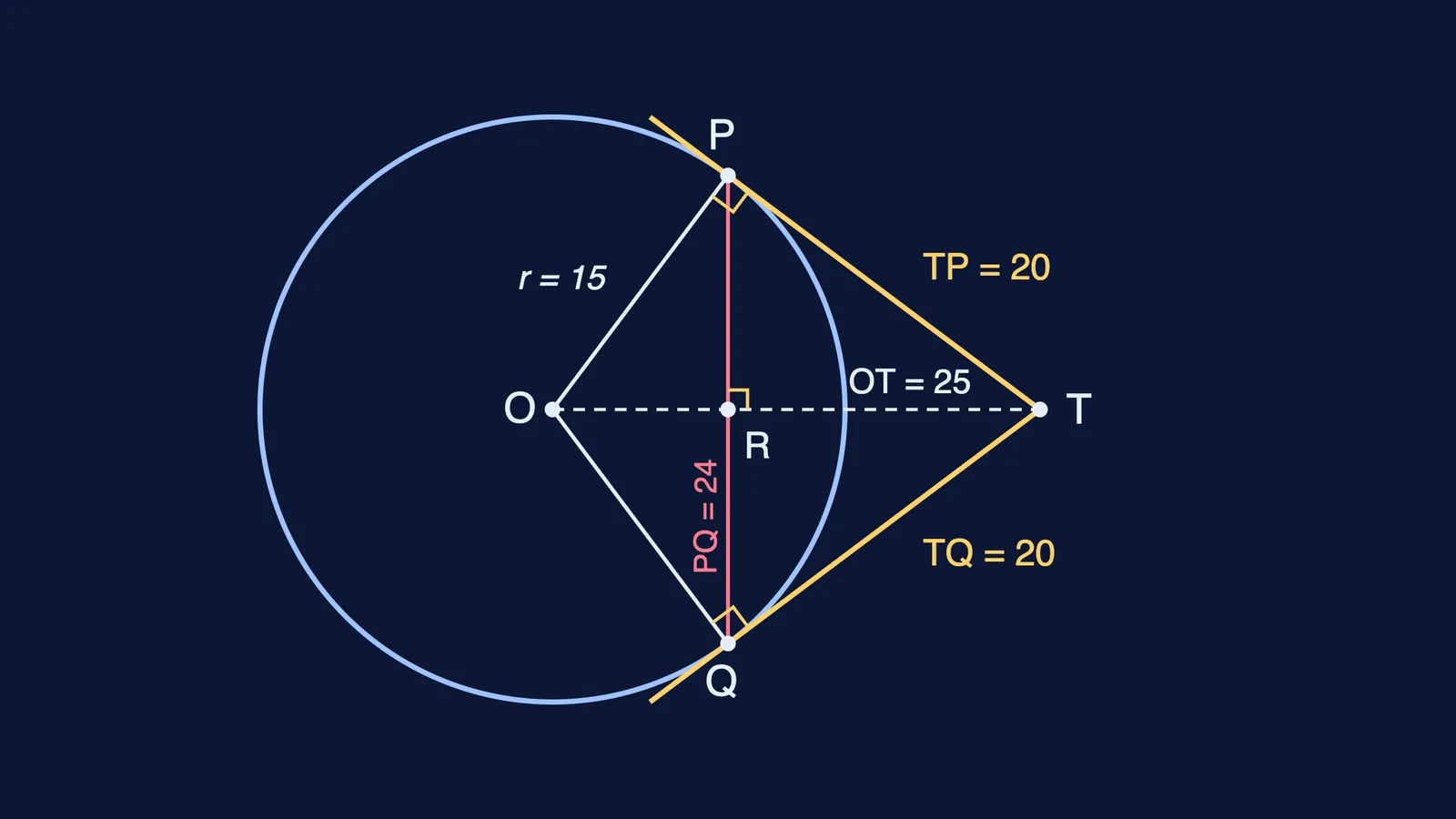
Symbols used throughout: O is the centre, r the radius, T a point outside the circle, d = OT, and P, Q the points of contact of the tangents from T.
What does the tangent-radius theorem give you?
A tangent meets the circle at exactly one point, the point of contact. A secant meets it at two points.
Theorem 10.1: the tangent at P is perpendicular to the radius OP, so ∠OPT = 90°.
At any point on the circle there is one and only one tangent.
Number of tangents through a point: none if it is inside the circle, one if it is on it, exactly two if it is outside.
Length of the tangent from T: TP = √(d² − r²), true only when d > r (Pythagoras in right triangle OPT).
The tangents at the two ends of a diameter are parallel.
The perpendicular to a tangent at its point of contact passes through the centre.
Two concentric circles, radii R > r: a chord of the larger circle that touches the smaller one is bisected at the point of contact, so its length is 2√(R² − r²).
Worked example: T is 17 cm from the centre of a circle of radius 8 cm. TP = √(17² − 8²) = √225 = 15 cm. With concentric circles of radii 13 cm and 5 cm, the chord touching the inner circle is 2√(169 − 25) = 2 × 12 = 24 cm.
Watch for: the hypotenuse of triangle OPT is OT, the line from the centre to the outside point. The tangent TP is a leg, never the longest side.
Are the two tangents from an external point equal?
Yes. That is Theorem 10.2.
TP = TQ (the two tangent lengths from T are equal).
OT bisects ∠PTQ, and also ∠POQ, so ∠OTP = ½∠PTQ.
∠PTQ + ∠POQ = 180°: the angle between the tangents and the angle the chord of contact subtends at the centre are supplementary.
∠PTQ = 2∠OPQ.
OT is the perpendicular bisector of the chord PQ. If OT meets PQ at R: OR = r²/d, PR = r × TP / d, and TR = TP²/d (from similar right triangles, as in NCERT Example 3).
Worked example: tangents from T meet at 64°. Then ∠POQ = 180° − 64° = 116°, ∠POT = 58° and ∠OPQ = 32°, which is half of 64°. For lengths, take r = 15 cm and d = 25 cm: TP = TQ = 20 cm, OR = 225/25 = 9 cm, PR = 15 × 20/25 = 12 cm, so the chord PQ is 24 cm.
Watch for: ∠POQ is the angle between the two radii, not ∠POT. Halving the wrong one gives an answer twice too big or too small.
How do tangent lengths work in shapes drawn around a circle?
When every side touches the circle, split each side into two tangent lengths and use Theorem 10.2 at each vertex.
Quadrilateral ABCD circumscribing a circle: AB + CD = AD + BC (opposite sides add up equally).
A parallelogram that circumscribes a circle is a rhombus.
Opposite sides of a circumscribing quadrilateral subtend supplementary angles at the centre: ∠AOB + ∠COD = 180°.
Two parallel tangents cut by a third tangent at A and B: ∠AOB = 90°.
Triangle with sides a, b, c around a circle of radius r, with s = (a + b + c)/2: the tangent length from vertex A is s − a, and area = r × s (three triangles, each with height r). These two follow from Theorem 10.2 and are not boxed in NCERT, so show the working in an answer.
Worked example: a triangle ABC is drawn around a circle of radius 3 cm, and the point of contact D splits BC into BD = 6 cm and DC = 9 cm. Let the tangent length from A be x. Then AB = x + 6, AC = x + 9 and s = x + 15. Area = r × s = 3(x + 15), and Heron's formula gives area = √((x + 15) × x × 6 × 9). Squaring, 9(x + 15) = 54x, so x = 3. AB = 9 cm, AC = 12 cm, and the area is 54 cm². For a quadrilateral with AB = 7 cm, BC = 9 cm and CD = 8 cm, AD = 7 + 8 − 9 = 6 cm.
Watch for: in AB + CD = AD + BC, pair opposite sides. Adding two neighbouring sides gives nothing useful.
The Fermi Problem Library has worked problems with a step-by-step solver that explains the reasoning rather than printing an answer.
How to revise this formula sheet
Start from one figure: circle, external point T, both tangents, both radii and OT. Every result on this page can be read off it.
Practise writing the two theorem proofs without notes, then compare your version with our Class 10 maths theorems to prove.
Redo the 15-20-25 example with r = 5 cm and d = 13 cm, and check that PR = 60/13 cm.
For any circumscribed shape, write a letter for each tangent length before using the side lengths.