On this page
This formula sheet follows NCERT Class 10 Mathematics chapter 4, Quadratic Equations (Reprint 2026-27) and the CBSE 2026-27 Class 10 Mathematics syllabus. Each group gives the formulas, what every symbol means, the condition each one needs, one worked example with fresh numbers and one mistake to watch for. For the full chapter walkthrough, read our Class 10 guide to quadratic equations.
Not included: completing the square. The current NCERT chapter mentions it only in a history note, and the CBSE syllabus lists only real roots found by factorisation and by the quadratic formula.
What is a quadratic equation in standard form?
Standard form: ax² + bx + c = 0, where x is the variable and a, b, c are real numbers with a ≠ 0.
Root: a real number α is a root if aα² + bα + c = 0. The roots of ax² + bx + c = 0 are the zeroes of the polynomial ax² + bx + c.
Number of roots: a quadratic equation has at most two roots.
Worked example: is (x + 1)³ = x³ + 2x − 5 quadratic? Expand the left side: x³ + 3x² + 3x + 1 = x³ + 2x − 5. The x³ terms cancel, leaving 3x² + x + 6 = 0. Here a = 3 ≠ 0, so yes, it is quadratic.
Watch for: decide only after simplifying. An equation that looks quadratic can lose its x² term (x² + 2x = x² − 6 becomes 2x + 6 = 0, which is linear), and one that looks cubic can turn out quadratic.
How do you find roots by factorisation?
Splitting the middle term: for ax² + bx + c, find two numbers m and n with m + n = b and mn = ac. Write bx as mx + nx and group in pairs.
Zero-product rule: if (px + q)(rx + s) = 0, then px + q = 0 or rx + s = 0, so x = −q/p or x = −s/r (p, r ≠ 0).
Worked example: solve 3x² − 10x + 8 = 0. Here ac = 24 and b = −10, so the numbers are −6 and −4. Then 3x² − 6x − 4x + 8 = 3x(x − 2) − 4(x − 2) = (3x − 4)(x − 2). The roots are x = 4/3 and x = 2.
Watch for: never divide both sides by x. In x² = 5x, dividing gives only x = 5. Write x² − 5x = 0, so x(x − 5) = 0, and you get both roots, 0 and 5.
What is the quadratic formula and when can you use it?
Quadratic formula: x = (−b ± √(b² − 4ac)) / (2a), provided b² − 4ac ≥ 0. The ± gives the two roots, and 2a divides the whole top line.
It works for every quadratic with real roots, including ones that do not factorise neatly.
Worked example: solve 2x² − 7x + 4 = 0. Here a = 2, b = −7, c = 4, so b² − 4ac = 49 − 32 = 17. Then x = (7 ± √17)/4, which is about 2.78 or 0.72.
Watch for: put the equation in standard form first and carry each sign with its coefficient. With b = −7, −b is +7 and b² is +49.
How does the discriminant decide the nature of roots?
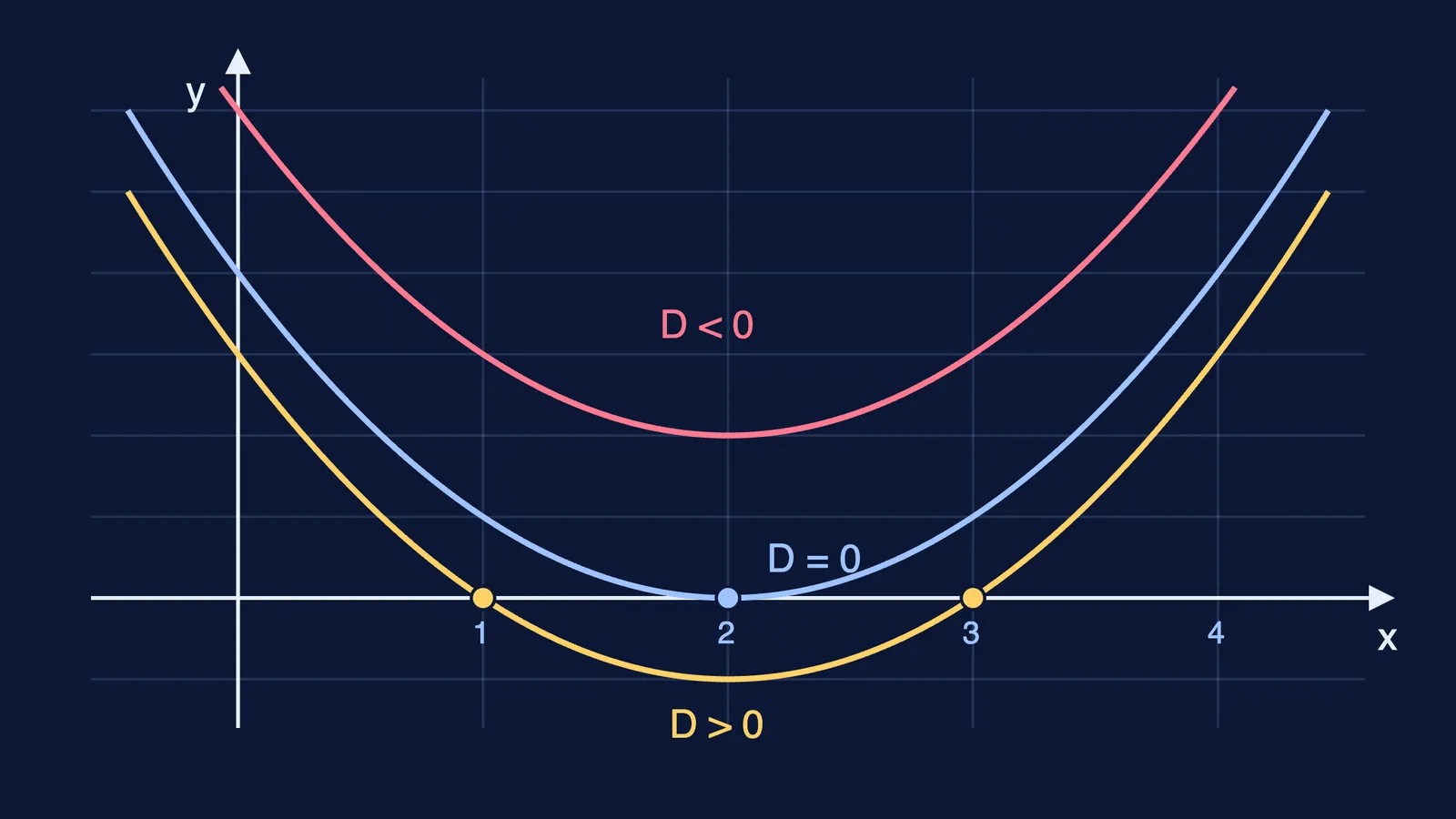
Discriminant: D = b² − 4ac, for ax² + bx + c = 0 with a ≠ 0.
If D > 0: two distinct real roots, (−b + √D)/(2a) and (−b − √D)/(2a).
If D = 0: two equal real roots, both equal to −b/(2a).
If D < 0: no real roots.
Worked example: for which k does kx² − 12x + 9 = 0 have two equal roots? Set D = 0: (−12)² − 4 × k × 9 = 144 − 36k = 0, so k = 4. The equation becomes 4x² − 12x + 9 = 0, and both roots are 12/8 = 3/2.
Watch for: when k is the coefficient of x², the answer must keep k ≠ 0, or the equation stops being quadratic. Also, D < 0 means "no real roots"; do not write that x = 0.
How do you use these formulas in word problems?
Let x be the unknown, write every other quantity in terms of x, and form an equation of the form ax² + bx + c = 0.
Solve by factorisation or the quadratic formula, then keep only roots that make sense in the situation.
Worked example: a rectangular garden is 3 m longer than it is wide, and its area is 180 m². If the breadth is x m, then x(x + 3) = 180, so x² + 3x − 180 = 0, which factorises as (x + 15)(x − 12) = 0. A breadth cannot be negative, so x = 12: the garden is 12 m wide and 15 m long. Check: 12 × 15 = 180.
Watch for: lengths, ages, speeds and counts cannot be negative, so reject those roots and say why in one line. More practice is in our Class 10 quadratic word problems on speed, age and area.
How to revise this formula sheet
Write ax² + bx + c = 0 with a ≠ 0 at the top of your page, and read off a, b and c with their signs before every problem.
Calculate D = b² − 4ac first. It tells you whether to expect two, one repeated or no real roots before you solve.
Try splitting the middle term; if no pair of numbers works within a minute, switch to the quadratic formula.
Substitute your roots back into the original equation, and in word problems check the answer against the story.
Revise zeroes of polynomials alongside this chapter, since roots and zeroes are the same thing; our Class 10 polynomials guide covers how zeroes relate to coefficients.
If you keep getting a different answer from the book, the Fermi Problem Library has worked problems with a step-by-step solver that explains the reasoning rather than printing an answer.