On this page
This formula sheet follows Chapter 3 of the rationalised NCERT Class 10 Mathematics textbook (Reprint 2026-27) and the CBSE Class X Mathematics syllabus for 2026-27, which covers the graphical method, the algebraic conditions for the number of solutions, and substitution and elimination. The 2026-27 chapter has no cross-multiplication method and no section on equations reducible to linear form, so neither appears here. For how to study the chapter, read our chapter guide to pair of linear equations in two variables.
What is a pair of linear equations in two variables?
General form: a₁x + b₁y + c₁ = 0 and a₂x + b₂y + c₂ = 0, where a₁, b₁, c₁, a₂, b₂, c₂ are real numbers, x and y are the variables, and in each equation a and b are not both zero.
Solution: an ordered pair (x, y) that makes both equations true.
Consistent pair: has at least one solution. Inconsistent pair: has no solution.
Dependent pair: the two equations are equivalent, so there are infinitely many solutions. A dependent pair is always consistent.
Worked example: is (3, 2) a solution of 2x + y = 8 and x − 4y + 5 = 0? First equation: 2(3) + 2 = 8, true. Second: 3 − 4(2) + 5 = 0, true. Both hold, so (3, 2) is a solution.
Watch for: checking the point in only one equation. A point on one line is not a solution of the pair unless it lies on both.
How do you tell if the lines intersect, are parallel or coincide?
For a₁x + b₁y + c₁ = 0 and a₂x + b₂y + c₂ = 0, the NCERT chapter gives these ratio conditions:
a₁/a₂ ≠ b₁/b₂: lines intersect at one point, exactly one (unique) solution, consistent.
a₁/a₂ = b₁/b₂ = c₁/c₂: lines coincide, infinitely many solutions, dependent and consistent.
a₁/a₂ = b₁/b₂ ≠ c₁/c₂: lines are parallel, no solution, inconsistent.
Worked example: for what k do 3x + ky = 7 and 6x + 10y = 11 have no solution? Set a₁/a₂ = b₁/b₂: 3/6 = k/10, so k = 5. Check c₁/c₂ = 7/11, which is not 1/2, so the lines are parallel. Answer: k = 5.
Watch for: stopping after a₁/a₂ = b₁/b₂ in a "no solution" question. Always check c₁/c₂ too; if it is also equal, the lines coincide instead.
How do you solve a pair of linear equations graphically?
Find two points on each line: put x = 0, then y = 0.
Draw both lines on the same axes.
Intersecting: the meeting point is the unique solution. Coincident: every point on the line is a solution. Parallel: no solution.
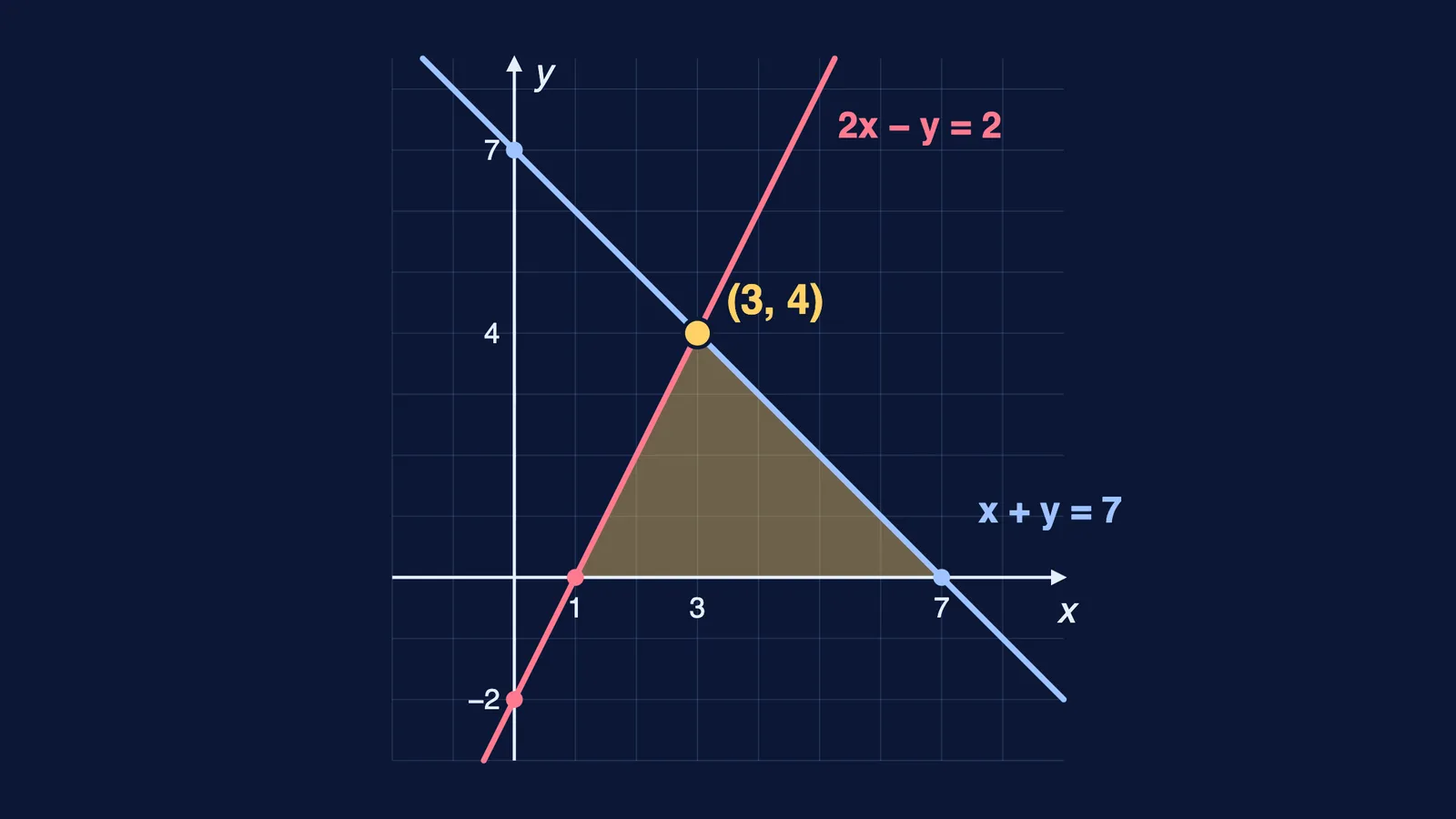
Worked example: solve x + y = 7 and 2x − y = 2 graphically. Points: (0, 7) and (7, 0) on the first line; (0, −2) and (1, 0) on the second. The lines meet at (3, 4), so x = 3, y = 4. With the x-axis they form a triangle with vertices (1, 0), (7, 0) and (3, 4); its area is ½ × 6 × 4 = 12 square units.
Watch for: crossing points off the grid lines. NCERT notes such coordinates are easy to misread, so check a graphical answer in both equations.
Substitution and elimination: what are the steps?
Substitution:
From one equation, write y in terms of x (or x in terms of y).
Put this into the other equation and solve the one-variable equation.
Put that value back to get the other variable.
Elimination:
Multiply the equations by suitable non-zero numbers so one variable has numerically equal coefficients.
Add (opposite signs) or subtract (same signs) to remove that variable.
Solve for the other variable, then substitute back.
Both methods: a true statement with no variable (such as 0 = 0) means infinitely many solutions; a false one (such as 0 = 9) means no solution.
Worked example (substitution): 4x − y = 7 and 3x + 2y = 19. From the first, y = 4x − 7. Then 3x + 2(4x − 7) = 19 gives 11x = 33, so x = 3 and y = 5.
Worked example (elimination): 5x + 3y = 35 and 3x − 2y = 2. Multiply the first by 2 and the second by 3: 10x + 6y = 70 and 9x − 6y = 6. Add: 19x = 76, so x = 4. Then 5(4) + 3y = 35 gives y = 5.
Watch for: when subtracting equations, change the sign of every term, the constant included.
Which set-ups turn word problems into equations?
Two-digit number with tens digit x and units digit y: number = 10x + y; reversed number = 10y + x.
Sum of a number and its reverse: 11(x + y). Difference: 9(x − y).
Ages: "n years ago" subtracts n from both ages; "n years from now" adds n to both.
Fixed charge plus a rate: total = F + r × (number of units), where F is the fixed part and r the charge per unit.
Worked example: a gym charges a one-time joining fee F plus a monthly fee m. Three months cost ₹2,900 and seven months cost ₹5,700. So F + 3m = 2900 and F + 7m = 5700. Subtract: 4m = 2800, so m = ₹700 and F = ₹800.
Watch for: writing the reversed number as "yx" and treating it as y times x. It is 10y + x.
How to revise this formula sheet
Pair each ratio condition with its picture and answer: intersect (unique), coincide (infinitely many), parallel (none).
Make up one pair of each type, then check it with the ratios and a quick sketch.
Solve one pair by both substitution and elimination and compare the steps.
Write one equation for each word-problem set-up from a situation you know, such as phone recharge plans.
Put every answer back into both original equations. More slips to avoid are in our list of Class 10 maths mistakes.
If a method keeps going wrong at the same step, the Fermi Problem Library has worked problems with a step-by-step solver that explains the reasoning rather than printing an answer.